
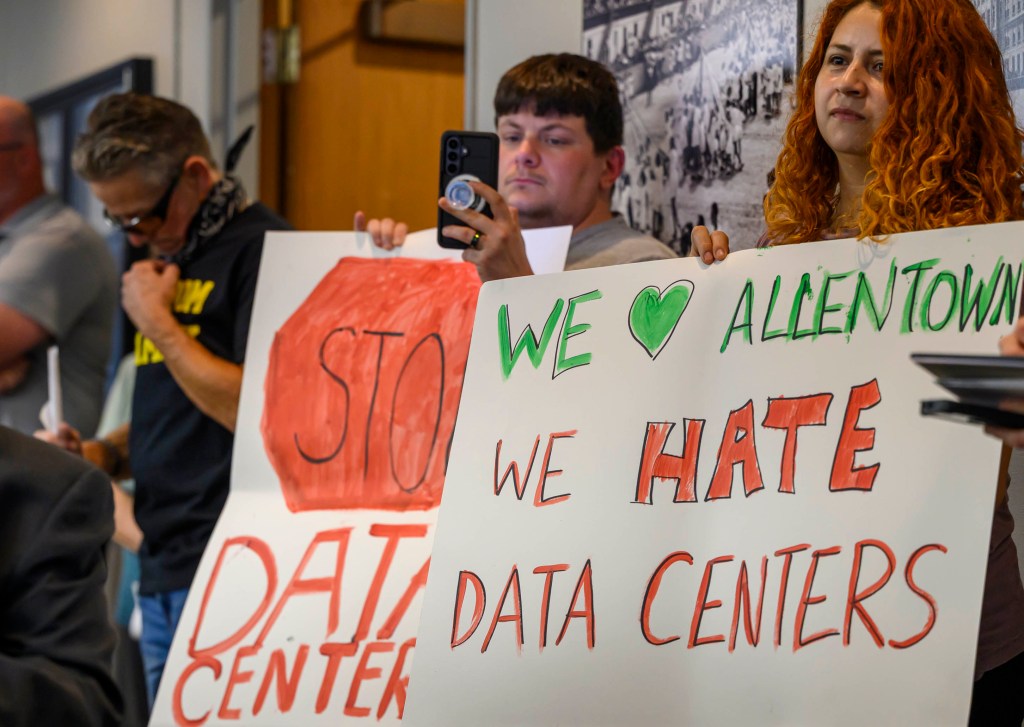
Developers on Thursday presented plans for a proposed data center in south Allentown before the city’s planning commission, giving the public its first look at specific details about how the facility would look and operate.
Anthony Maras of Quantm Group LLC, which is proposing the data center at 2401 W. Emmaus Ave., gave a presentation before an audience packed with opponents at Allentown City Hall about how the group would mitigate environmental, noise, electricity and other concerns residents have voiced.
The proposal has been met with fierce opposition from local residents; an online petition opposing its construction had garnered more than 4,300 signatures on Change.org. The site where the center is proposed is next to homes, local businesses and Camelot, a nonprofit that helps chronically and terminally ill children.
The planning commission in 2022 approved a 224,000-square-foot warehouse on the Emmaus Avenue site, and developers broke ground on construction in 2024, but the building has been vacant since then. Quantm Group LLC has applied for a 23,342-square-foot addition to the building in order to convert it into a data center.
What we learned about the data center proposal
During his presentation, Maras argued that a data center would be preferable for residents compared to the warehouse already approved by the city. The data center would result in less truck traffic, less water use and more tax revenue for the city, bringing in around $4 million annually in revenue if approved, he said.
“My goal here tonight is not to sway anybody’s opinion, but to give you information about what this project means, in relation to what is currently allowed there,” Maras said.
For example, the warehouse was permitted to use up to 4,500 gallons of water daily, but the projected water use of the data center would be around 1,500 gallons a day on average, he testified, which would be used for plumbing and humidification to prevent static electricity.
That calculation does not include the water used to cool the data center’s computer infrastructure. Instead, the data center would use a “closed-loop cooling system” for its computer systems, which would use water delivered to the facility and not from the local water supply. That water would remain in the closed loop system and would not drain into local waterways, he said, which will save water and prevent pollution.
The Emmaus Avenue data center will use 75 megawatts of electricity. Developers have plans to build a 23,000-square-foot PPL substation on the site to accommodate the spike in energy demand. Quantm LLC will pay for the PPL substation upgrade, which will cost around $2.5 million, Maras said, and would help prevent electric rate increases for local residents. They plan to construct a wall surrounding the sub-station to mitigate noise.
He also said that Quantm LLC will voluntarily commit to monitoring emissions, conducting noise studies and providing community benefits via deed restrictions on the property, even though the developers are not legally obligated to do so.
The data center, if approved, will bring around 66 full-time jobs to the site, Maras said.
Quantm LLC cannot yet disclose the data center’s end user — typically, companies like Quantm will act as a subsidiary during the development approval process on behalf a larger company looking to use a data center, like Google or Meta — because they are still finalizing paperwork agreements. He vowed that a representative from the data center user will attend the next city meeting and address the crowd’s concerns.
Reaction
Despite the developers’ assurances, residents said they still worried the data center would cause harm to the surrounding neighborhood.
Several voiced concerns that the data center would cause excessive noise, drive up the price of energy, and harm the local residents, business owners and the children who live and play nearby.
Priscilla and Angel Declet live in a home right across the street from the proposed data center, and said during public comment that their son, who has special needs, is profoundly sensitive to loud noises. They worry about how noise from the data center — including ambient noise or vibrations — will affect him.
“Behind every decision, there is a family that will live with it,” Angel Declet said. “Studies do not account for children with special needs, children who feel noise and vibrations far more deeply than most. This data center directly affects children who have no voice of their own.”
Others said they were skeptical of the developers’ claims about water use, electricity use and commitment to monitoring air pollution.
“I would really like to believe all the things I heard from the developer, because it sounded like they were trying hard to put a lot of safeguards in place, but I think of the situation i know of with a developer, and they had a rock solid legal agreement for what they were going to do as far as their development, and they did not live up to it,” said Allentown resident Johanna Heft.
The Planning Commission did note vote on the proposal.
City staff also offered feedback on the proposal via letter. Melissa Velez, chief city planner for Allentown, said that while the city has recognized that the data center is a legally permitted use on the site, a data center use “may not represent the highest and best land use for this site when evaluated against long-term planning objectives, particularly those related to job creation, land efficiency and compatibility with nearby residential uses.”
Maras said that Quantm Group LLC will submit a new land development application that addresses some of the public feedback.
Reporter Lindsay Weber can be reached at Liweber@mcall.com.