
This article is part of Lancaster Farming’s Agriculture 250 series. Agriculture 250 is a series of stories rediscovering, reflecting on and celebrating America’s farming history as the nation celebrates its 250th birthday in 2026. Click here for more stories from this series.
You can’t get there from here, at least not profitably.
That was the predicament farmers in central Pennsylvania and western New York faced in the first decades of the 1800s.
Philadelphia and New York City were the nation’s two largest cities, and therefore the most desirable markets for agricultural products.

Agriculture 250 is a series of stories by Philip Gruber telling the story of U.S. agricultural history for the nation’s 250th anniversary.
But because of rough topography and poor roads, many Pennsylvania farmers found it easiest to ship to Baltimore, and New York producers turned their eyes across the Canadian border to Montreal.
Sandwiched between two other major ports, the Philadelphia merchants could not abide their lack of access to in-state farmers.
Prosperity and prestige were at stake. Baltimore’s population sneaked ahead of Philadelphia’s in the 1830 census and stayed in second place (behind New York) until 1860.
So the Philly merchants took the fight to Baltimore’s turf.
From 1824 to 1828, the Pennsylvanians cut a 14-mile canal across the Delmarva peninsula in northern Maryland and Delaware, said Holly Roddy of the Chesapeake City Museum. The museum preserves the history of the Maryland town that sits on the Chesapeake and Delaware Canal.
Initially livid, the Baltimore merchants soon found the canal benefited them as well, according to historian Ronald Shaw.
As expected, agricultural goods were a major part of the early canal traffic.
“Cecil County, where the canal is, is still agricultural in nature,” Roddy said.
The C&D Canal arrived at the beginning of the “canal mania” that gripped the Mid-Atlantic and Midwest in the 1830s.
By 1860, the U.S. had built more than 4,200 miles of canals, including 350 miles that had been abandoned.
“In this era of agricultural expansion,” Shaw writes, “canals gave the great staple crops of the interior an outlet to eastern ports, much as the steamboat did for the export of southern cotton.”
Only a handful of canals achieved unquestionable financial success, and just a few have survived to the present day.
But the canals dramatically streamlined the movement of agricultural products to market — at least until the railroads drove most of them out of business.
An Era Begins
Augustine Herman had proposed a Delmarva canal back in the 1600s.
The Bohemian worthy created the first accurate map of the Chesapeake Bay and became Maryland’s first naturalized citizen, so he was not speculating idly.
Perhaps he was inspired by France’s Languedoc Canal. The greatest canal yet built in Europe took shape in Herman’s lifetime.
But a Chesapeake canal also made a lot of sense.
Sailing between Baltimore and Philadelphia was circuitous. The land that stood in the way was relatively flat and probed by many wide creeks that could provide the western terminus for a canal.
But in Herman’s day, Americans simply didn’t know how to build canals.
The first notable effort in the United States was Massachusetts’ 27-mile Middlesex Canal, which connected Boston to the Merrimack River and was built from 1793 to 1803.
It was too small to accommodate much freight traffic and ended up being used mainly for water power, said Martha Capwell Fox, the historian at the National Canal Museum in Easton, Pennsylvania.
Erie Canal
The seed for the canal era was planted in 1807 when New York flour merchant Jesse Hawley published a series of newspaper articles proposing a canal linking the Hudson River to Lake Erie.
Such a route would funnel farm products from the newly opened Midwest to New York City — and ensure rival Eastern ports didn’t get the business.
Hawley wrote under the pen name Hercules, apparently fearing his essays would be dismissed if people knew their author, ruined by the high cost of overland freight, was in debtors’ prison.
Land speculators in western New York liked the idea of a canal, which could dramatically increase the value of their holdings.
But farmers in the Southern Tier were incensed that the canal would come nowhere near them. And having grown fat on Atlantic commerce, leaders in New York City initially opposed funding a trade route into the hinterland.
Gothamites only came around once canal sections started opening and showed how much the city would gain from the waterway, author Gerard Koeppel writes.
Lawmakers in Albany battled for years over how to design and build the canal.
Gouverneur Morris, a signer of the Constitution a quarter-century early, lent prestige to the canal commission. But he slowed progress by insisting the canal could be built without locks.
The truly transformative support came from De Witt Clinton, a member of a prominent political family who saw an opportunity to reverse his dimming political fortunes.
Clinton became the canal’s greatest champion, and the canal catapulted him to the governorship.
Clinton had hoped to soar all the way to the White House, but Koeppel argues he was foiled by his patrician self-involvement and iffy sense of political strategy.
De Witt Clinton ceremonially mingles the waters of Lake Erie and the Atlantic Ocean in this 1826 print. Clinton, a well-heeled New York governor, was the canal’s leading advocate.
New York Public Library | Public domain
Still, Clinton made sure the state funded and ran the canal when it became clear the federal government would not help New York.
As with Philadelphia and Baltimore, a rivalry was involved.
Like canal enthusiast George Washington before them, presidents Thomas Jefferson and James Madison coveted the western canal route for their native Virginia.
Unfortunately for them, their preferred corridor along the Potomac River went through extremely challenging terrain.
The Chesapeake and Ohio Canal never made it west of Maryland, and Virginia failed to become the gateway to the West.
Despite such parochialism, canal boosters often promoted canals as a way to tie the nation together.
Capwell Fox thinks canal operators — especially private companies — were more focused on making money.
“To me, in a lot of ways, rhetoric about tying the country together was, you know, rhetoric,” she said.
Launchpad
The Erie Canal was built from 1817 to 1825, and it set the standard for American engineering projects.
For one thing, it established the practice of divvying out pieces of a large project to contractors, rather than having one huge organization directly employ all the workers.
In addition to improving efficiency, Koeppel writes, this strategy aided farmers along the canal route since they typically landed the contracts.
The Erie Canal also produced the nation’s first civil engineers.
John Randel, Nathan Roberts, Canvass White and Benjamin Wright were surveyors who learned on the job. They went on to oversee construction of many of the U.S.’ other canals.
At the beginning, these aborning engineers were playing catch-up to the canal builders of industrial northern England, who had a several-decade head start on lock design and building materials.
One of the Brits’ greatest achievements was the development of hydraulic cement, which hardens in water and was needed to build the canal locks. The most famous version is Portland cement, named after its English place of origin.
On the Erie Canal project, procurement agent Andrew Bartow figured out a formula for a cement that could be made locally.
He sold the patent rights to Canvass White, though according to Koeppel, the canal’s two dozen cement suppliers rarely bothered to pay the men royalties.
Workers use simple machines to excavate the Erie Canal near Lockport, N.Y., in this undated print.
Library of Congress
Canal construction was labor-intensive, with a given canal employing as many as 5,000 laborers at a time.
German and Welsh settlers provided the muscle in some places, as did slaves on the few Southern canals.
But the canals are mainly remembered for employing thousands of immigrants from poverty-wracked Ireland.
The laborers were generally young, single, unskilled men. In America, they tended to form cliques with men from their home counties, Shaw writes.
The workers at least sometimes fulfilled the stereotype of the drunken, fist-flailing Irishman, though this violence was not necessarily mindless. Shaw says strikes and riots often focused on unpaid or low wages, or were attempts to prevent rival groups from getting jobs.
Laborers on the Erie Canal were typically paid set wages, Koeppel writes. Workers thought piece rates were a tool for exploitation, while contractors just saw them as a budgeting nightmare.
Keystone of Canals
Pennsylvania wasn’t the first state to build a canal, but it quickly built out the nation’s largest canal network.
The state’s first canals were designed to transport anthracite to Philadelphia, a development that came just in time for the Industrial Revolution.
But Pennsylvania’s ambitions were bigger than coal. Lawmakers dreamt of linking Pittsburgh to Philadelphia by water, bypassing the difficult wagon routes through the Allegheny Mountains.
The C&D and (for much of its route) the Erie Canal cut across land between water bodies. But many of the Pennsylvania canals paralleled natural waterways.
River valleys provided conducive topography and abundant water for canals, even if the streams themselves were unsuitable for commerce.
“Mostly the Susquehanna was so shallow and rocky, and it was the same thing with the Schuylkill and the Lehigh too, that there was no way they could be made navigable for long distances,” Capwell Fox said.
Boaters head south on Pennsylvania’s Delaware Canal in 1900.
Provided by Martha Capwell Fox
Wherever they went, canals opened new areas to agriculture, giving farmers cost-effective means of bringing goods to market. The Erie Canal also goosed New York’s salt industry.
In Pennsylvania, even the coal canals apparently carried some agricultural goods, since they set shipping rates for them.
But the coal companies were so focused on heavy industry that they rarely bothered to keep records of their farm freight, Capwell Fox said.
Some toll sheets have survived.
In 1866, the Pennsylvania Mainline Canal set a rate of 8 cents per ton per 5 miles for corn, rye, oats, milled feed, hay, straw, bones and unground bark. The rate jumped to 10 cents for cider, flour, fish, wheat, seeds, potatoes and fruit.
Capwell Fox thinks the costs were connected to the space each commodity would take up on the boat. As a result, light but bulky feathers ended up with a relatively high transport fee.
“The amazing thing to me is that somebody worked all of this out by hand,” she said.
Life on the Canal
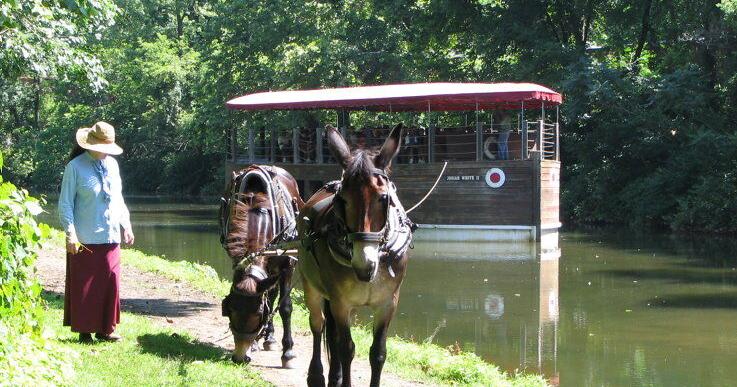
Even when canal boats carried coal or firewood, they were pulled by draft animals.
Mules were most common since they could log 18-hour days and horses couldn’t, Capwell Fox said.
Generally driven by youths, the horses or mules had to be changed every 15 miles or so.
Canal boats traveled at 4 to 10 miles per hour; any faster and they would throw waves onto the banks.
And when boats passed, one slackened its tow rope so the other boat could pass over it, Shaw writes.
Every canal had its own boat design.
Pennsylvania’s tended to be huge, with some vessels up to 120 feet long. The Lehigh and Schuylkill canal boats were closer to 90 feet long, Capwell Fox said.
Since canal boats were towed, they were technically not barges, which are pushed, Capwell Fox said.
The canals punched through long stretches of New York, Pennsylvania, Ohio and Indiana that — at least initially — were essentially wilderness.
At night, travelers experienced intense solitude, with only the boat’s lantern to break the darkness.
A postcard of a 1909 Erie Canal-themed parade float marks the tricentennial of Henry Hudson’s expedition and centennial of Robert Fulton’s steamboat.
Library of Congress
Even in the daytime, travel on the packets, or passenger boats, was a world of its own.
The experience got mixed reviews, according to Shaw.
Gentleladies deplored being crammed into dirty quarters with the lower rungs of humanity.
Yet on an American tour, the English novelist Charles Dickens enjoyed his canal boat’s spread of food, including salmon, shad, liver, pickles and black pudding. He took to lounging on deck as the boat moved forward almost noiselessly.
Whatever their faults, canal boats offered a smoother and faster ride than stagecoaches.
“It was the first iteration of something that kind of approximates cruise ships,” Capwell Fox said.
Today’s tourists can take canal boat rides at the National Canal Museum. But these aren’t replicas of old-time canal boats, which Capwell Fox said were designed without sightseeing in mind.
That perhaps explains why passengers like Dickens spent so much time on deck — and were forced to seek cover at every cry of “Low bridge!”
(The museum and boat rides are currently closed because of work on the bridge that leads to the museum.)
The Cost of Ambition
As the railroads and interstates would later do, the canals raised the fortunes of cities they served and marginalized towns they bypassed.
On the Erie Canal, Syracuse and Utica grew at the expense of Rome and Schenectady. Agricultural freight made Rochester the Flour City.
Had it not become the canal’s western terminus, Buffalo might still be a forgettable lakeside village.
“Surely, the water of this canal must be the most fertilizing of all fluids,” the novelist Nathaniel Hawthorne wrote, “for it causes towns — with their masses of brick and stone, their churches and theatres, their business and hubbub, their luxury and refinement, their gay dames and polished citizens — to spring up, till, in time, the wondrous stream may flow between two continuous lines of buildings, through one thronged street, from Buffalo to Albany.”
Hawthorne might have been joking, but the upshot of all this fertilizing was that seemingly every town in America wanted a canal connection.
States frequently found themselves adding side routes to appease residents in areas bypassed by mainline canals. These spurs, based more on politics than profitability, badly overextended several states’ canal networks, Shaw writes.
Boats travel the Erie Canal in 1909 through Rochester, N.Y., one of the cities raised from obscurity by the canal.
Library of Congress
As canal mania spread westward, projects became more ambitious.
Indiana’s Wabash and Erie Canal was arguably the greatest boondoggle of the canal era.
Other than China’s colossal Grand Canal, the 468-mile monstrosity that hugged the Wabash River is considered the longest canal ever constructed.
To stretch a canal diagonally across the barely settled state, Indiana and private industry poured millions into construction, with financing strategies that Shaw says bordered on fraudulent.
But the canal was a huge money-loser, and construction was marred by a cholera outbreak that killed 150 workers.
Even then, Shaw writes, more than 100 miles of canal between Terre Haute and Evansville had to be given up after locals repeatedly breached a reservoir, fearing it would be a source of disease.
Yet amid the trouble with the “reservoir regulators,” Shaw argues the canal carried respectable cargoes of Indiana tobacco, wheat, pork and wood down to the Ohio River.
The canal’s true success, he says, was in encouraging settlement in new areas.
A Canal Continues
While much of America’s inland canal system slid into obsolescence after the Civil War, the Chesapeake and Delaware Canal remained active.
The canal benefited from being short and connecting two of the East Coast’s major ocean ports.
Still, the C&D had to change with the times. After taking over the canal in the 1920s, the Army Corps of Engineers significantly widened and deepened the waterway, and removed the locks.
As freighters kept getting bigger, the Army broadened the canal again in the 1960s. Ukrainian Americans from Pennsylvania replaced the old-time Irish crews on this project, said Roddy, of the Chesapeake City Museum.
Today the canal is about 460 feet wide, 35 feet deep in the center, and still regularly dredged. According to the Corps of Engineers, the canal carries 40% of ship traffic to and from the Port of Baltimore.
While the first widening kept the canal relevant, it also ruined Chesapeake City economically. Several streets were shaved off near the waterfront, and with the removal of the lock went business for the town’s taverns and boarding houses.
“There was no reason to stop here anymore, so the people didn’t,” Roddy said.
The Beatrix, a Dutch-flagged cargo ship, travels through the Chesapeake and Delaware Canal. While many 19th century canals were eventually abandoned, the C&D has been expanded and remains an important route for ships heading to Baltimore.
Army Corps of Engineers
During World War II, a German-built boat took out the bridge over the canal that united the two sides of the town — a disaster reminiscent of Baltimore’s Francis Scott Key Bridge collapse in 2024.
Some people assume the canal wreck was Nazi sabotage, but the crew just lost control of the ship, Roddy said.
In any case, the wartime steel and labor shortages prevented the bridge from being replaced until 1949.
But the new span was too far outside of town to tie Chesapeake City together. The place declined, even becoming a biker town for a time, before a DuPont family member organized a historic preservation effort starting in the 1970s.
The wide canal attracts plenty of pleasure boaters these days, and it still regularly ushers commercial freighters through the town of 750 people.
“All the restaurants that face the water, their patrons love it,” Roddy said, “because they see these giant ships come through and they look like they’re going to hit the bridge, and of course they don’t.”
End of the Age
For all their practical value and romantic traditions, canals had serious drawbacks.
They required large amounts of nearby water. They could adapt to changes in elevation only with a multitude of locks. And in northern climates, they might shut down over the winter to prevent damage or stranding from ice.
In the 1840s and 1850s, canals sent agricultural freight rates plummeting. Ohio, Pennsylvania and New York canals all moved flour for less than 2 cents per ton-mile, a boon to farmers but not canal operators.
The canal era was also the beginning of the railroad age, and the competition between the two transportation modes was particularly obvious for the Chesapeake and Ohio Canal.
Wedged into the Potomac’s narrow, mountainous river valley, the canal was finally completed at Cumberland, Maryland, eight years after the Baltimore and Ohio Railroad had reached the town.
The canal’s crowning achievement, and symbol of the problems, was the 3,100-foot Paw Paw Tunnel. It took 14 years to build because of labor conflicts, money problems and the crumbliness of the slate that was being blasted out of the mountain.
This hard-won landmark of western Maryland is now owned by the National Park Service and open to the public.
The Paw Paw Tunnel is one of the engineering feats of the Chesapeake & Ohio Canal on the Maryland-West Virginia border.
Michael Kreiser | Public domain
By the time Pennsylvania succeeded in building a statewide canal network that linked its two leading cities, the competition from railroads was stiff enough that the state began abandoning and selling off canal segments.
Though some private coal canals operated into the early 1900s, the state government had effectively washed its hands of canal management by the Civil War, Capwell Fox said.
America never quite got canaling out of its blood.
President Theodore Roosevelt in 1903 committed the U.S. to building its greatest canal, across Panama.
In 2021, the Bipartisan Infrastructure Law committed $17 billion to improvements for ports and waterways, including canals.
And generations of schoolchildren have learned the “Erie Canal Song,” the most familiar vestige of a bygone era.
Despite its brevity, America’s canal boom expanded the footprint of commercial farming and established Pennsylvania as a powerhouse of the Industrial Revolution.
Access to anthracite and distribution routes made eastern Pennsylvania the largest iron-producing region in the United States until about 1870, Capwell Fox said, and later made Pittsburgh the Steel City.
By moving iron, the canals paved the way for the iron horse. And it was the mighty locomotive that would expand America’s transportation network, and the nation’s agriculture, west of the Mississippi.
A park in Delphi, Ind., seen in 2016 preserves a section of the Wabash and Erie Canal, the longest canal ever built in the United States.
Adam Moss | CC BY-SA 2.0