
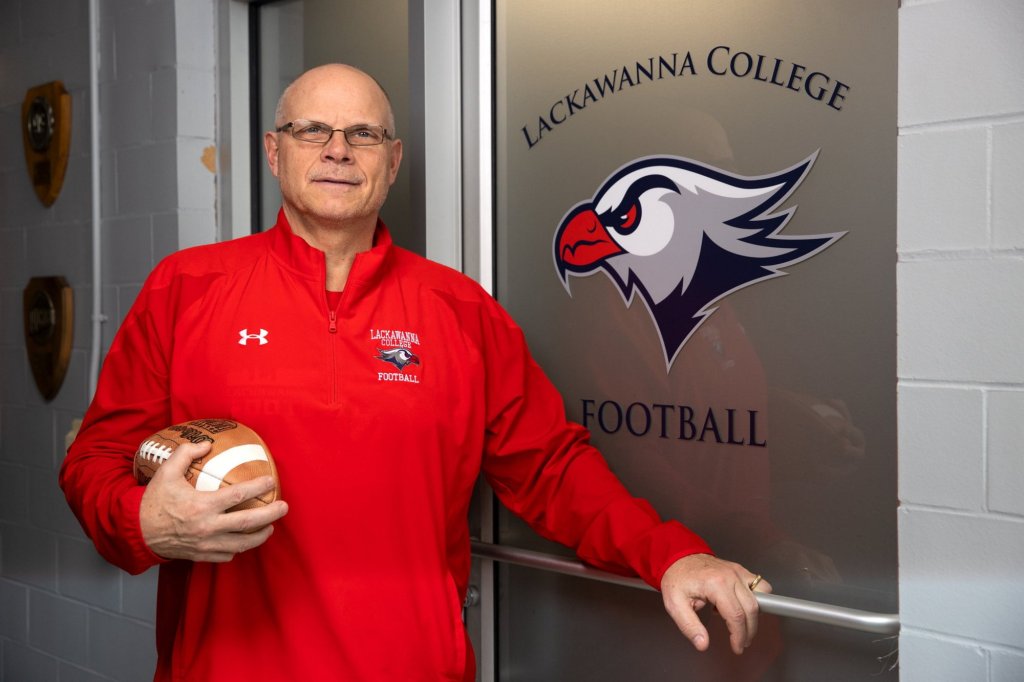
Lackawanna College has changed quite a bit since 1994. Not surprising, considering it was a junior college back then, a two-year school designed to give students in Scranton and surrounding neighborhoods a shot to start off their college careers affordably and close to home.
Now, it is one of the more innovative, faster-growing four-year institutions around the region, with campuses stretching from Hawley to Towanda, and Hazleton to Sunbury. In July, it completed a merger with Philadelphia-based Peirce College that both made it Pennsylvania’s largest private, nonprofit open-enrollment college and enabled it to offer master’s degree programs.
That kind of change is only spurred by many hard-working people. But, it helps when the most public-facing faculty member at the school is also championing the mission. For better or worse at institutions of higher learning like this one, that’s the head football coach. Because Lackawanna had Mark Duda in that role, it sure was better off.
When the Plymouth native and Wyoming Valley West grad announced his retirement as Lackawanna’s football coach Monday morning effective at the end of the 2025 season — the Falcons’ last scheduled game this season is on Nov. 13 against powerhouse Snow College at PENFED Field at Scranton Memorial Stadium — it marked the end of an era for the football program and university alike.
At the same time, it is difficult not to look at this news as a period at the end of an era for the tried-and-true ideals of collegiate sports coaching primarily as an extension of educational opportunities.
It’s not arguable that the biggest story in major collegiate sports this year is the number of coaches who have lost their jobs after disappointing starts, and the truckloads of money administrators were willing to pay them to walk away.
Most credible estimates have the total buyout money paid to coaches fired since the start of the 2025 season in late August ranging between $160 and $190 million, led by Louisiana State’s buyout of head coach Brian Kelly that topped $53 million. Of course, Penn State contractually could be on the hook for as much as $48 million in the unlikely event its fired head coach, James Franklin, doesn’t find work.
While it is eye-catching in its scope, the crux of this story shouldn’t revolve on the money. It’s the changing priorities of the job that should matter most.
The college football season will only hit its homestretch this weekend, but already, 10 head coaches of Football Bowl Subdivision programs were fired. The prevailing theme behind all those ousters: They didn’t win enough games for programs that expected to win games consistently.
It was an especially difficult reality for Franklin, who won 70% of his games at Penn State, won a Big Ten championship in 2016, took his team to New Year’s Six bowls five times between 2016 and 2023, and coached Penn State to the national semifinals in January. Plus, his players received degrees at rates above the national average 15 straight years; that’s no small feat in college football’s transfer portal era, when players can come and go as they please, with no regard for a program’s graduation rate.
Even at a school whose library is named for a legendary former football coach, Joe Paterno, the 11-plus seasons of consistently winning and educating players wasn’t enough to save Franklin’s job after a three-game losing streak. That’s striking, in a way. But it also enables us to shine a spotlight on Duda, and his accomplishments at a school where academics take on added importance.
Players who came through his program talked often not just about the academic focus Duda and his staff emphasized, but the lessons he taught them about growing up and challenging themselves and earning accolades on the field and in the classroom that set them up for success in life.
“You just can’t put any limits on yourself,” star Lackawanna offensive lineman Bryant McKinnie said during a return to the school in 2024, recounting the lessons he learned from Duda before going on to achieve All-American status at the University of Miami and a Super Bowl championship with the Baltimore Ravens. “Just come here, be consistent and work hard, and you can achieve what it is you set your mind to.”
Lackawanna will miss Mark Duda’s example, and the important thing is, it knows it. He won more games than anybody coaching at the junior college level, sent 450 athletes to Division I football programs and coached 25 players who went on to play in the NFL. The fact his legacy at Lackawanna goes far beyond that is a stark reminder of the kinds of standards not valued as much in big-time college football as they used to be, but should be still.