
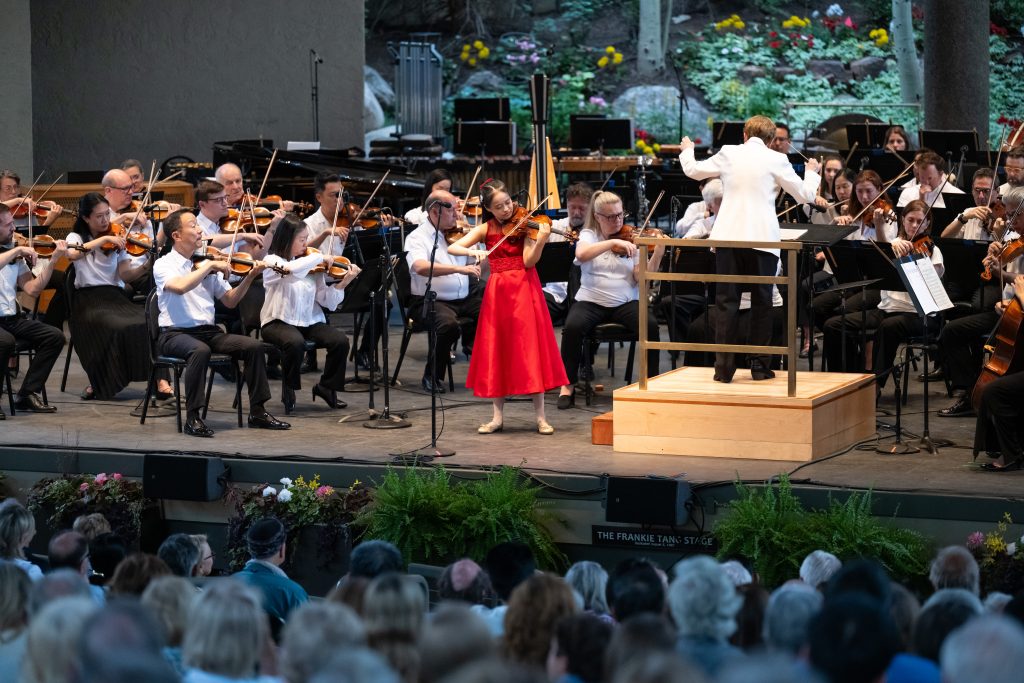
A youthful current ran through the Gerald R. Ford Amphitheater on Wednesday night. Fifteen-year-old Himari’s bold rendition of the Sibelius Violin Concerto thrilled Vail concertgoers, who were also treated to the Philadelphia Orchestra’s performances of selections from “Romeo and Juliet” and a Bravo! Vail co-commissioned piece, “The Rock You Stand On.”
My bias might be showing, but it seemed there were more than a few young music lovers in the audience. Then again, maybe monitoring my own three kids (all under the age of 5) had me noticing other young parents perched on the lawn under the partly cloudy evening skies. My daughters, however, weren’t the only ones captivated by the syncopations pulsating between brass and strings throughout John Adams’ 10-minute opener.
 Two young concert goers get ready to listen to the Philadelphia Orchestra’s performance on July 15, 2026, in Vail.Tom Cohen/Courtesy photo
The Harvard graduate’s 2025 composition, a gift to conductor Marin Alsop — who commanded the podium on Wednesday as the orchestra’s principal guest conductor — gradually grew in intensity, driven by its flourishing underlying jazz rhythms.
“She is one of the very few conductors whom I can trust to do the right thing with what I’ve written,” Adams was quoted in the program notes.
The piece properly prepared the audience for the evening’s marquee moment. Himari, one of the youngest-ever students at the Curtis Institute of Music — where she studies with Bravo! Vail’s founding artistic director, Ida Kavafian — has been described as a “once-in-a-generation talent.” Since her orchestral soloist debut at the age of 6, she’s worked with top orchestras across the world and claimed first prize at several international competitions, including the 12th Arthur Grumiaux International Violin Competition (Belgium), the 26th Andrea Postacchini International Violin Competition (Italy), the 20th Schelkunchik International Music Competition (Russia) and the Kogan International Violin Competition (Belgium).

Support Local JournalismDonate
Sibelius’ rare, mid-movement placement of the first cadenza highlighted the young virtuoso’s abilities. The Finnish composer’s lack of dialogue between orchestra and soloist only further exaggerated the spotlight’s focus on the teen sensation. And while all those furious sixteenth-note runs and double and triple-stopped figures were fun to watch, Himari’s mature handling of the breathtakingly fragile middle movement stood out even more. She pulled and pushed the Munetsugu Collection bow across her 1717 ‘Hamma’ Stradivarius Violin, each stroke tugging at the audience’s already breathless anticipation. How could someone so young be so at home drenched in the characteristically dark and sober sounds Sibelius had firmly established by the time he composed this, his only concerto?
In the final dance, the soloist snapped through the stately polonaise patterns playfully. She slid her left-hand fingers — now nearly a centimeter longer than those on her right — with shocking swiftness. While most classical concert enjoyment is strictly limited to audial sensations, the final few minutes of the third movement were visually captivating as well — even capable of capturing the somewhat wandering attention of the 3-year-old sitting on my lap at the time.
After intermission, she and I moved a little closer to the action. As we found our spots, I pointed out the brass players warming up. It was smart to stretch through their ranges: The highly-dissonant, fortissimo orchestral blast opening the “Montagues and Capulets” piece set the stage and the low brass followed with the haunting, pesante pulse of the “Dance of the Knights” bass line.
Under Alsop’s baton, the strings tightly traded off runs with the woodwinds through the dancing selections — something only a more seasoned listener could probably appreciate. But young and old alike could notice, in some sense, how the silent rests and unison jabs at the end of “The Death of Tybalt” spoke more than the continuous exchange of musical ideas elsewhere. Around 7:40 p.m., the clouds opened. Real rain fell just as the horns came back to the fore, signaling Romeo’s visit to Juliet’s tomb and ushering forth the beginning of a tragic end to the young lovers’ fast-moving romantic storm.
As double reeds led the orchestra’s search for solace in the tender, open-voiced major chord to close, I noticed a young girl a row over bursting into tears. Her mother came to comfort her. The parent in me thought it might just be past her bed time. But the musician in me maybe knew better:
Whether you’re a prodigy who starts taking lessons at 3 or a 3-year-old simply dressed up like a princess to enjoy a fancy night out at a concert, music speaks to us all. And at some level, we all understand it.
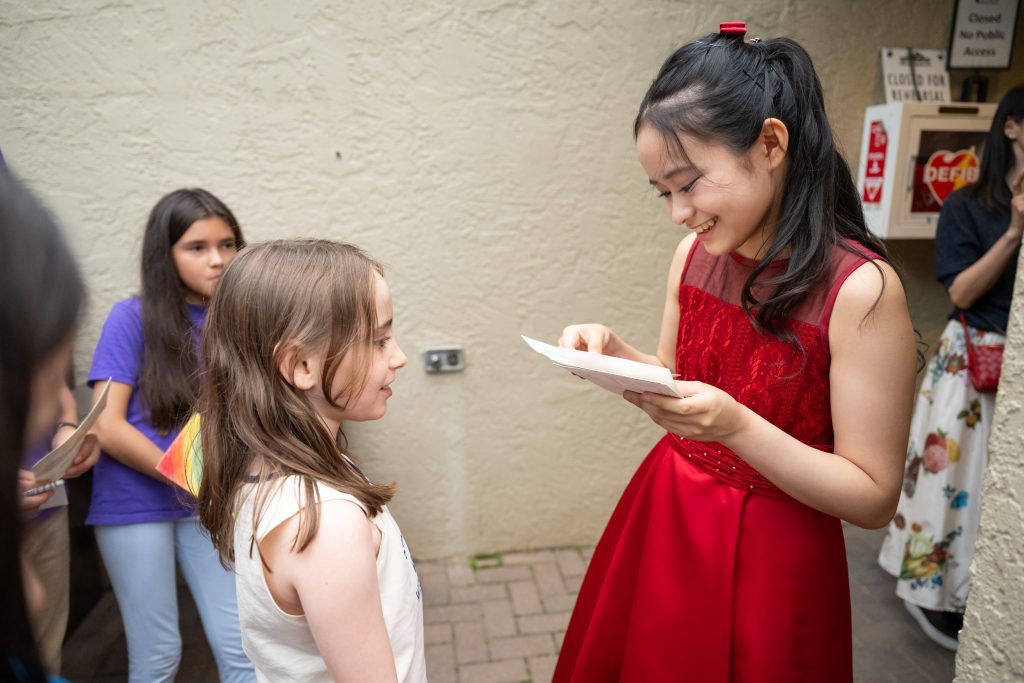 Himari signs autographs for Presto Club kids at a meet and greet on July 15, 2026 in Vail.Tom Cohen/Courtesy photo