
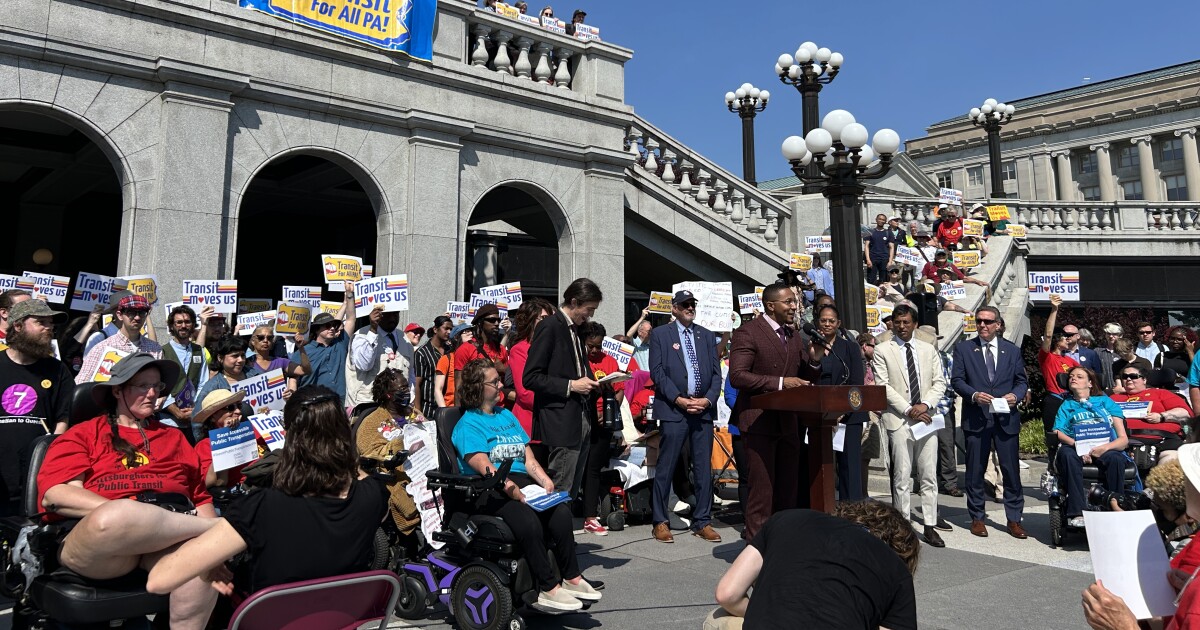
Activists who have pressured lawmakers to include a new statewide funding stream for public transit agencies in the state budget said they’re concerned that this year’s deal doesn’t address future stability. But minor wins should help define a path forward for next year’s expected budget debate, they said.
The four-month budget impasse last year was largely due to debates about how to fund public transit. And Senate GOP leader Joe Pittman told reporters last week that taking transit off the table this year made negotiations much smoother, resulting in a less-than-two-week delay.
“I think the biggest change was, the range of issues were much simpler,” Pittman said. “We worked diligently to try to figure out a solution to transit last year, and it consumed an inordinate amount of time and energy.”
Gov. Josh Shapiro in recent years has asked state lawmakers to approve a larger share of sales and use tax revenue for public transit, which he estimates could raise nearly $300 million for agencies.
When that measure failed to gain traction last year, the governor instead signed off on letting the state’s largest systems draw from capital accounts for operating costs for two years. Pittsburgh Regional Transit and Philadelphia’s SEPTA have used millions from the Public Transit Trust Fund to avoid service cuts, but the stopgap measure ends next summer.
For his part, Shapiro said after this year’s negotiations yielded no transit results, he’d continue to push legislators to agree on a new funding mechanism.
“I was able to flex $106 million for PRT to, in effect, get them through two years. We’re now approaching the second year,” Shapiro said Thursday during a stop in Monroeville. “It’s time for the legislature to come together … and get a bill to my desk to increase funding for mass transit all across Pennsylvania.”
But even if lawmakers agreed to Shapiro’s budget request for transit, some activists said agencies would be left desiring more.
Connor Descheemaker, statewide campaign manager for Transit for All PA, said sales tax earmarks for transit would come up short for systems across the state that have had to cut service. Descheemaker added that PRT has lost 20% of routes since the start of the pandemic.
“The governor’s proposal was well over $100 million shy of the need to preserve the status quo, and the status quo is lost,” Descheemaker said. “Every single transit agency in Pennsylvania has lost service since 2020, so that’s not the solution that we’re fighting for.”
Locally, the cuts have manifested in fewer bus routes and often-paused service for the Mon Incline, among other service delays, Descheemaker said.
“We hear about [service disruptions] with the light-rail car … and those accessibility projects that are needed,” Descheemaker added. “All of those are getting postponed or canceled outright because, again, best-case scenario, PRT is robbing its capital budget. What a privilege, I guess.”
PRT did not respond Friday to a request for comment.
Transit for All PA, however, is celebrating some state budget wins despite no long-term funding solution in this year’s deal. Two PennDOT bodies will study future fixes for transit agencies and paratransit in 2027: the Shared Ride Advisory Committee and Transportation Advisory Committee.
Both groups, Descheemaker said, should in “six-to-eight months deliver us a state of play, a diagnosis of the need for transportation and transit funding in PA and how we might fix it.”
The Shared Ride Advisory Committee will advise the state on how to best fund transit for riders with disabilities and seniors for door-to-door, non-fixed route services throughout the state. The service is also commonly known as “paratransit.”
Republican House member Jeremy Shaffer of Richland Township is one of 15 members on the committee, along with Pennsylvania Department of Transportation Secretary Mike Carroll, disability advocates and other lawmakers. (The group’s second meeting is in Harrisburg on Wednesday, but people can attend virtually to offer public comment.)
On Friday, Shaffer said he wasn’t surprised that the budget this year didn’t touch long-term transit funding, as Harrisburg “kicked the can down the road for two years” last year, he said. But “some tough choices are gonna have to get made in the next budget,” he added.
And Shaffer acknowledged that future debates will need to include “a new or modified approach” and could include a bipartisan task force to study how mass transit can succeed, he added.
The ride-share tax would amount to 6% of the cost of a fare. A second bill would raise a state car-rental fee from $2 to $6.50 and boost a fee on car leases from 3% to 5%. Revenue from those taxes would be used to fund public transportation systems around the state, including Allegheny County’s Pittsburgh Regional Transit.
Senate Republican leaders previously floated one possible transit revenue stream for the state: the legalization and regulation of skill games. Now legislators must either decide on a suitable tax rate before an October deadline set by the state Supreme Court, or the machines will be open to seizure by law enforcement.
But now that the court has ruled, there’s “no shortage of programs that are trying to compete for that money,” Shaffer said.
Democratic senators, such as Lindsey Williams of Pittsburgh and Nikil Saval of Philadelphia, have introduced a package of bills aligned with transit advocates’ requests, though the legislation has stalled in the transportation committee.
Meanwhile, in the House, Pittsburgh House members Aerion Abney and Jessica Benham have sponsored similar bills to see ride-share company profits and car-rental fees go toward transit agencies. Advocates had hoped a funding stream — such as the once-floated idea to tax slot-like skill machines as a tradeoff — doesn’t come at the expense of lower-income Pennsylvanians.
Still Descheemaker, of Transit for All PA, said, “Anytime that new revenue is discussed, we need to acknowledge that transit is something that is bleeding out right now — you know that well in Pittsburgh, and we see that in every corner of Pennsylvania.”