
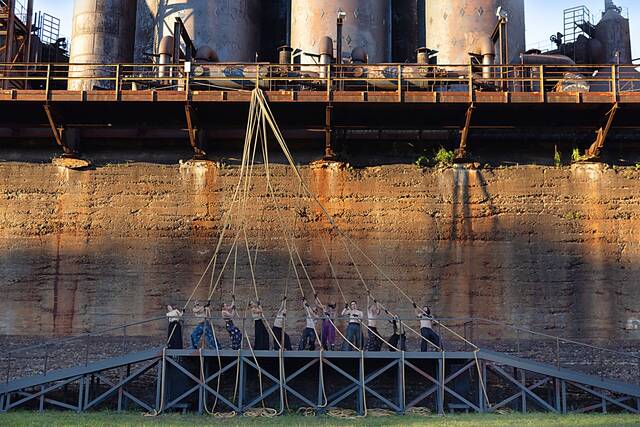
Tucked into a lush natural setting at the Carrie Blast Furnaces — a company-favorite site — is the enchanted island where Quantum Theatre’s “The Tempest” conjures magic, music and a meaningful farewell.
This is not close to the first time Quantum has tackled Shakespeare. It isn’t even the first time that it’s brought the Bard’s words to the Blast Furnaces. But this is the final production that founder and artistic director Karla Boos will direct before her retirement later this year.
Boos founded Quantum in 1990 and the company did Shakespeare for the first time with “Antony and Cleopatra” in 1997.
“The Tempest” is an evergreen choice for a send-off, as it’s believed to be Shakespeare’s final solo-written play.
In a note from the director, Boos said that she resonated with Jan Kott’s writing on the play, which describes “The Tempest” as offering “fragile — though stubborn — hope.”
The romance-comedy revolves around protagonist Prospero, played by longtime Quantum Shakespeare collaborator Jeffrey Carpenter in a fierce and stunning turn. The magician is also the exiled ex-Duke of Milan who ended up on the island where the play takes place with his young daughter, Miranda (the winning Carolina Vargas Romero).
After a dozen years stranded, Prospero gets an opportunity for revenge when his traitorous brother, Antonio (Corey Rieger) and a party of other nobles sail nearby. With the help of Ariel (Tomé Cousin), the spirit on the island that he has pressed into his service, he causes a storm that forces the ship to his shores and enacts a multi-pronged plan to regain his former position.
The first scene of Quantum’s “The Tempest” is the shipwreck, where audience members pause on their walk to the island set to watch the beautifully choreographed event, full of atmospheric sound and haunting movement. Sound designer Joe Pino, along with music director, composer and arranger Daniel Nesta Curtis, filled the entire show with immersive music and effects, but the opening was a masterpiece.
Stephanie Mayer-Staley’s scenic design is simple but effective, especially with Prospero’s elevated “cell” hovering over the round island stage. At this point in the year, the sun still adequately illuminates the theatrical setting up until intermission, when C. Todd Brown’s lighting design takes over, shifting through brightness for the darkening skies and punctuating Prospero’s magical casting with flashes and colors.
The play requires a fairly large cast, all of whom brought their A-game. Jereme Rodriguez, who portrays Prospero’s slave Caliban, impresses with physicality and intensity that draw the whole audience in. Cousin’s Ariel is similarly physical, though more sprightly (no pun intended), but equally vulnerable in portrayal. Cousin also provided the evocative choreography for the play. And from comic relief to enchanted sailors, the whole crew of the wrecked ship shines.
One of the most dazzling creative efforts in the production is the show-within-a-show conjured by magic for lovers Miranda and Ferdinand (an earnest and lovable Joshua Brelsford). Three goddesses in elaborate costumes and headdresses — incredible efforts by costume designer Susan Tsu — stage an enthralling musical performance until they are interrupted by Prospero. Sandy York, Jennifer Tober and Adrienne Wehr move with an ethereal grace as their shadow selves stretch tall on the backdrop behind them.
Much like apparently many, many people around the world, I went to the cinema to see Christopher Nolan’s “The Odyssey” this weekend. If you’re looking for a live local companion piece to that film, “The Tempest” is a great fit.
There is so much to discuss about “The Tempest,” from conversations about colonialism and oppression to examinations of gender. But it is also about magic, and the magic of creativity. At the end of the play, Prospero asks the audience to set him free, much the way he sets Ariel free. In a note from the director, Boos says, “It’s about history, history endlessly repeating itself. If it’s not too grandiose to say so, theater artists make theater to decode human behavior, and behind that impulse is a wish to see evolution — human beings becoming better-behaved.”
Boos has given the Pittsburgh theater community a magical gift for the past 35 years, and this last spell is just as enchanting as any in her body of work at Quantum. “The Tempest” is directed with freshness, spirit and passion, bringing an oft-performed classic to life in collaboration with a top-notch creative team. It is a final directorial effort to be remembered.
Quantum Theatre’s “The Tempest” will run through Aug. 23 at the Carrie Blast Furnaces. For tickets and more information, visit quantumtheatre.com.