

Philadelphia pulled in fewer venture dollars in Q2 than it did in the previous quarter, but local investors argue the drop doesn’t overshadow the region’s underlying stability.
Startups brought in $1.26 billion across 152 deals in Q2 2026, according to the latest Venture Monitor report, released quarterly by PitchBook and the National Venture Capital Association.
“The better companies understand that investors now expect more than a pitch deck and a large market estimate.”
Howard Lubert, Keiretsu Forum Mid-Atlantic
Crossing the $1 billion mark for the third consecutive quarter signals a resilient local market, Howard Lubert, area president of angel investor network Keiretsu Forum Mid-Atlantic, told Technical.ly.
“That tells me there are real companies here and investors are still willing to fund them,” he said.
Plus, while Q2 fell below Q1, it could be partially due to an outlier figure. In Q1, the region pulled in $2.99 billion over 162 deals, but that surge was largely due to the quarter’s top deal: a $500 million raise from World Liberty Financial.
Q1’s average deal size ballooned to $18.5 million and Q2 settled back down to a more standard $8 million. To Antonia Dean, partner at Black Operator Ventures, those spikes don’t eclipse the region’s overall stability.
“[That’s] where we’re going to be quarter over quarter,” she said. “There will be moments where we will have outliers from the companies that really break through.”
Companies successfully raising in Philly are capital-efficient, durable and built with clear exit pathways, Dean added.
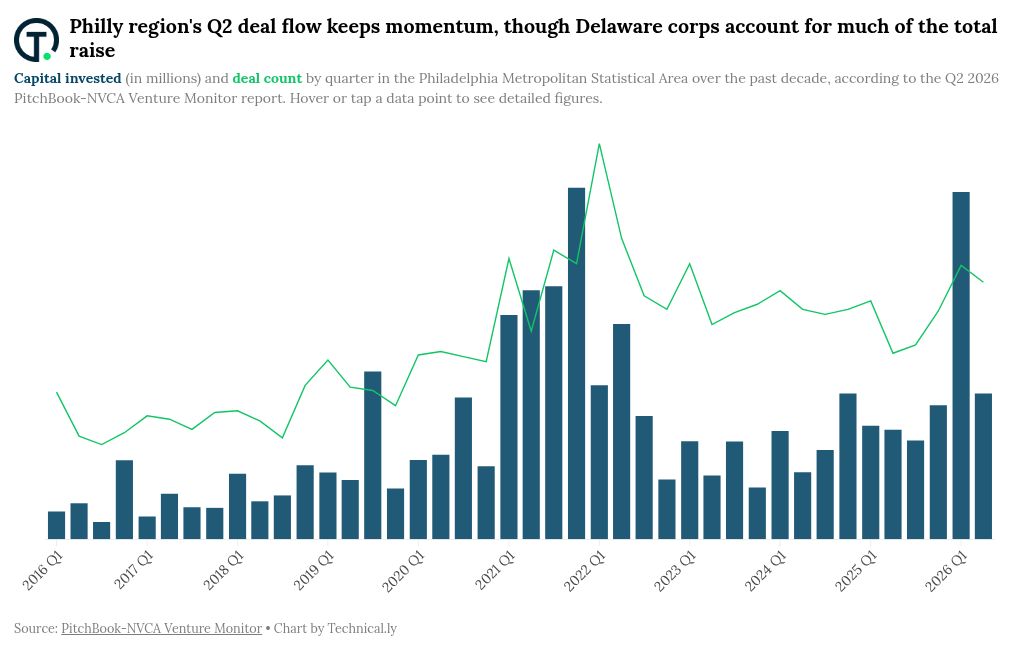
However, the headline data comes with an important caveat: Several of the quarter’s largest deals went to companies with seemingly little to no physical footprint in the region.
For example, while AI research lab Decart brought in $300 million — the region’s top deal last quarter — the startup’s actual HQ is in San Francisco, not Wilmington, Delaware, as PitchBook lists. Incorporating in Delaware is a common tactic companies use to benefit from a business-friendly tax structure, even if most of their operations happen elsewhere. At least two other top-five deals listed for Philly appear to have a local presence in name only, too.
The second-largest deal, cloud platform RunPod’s $100 million, also wasn’t in the greater Philadelphia region. However, unlike the paper-only corporations, it has a slightly stronger tie. The company previously told Technical.ly that CEO and cofounder Zhen Lu is based in nearby South Jersey, even though it says the 4-year-old startup is now headquartered in San Francisco.
As always, these figures may vary slightly after publication, as some deals aren’t accounted for until weeks after quarterly VC reports are published, or PitchBook may find errors in its data.
Keeping the focus on existing strengths, not AI hype
Venture capital is consolidating globally, and Philly is no exception. A handful of mega-firms — primarily in AI — scored the biggest deals.
While the wider market fixates on blockbuster IPOs from the likes of OpenAI and Anthropic, Dean from Black Operator Ventures said those mega-deals won’t move the needle locally.
AI is not a particular strength of Philadelphia. In fact, the latest Startup Genome report points to a distinct dearth of local infrastructure for AI startups.
Instead of chasing that novelty, Philly should focus on what it does have, specifically in the life sciences and healthcare industries, Dean said.
Local biotech standout Latus Bio secured a $97 million round — the market’s third-largest deal last quarter — proving that healthcare and life sciences remain a major magnet for capital.
“The hope is … that as those big AI deals start to return some liquidity to allocators, that’ll have a downstream effect of loosening up the purse strings across the market,” Dean said.
There’s also an opportunity for local investors to get a good deal investing in companies with strong science that may be overlooked by the current market, she said.
“I don’t think Philly is trying to be the next Bay Area, and I don’t think we should be,” Dean said. “We are winning a different game.”
How the market decides which biotech to fund
Overall, Lubert is seeing a lot of companies in Philly looking for investment, but he warns that most simply aren’t deal-ready.
“The better companies understand that investors now expect more than a pitch deck and a large market estimate,” he said. “They want evidence. They want customers or credible market validation. They want realistic valuations. And they want a board that will act when the company misses its milestones.”
In the case of life sciences, Philadelphia has plenty of innovative ideas in the ecosystem, but companies need to come prepared with a roadmap for scaling and proving ROI, Lubert added.
Big pharma spent years snubbing early-stage ventures in favor of safer, later-stage bets, according to Lubert. That tide is turning.
Because Philly excels as an early-stage ecosystem, prepared life sciences founders are uniquely positioned to cash in.
To win over today’s cautious VCs, Lubert said founders must prove three things: truly proprietary science, cleared regulatory milestones and a leadership team capable of executing under pressure.
“That does not mean every local biotech deserves funding,” Lubert said. “It means the strongest assets may be more valuable than they were several years ago.”