
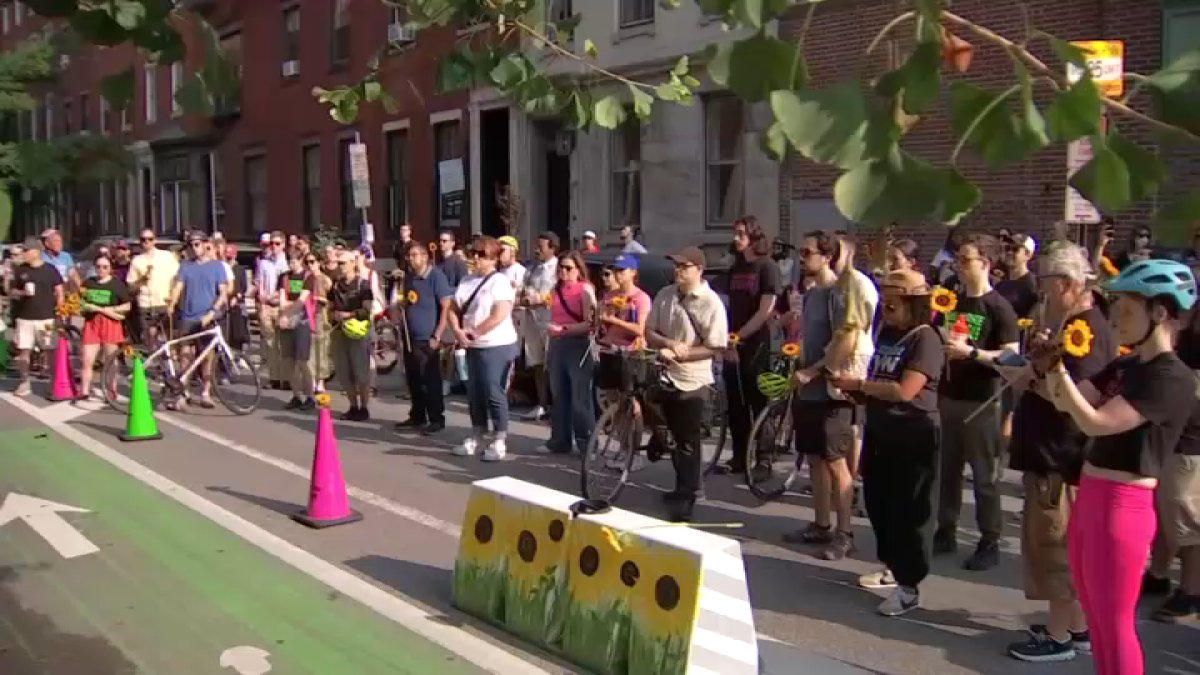
A memorial barrier honoring Dr. Barbara Friedes disappeared just hours after supporters installed it near the Center City intersection where the Children’s Hospital of Philadelphia pediatrician was struck and killed two years ago.
The barrier was placed Sunday by Philly Bike Action along the bike lane at 18th and Spruce streets, two days after the anniversary of Friedes’ death. Organizers said the barrier was intended both as a memorial and as a symbol of the need for improved bicycle safety.
Hours after the ceremony ended, organizers said the barrier had disappeared.
“It felt so heartless,” organizer Jessie Amadio said. “It’s so obviously a memorial tied to the ‘angel bike’ that’s right here. Everybody knows this is where that crash happened.”
The barrier was later found discarded behind a dumpster in a nearby alley.
Friedes, 30, was killed after a driver who later pleaded guilty admitted he was intoxicated when he struck her as she rode her bicycle through Center City in July 2024. The driver is serving a prison sentence.
Amadio said the memorial barrier was painted with 12 sunflowers, Friedes’ favorite flower. Each sunflower represented one of 12 cyclists killed since Friedes’ death.
During Sunday’s memorial, supporters filled the base of the barrier with water to weigh it down and to symbolize their continued support for bicycle safety.
“The grief is still really near in the city for a lot of people even two years since Barbara was killed,” Amadio said.
After the barrier disappeared, Philly Bike Action posted on social media expressing shock and initially blamed the City of Philadelphia for removing it.
Amadio said the organization believed it was reasonable to suspect the barrier had been removed by city officials because it was not a street-legal traffic device.
“I think it stands to reason that it would have been removed for official reasons given that it’s not a street-legal implement,” Amadio said. “So, I think that is a natural first guess. And again, like I said, it just didn’t seem possible that just some random person would do something so callous.”
However, the City of Philadelphia denied any involvement.
In a statement to NBC10, a spokesperson for the Managing Director’s Office said no city department directed the barrier’s removal and criticized social media posts accusing the city of taking it down:
“A Philly Bike Action post on social media on Sunday falsely stated that the City of Philadelphia removed the bike lane barriers placed on Spruce Street as part of the memorial service for Dr. Barbara Friedes. The post included a petition that asked people to send complaints to Mayor Cherelle L. Parker and other City officials for having the barriers removed. The City quickly responded on Sunday and confirmed on Monday morning that no one in any department provided a directive to remove the barriers, and we are disappointed that our departments were accused of this action. We confirmed this with every department leader, including Streets, OTIS, Sanitation, Fire, and PPD, and later learned that the barriers were found in a dumpster in an alley behind the Spruce Street memorial. The City is also mourning the tragic death of Dr. Friedes and have been committed to finding ways to keep cyclists, pedestrians and drivers safer and are disappointed that our dedicated, hardworking staff and City leaders were erroneously blamed for this action. “
A short time later, Philly Bike Action issued a statement saying it regretted the initial confusion that blamed the city.
Amadio said the group appreciated the city’s response and remains focused on making Philadelphia’s bike lanes safer.
“We’re happy to see that the Parker Administration has taken it so seriously. We know that this issue is important to them and this demonstrates that,” Amadio said.
She added that the organization is working to find a permanent home for the memorial barrier.
“I think what’s really important here is the fact that Barbara was killed in this unprotected bike lane two years ago; it’s still unprotected and it needs more than a symbolic memorial protection,” Amadio said.
It remains unclear who removed the barrier or why.
Part of this story was originally reported for broadcast by NBC Philadelphia. AI tools helped convert the story to a digital article, and an NBC Philadelphia journalist edited the article for publication.