
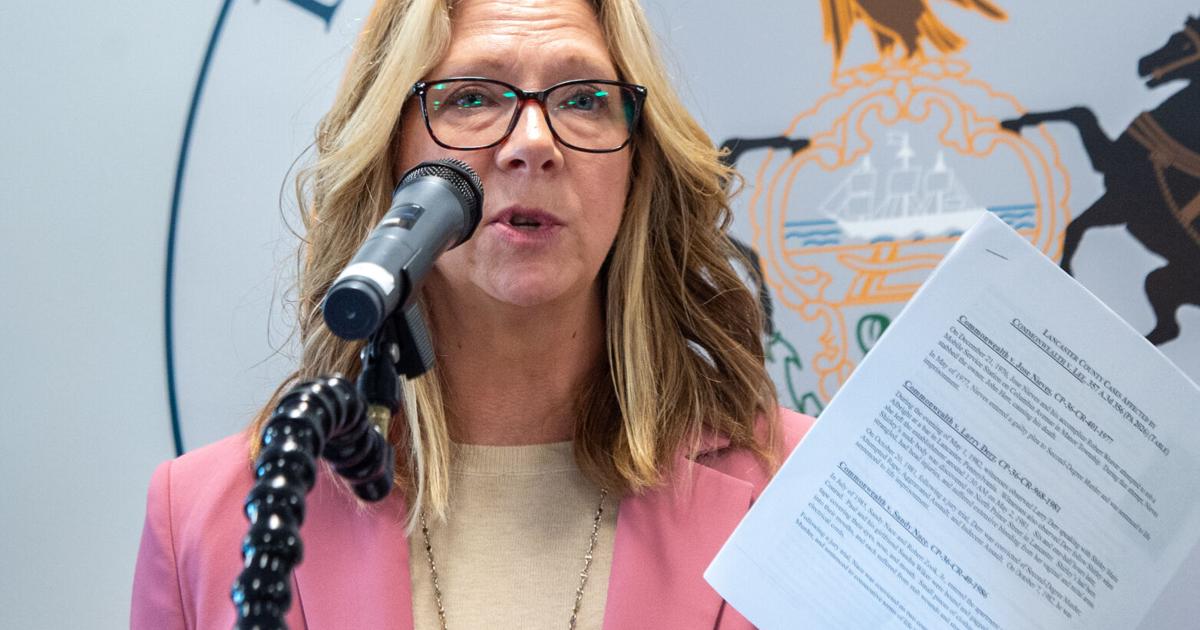
Holding six pages detailing 19 Lancaster County second-degree murder cases, county District Attorney Heather Adams urged state lawmakers Wednesday to address a March court ruling that makes mandatory life-without-parole sentences in such cases unconstitutional.
The Pennsylvania Supreme Court ruling could open a path to parole for inmates in about 1,160 cases statewide, including the 19 local cases Adams’ office identified, though the court’s ruling only applied to the case at hand.
“Many of these cases are more serious and more violent than the factual patterns we see in first-degree murder. As an example, many of them involve home invasions, where the victims were either strangled, beat, stabbed — often bound — and left for dead,” Adams said at a Wednesday morning news conference at the Lancaster County Courthouse.
Joined by state Attorney General Dave Sunday, state Sen. Scott Martin, and others, their urgings appear to be in vain because when the state’s high court ruled the prison sentence violates the state constitution’s ban on cruel punishment, it gave the legislature 120 days to come up with a fix. Friday is the deadline.
“Despite efforts over the last four months, disagreement remains on whether and how to address the court’s ruling … and it has become clear that no legislative solution will be negotiated before the end of the 120-day period,” Nicole Reigelman, House Democratic caucus spokesperson, said in an email Wednesday afternoon.
House lawmakers, however, would be working on the matter Thursday, she said.
Second-degree murder is commonly known as felony murder because it is a killing that happens in the course of committing or attempting to committ a felony such as burglary, robbery, arson, rape, involuntary deviate sexual intercourse or kidnapping.
Sunday said if representatives fail to act, it means the 1,160 people serving life sentences in Pennsylvania for second-degree murder will begin petitioning courts for a new sentence.
Without legislation setting punishment, it means judges across the state will be left to come up with sentences on their own — and the possibility that some people will be released, he said.
Reigelman said “rhetoric has taken over from reality” and that the subject of the court’s ruling – Derek Lee – will be resentenced to up to life without parole in Allegheny County Court.
Lee took part in a 2014 robbery in which his accomplice shot and killed a man in his Pittsburgh home during a struggle over a gun. Lee was running upstairs at the time after pistol-whipping the man and stealing his watch.
“In the continued absence of agreement on a path forward, we will continue to rely on the sound judgement of courts across this commonwealth to impose just sentences,” Reigelman said.

Martin and Reigelman both likened the situation to the U.S. Supreme Court’s determination that mandatory life sentences without parole were unconstitutional for juveniles convicted of first-degree or second-degree murder.
In 2016, the court made the decision retroactive, leading to the resentencing of 13 people in Lancaster County who were juveniles when they committed killings.
“That took a lot of time and effort, and of course, that has a ripple effect on other people’s cases and the timeliness of things, and when you talk about a potential of 1,160 individuals potentially filing here, this is going to have a huge strain on this justice system,” Martin said.
Reigelman said juvenile resentencings continue.
Adams said without a sentence structure for second-degree murder, “we will lose consistency in sentencing. We will lose fairness in sentencing. We will lose truth in sentencing, and when that happens, we lose all effective deterrent for committing the crime of second-degree murder.”
19 Lancaster County cases impacted by 2nd-degree murder ruling
The Pennsylvania Supreme Court’s ruling in March that overturned the use of automatic life sentences without parole for people convicted of second-degree murder affects the following 19 cases in Lancaster County. Details of each case are provided by the Lancaster County District Attorney’s Office or LNP | Lancaster County archives. All are serving life sentences without parole.
Jose Nieves: Nieves pleaded guilty to second-degree murder in the December 1976 stabbing death of John Herr, whose Manor Township gas station he and an accomplice tried to rob.
Larry Derr: Derr was convicted of second-degree murder, attempted rape, aggravated assault and indecent assault in the May 1981 death of Shirley Marie Albirght.
Sandy Nace: Nace was convicted of two counts of second-degree murder in the July 1985 deaths of Paul Conrad and his girlfriend Sandra Wiker, who were stabbed and strangled.
Dale Healy: Healy was convicted of second-degree murder in the September 1979 starvation deaths of siblings Horace and Mary Swarr after he and an accomplice ransacked the Swarrs’ home and left them bound and gagged.
Edwardo and Agustin Rosario: The Rosario brothers were convicted of second-degree murder for their roles in the December 1990 death of Maurice Scott, who was robbed and stabbed in his Marietta home.
Shariff Rashed: Rashed was found guilty of second-degree murder after he and an accomplice fatally shot Charles Michael Dixon and Jeffrey Thomas Mitchell in December 1993 during a drug deal in Lancaster city.
Wilfredo Portalatin: Portalatin was convicted of second-degree murder for his role in the December 1993 shooting death of Ignacio Haro in Haro’s New Holland home.
Ricardo Morales-Vasquez and Roberto Colon: Morales-Vasquez and Colon were each found guilty of second-degree murder, two counts of aggravated assault and criminal conspiracy for their roles in the April 2002 shooting death of Shalimar Espinosa during a robbery in Lancaster city.
Derrick Burnside: Burnside was convicted of second-degree murder in the December 1998 death of James Bell after Burnside set Bell on fire in Lancaster City.
Ernest Rykard and Jacquin Carr: Rykard and Carr were found guilty of second-degree murder for their roles in the November 2006 shooting death of Shawn Hutchinson during a robbery in Lancaster city.
David Jordan: Jordan was found guilty of second-degree murder for his role in the October 2004 shooting death of Heather Nunn in her Lancaster city home.
Cody Wunder and Stephen Harmer: Wunder and Harmer were convicted of second-degree murder in the shooting death of Douglas Herr in his Drumore Township home.
Christopher Lyles and Michael Patrick Baker: Lyles and Baker were convicted of second-degree murder for their roles in the December 2016 shooting death of Dennis Pitch during a robbery in Salisbury Township.
Javen Jackson: Jackson was found guilty of second-degree murder, robbery of a motor vehicle and arson in the November 2019 death of Thomas Blackwell. Blackwell, of Terre Hill, fell from his truck as Jackson tried to steal it after Jackson set fire to an apartment complex a few days earlier.
Senate legislation
Martin said that after the court’s ruling, state senators began meeting with stakeholders to craft legislation to remedy the matter.
What emerged, he said, was a bipartisan bill sponsored by state Sen. Lisa Baker, R-Luzerne County. Lancaster County’s three state senators, Republicans Martin and Chris Gebhard, and Democrat James Malone, voted for it.
In her June 22 co-sponsorship memo, Baker wrote, “In discussing second-degree murder, many advocates, and in fact, the court itself, have placed heavy emphasis on the ‘look out’ or ‘get away driver.’ While it is true that the universe of inmates serving life sentences for second degree murder includes these less-culpable accomplices, it also includes individuals who actively participated in the murder.”
Baker’s bill, Senate Bill 1400, recognizes differing degrees of culpability by generally giving judges discretion depending on a defendant’s roll to sentence to between 35 years to life, with the possibility of parole.
For outlier cases, the proposal would allow sentences of 10 to 40 years if certain criteria are met, including that the defendant did not act alone, and did not kill or attempt to kill the victim, or get someone else to, and had no weapon.
And it would allow a jury to sentence someone to life without parole when the jury determines the defendant killed the victim and met one of several aggravating factors, including if the victim was a police officer or under 13 years old or if the underlying crime was rape or deviate sexual intercourse.
It would also allow anyone now serving life for second-degree murder to become eligible for parole after serving at least 35 years or once they turn 70 and have served at least 20 years.
Sunday said opponents of life in prison for second-degree murder often point to the example of a getaway driver in a robbery who had no actual involvement in killing someone as reason discretion is needed and that Baker’s bill would do that. Adams and Martin agreed.
Success! An email has been sent to with a link to confirm list signup.
Error! There was an error processing your request.