
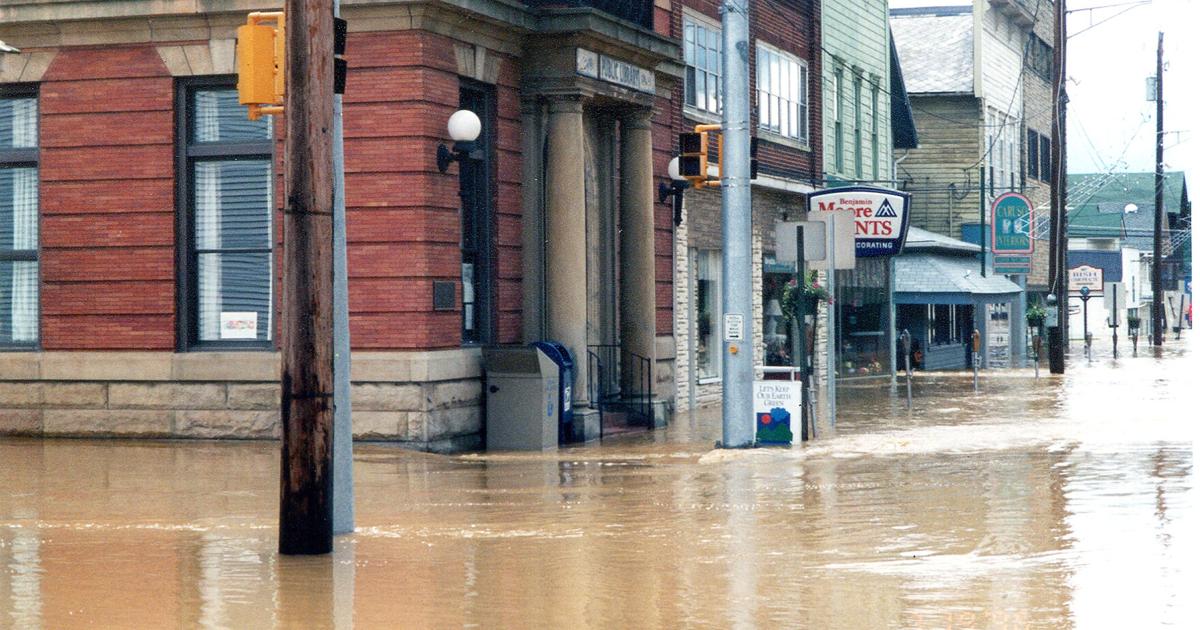
NEW BETHLEHEM – Former New Bethlehem police officer and fire chief Barry Fox woke to an emergency call on the morning of July 19, 1996 — the Brookville Fire Department needed assistance and his community would soon be in jeopardy.
Unbeknownst to Fox when he turned in during the early morning hours after his shift, neighboring Jefferson County had received six to nine inches of rain in less than 12 hours, causing Red Bank Creek to swell.
“I worked the night till 2 o’clock [in the morning] and it was raining, it wasn’t anything bad. I went home and went to bed,” Fox recounted. “At 6:30 [a.m.] the fire whistle blew and control called me and I said, ‘What’s going on?’ Dispatch said, ‘Brookville needs your boat and some manpower, they’re getting flooded.’”
“I said, ‘If Brookville is getting flooded we’re going to be getting flooded.’ The dispatcher goes, ‘Aren’t you underwater yet?’ I said, ‘No, it’s nice outside.’ The sun was shining, it was getting hot.”
Knowing New Bethlehem would feel the effects of what was happening upstream, Fox and members of the fire company undertook the task of notifying the unsuspecting town.
“We went down to the fire hall, rounded up our boat, put it on a truck, and a crew headed up to Brookville,” he relayed. “Then we went out; it was a hot, muggy, miserable day. When we started telling everybody, the sun was shining. We knew it [the flood] was coming down.”
“We went out and we warned people and they just looked at us, ‘You’re a bunch of drunk firefighters. What are you talking about? There’s nothing going on.’ They didn’t heed the warning, a lot of them, you really can’t blame them — we had no cell phones, people didn’t have scanners, they didn’t know what was going on up in Brookville or Summerville.”
Fox also began seeing some worrying signs, “I went down to the creek, right at Gumtown Park, and the creek was lower than it ever was, it was just low. We [the late Bob Stahlman and Fox] stood there for an hour and all of a sudden the creek got muddy and it started coming up and it just kept coming up.
“Starting about 8:30 [a.m.] it really started coming up. The creek got muddy and everything else, but everybody kept saying, ‘It’s never got this high,’ and it just kept coming up. It wasn’t like a flash food. We had time to get to people and once they realized it was coming up, they started moving [to safety]. That’s the Godsend, it was slow.”
The rise of the creek trapped some who delayed evacuation, including those renovating the high school who had to be rescued from the building’s roof by helicopter.
For Fox, rescuing the Evans family from their home at the corner of Lafayette and Water streets was personally memorable.
“They got trapped and we ended up going down there. Mr. Evans was hanging on to his dog, hanging on to the side of the building, his wife was still in the house. I was in waist deep water because we couldn’t get a boat in, it was too swift.
“We got him and we went in and got her out, and while we’re doing that the control center calls me and says, ‘There’s a tornado in your area [Shannondale].’ I said, ‘What do you want me to do about that? I’m waist deep in water.’ There’s not much you can do.”
Eventually flooding submerged much of the town, including the Broad Street business district, with some buildings swept away. Despite this, no lives were lost.
The bridge crossing the creek on Route 66 remained standing, the superstructure catching debris coming downstream.
According to Fox, that proved to be a blessing, “The bridge acted like a dam, that really helped New Bethlehem because all the debris stayed in the main channel — all the logs, all the poles, all the houses, everything stayed in the main channel.
“We had electricity the whole time because the debris stayed in the channel. The debris would have come down along [Route] 28 and wiped out all the power poles, the houses, the buildings would have been flattened. It made a mess [in the town], but it was all muddy water.”
Contrary to rumor, none of the flooding that day in New Bethlehem could be attributed to Brookville’s dam failing.
“Everyone said, ‘Oh, the dam broke in Brookville, that’s why we got the water.’ No, we didn’t get the water from the dam in Brookville [failing],” Fox noted. “I had a meeting with the Army Corps of Engineers [later], the dam in Brookville is the same as we have down here, it doesn’t hold a whole lot of water back.”
“It was all the water coming into the Red Bank Valley basin from Brockway, Punxsutawney was getting it, and everything else there was all those little tributaries come down, and it just was a wall, you know, a wall [of water that went over the top of the Brookville dam].”
By late afternoon/early evening, the creek had crested and water began receding, revealing the extent of the damage, notably a layer of mud coating everything.
“Once the flood went down, the real work started of trying to get the place back where people could actually live; get the town opened up so people could travel through,” Fox commented.
“We had several fire companies coming in to help us. After it started receding, they just walked, just kept moving up, hosing things down, the streets.”
The subsequent clean-up and recovery, which in some instances took months to accomplish, was, per Fox, a testament to the community’s solidarity.
“This town came together like you wouldn’t believe.” he observed.
“I mean, everybody has their own problems, but during that time of the flood, nobody had a problem. Everybody worked together.”