

The morning of September 21, 1905, dawned full of promises of mild temperatures and sunshine over the Lehigh Valley. The headlines were both grim and amusing. Yellow fever was gripping the South with a high death toll in Arkansas. The governor of that state would not confirm whether President Roosevelt’s annual fall hunting trip there set for October would be held.
The day before at Sagamore Hill, their summer home, the Roosevelts entertained the Duke and Duchess of Marlborough, the duchess being the former Consuelo Vanderbilt. The New York Times noted that it was the first time a motor vehicle had been allowed on the grounds.
“Mr. Roosevelt, fearing that otherwise he would be constantly annoyed by the ‘chug-chug’ of the motor cars, which are numerous in the neighborhood, caused a sign bearing a stern injunction against machine vehicles to be place on the road to Sagamore Hill.” His daughter Alice forsook her Baker Electric automobile and walked up, rather than risk parental wrath.
But it was a different kind of transportation that afternoon that motivated the large crowds, estimated to be between 75,000 and 100,000 that flocked to the Allentown Fairgrounds that day, some with picnic baskets in hand. It was to witness a horse race by the sensation of the day, the pacer Dan Patch.

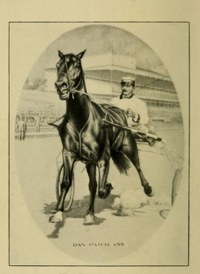
Dan Messner didn’t like the horse’s looks. A dry goods merchant from Oxford, Indiana, he had purchased a horse named Zelica in the fall of 1894, hoping to use the three-year-old filly as a driving horse. But now she had gone lame. The following year he paid a $150 stud fee to have her impregnated by Joe Patchen, a racehorse.
According to the Dan Patch Wikipedia entry, he was born on April 29, 1896, at Oxford. “His legs were so crooked he could not at first stand on his own feet,” it writes. All Messner’s friends were convinced that it would never run. Some even suggested he “put down” the colt.
But with care and feeding Messner found the horse growing stronger. In 1897, at Messner’s request, the American Trotting Association assigned him the name Dan Patch. By 1898 Messner was able to use him to pull his sleigh in the winter.
As the new century dawned Dan Patch began to attract the attention of other horse breeders and owners. One of the most persistent was Manley E. Sturges of New York. In 1901 he watched Patch at a horse race on Brighton Beach in which he had a large bet and was impressed when he won.
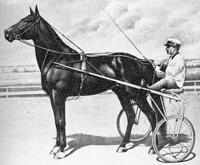
Dan Patch in harness, from Types and Breeds of Farm Animals published in the U.S. in 1906
He was “part-owner operator of an illegal but highly profitable casino in Manhattan, the Victoria Club,” notes Wikipedia. Although the Victoria Club was often raided by the police, Sturges always seemed to know when that was and was never there. When he heard that Messner had Patch up for sale he jumped at the chance. But Dan Patch’s owner drove a hard bargain. After much dickering the horse was sold for a record $20,000.
According to one account, one that in later years Messner confirmed, he feared Sturges and what might be described today as his “underworld connections.” In February of 1902, a two-year-old daughter of Patch died suddenly from poisoning. Messner is said to have believed Sturges was responsible.
Shortly thereafter Sturges sold Patch to Marion Willis Savage for what one source calls the unheard-of sum of $60,000 (equivalent to $2,230,000 in 2025). Savage was the owner of the International Stock Food Company. Patch had already won several races starting at the Indiana County Fair in 1900. In 1901, under the direction of trainer Myron McHenry, a series of races in the east called the Grand Circuit showed what Patch could do. “Dan Patch,” said McHenry, “is the best pacer I ever drew a rein over.”
In 1903 Dan Patch was being hailed as “the champion harness horse of the world.” He was appearing at a half-mile track in Lima, Ohio when he set a world record. By 1904 owner Savage, said to be tired with McHenry’s heavy drinking and criticism that he was treating Patch like a circus act, hired Harry Hersey to take over the role of trainer. At the same time crowds were being drawn to Dan Patch’s appearances. More than 40,000 racing fans were to see him in Des Moines that year and 50,000 in Milwaukee.
It seemed at first that 1904 was not to be Dan Patch’s year. Telegraph keys tapped out the news, Dan Patch had a strangulated hernia which had a very high fatality rate and was probably going to die. The racing fraternity and the good part of the public was stunned. Later it was found that it was an impacted bowel, “still serious but much more survivable,” notes one source.
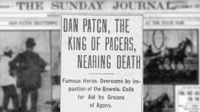
Newspaper announcing the illness of Dan Patch (Patchen)
When the word came out that Patch was recovering a national sigh of relief was heard. Some unkind sceptics went so far as suggest that Savage made it up to create publicity. Most sources doubt it. The focus was on 1905 as the big year. Dan Patch was nine years old that year. Most racehorses were considered past their prime at that age. Expectations were not high. Was Dan Patch back in his old form? Or had his bout with illness altered his performance on the track? This racing season would tell.
It began that September at the Minnesota State Fair before a crowd of 98,000 where Patch once again was the winner. Then it was on to Indianapolis Fair and another win. Finally on September 21, 1905, a clear day with temperatures in the low 70s, Dan Patch made his first appearance at the Allentown Fair.
Estimates of the crowd vary from 75,000 to 100,000 men, women and children piling into the stands. H.C. Hersey, described in the Morning Call as Dan Patch’s driver, said he had never seen a track so clean and kept as Allentown’s, adding that he had never seen that many people in the stands in any other place.
When Dan Patch arrived, the Call noted it was a little after 4:30. The crowd fell silent. “The king of harness horses was clearly a great attraction…three times he rounded the track to the admiration of all present, warming up for the encounter.” Each time Patch passed, applause rippled through the stands.
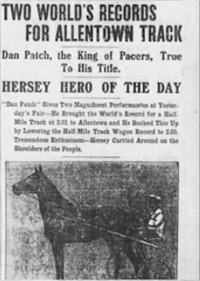
At the end of the races the crowd rushed on to the track, lifted Hersey and carried him on their shoulders. It was an outburst of enthusiasm that seemed to sweep the entire crowd. During the race a tent that covered the exhibit for the American Thresher Company burned to the ground. No one noticed until the race was over. Fair President Jerry Roth put a large horseshoe wreath of roses and carnations around Patch’s neck.
In a brief article, the New York Times, which had earlier nicknamed Patch as “the Black Whirlwind” described the race the next day on page 10:
“Records were broken in the harness races at the Allentown Fair today in the presence of 75,000 persons who shouted and cheered. Then Dan Patch, paced by a team of runners and with H.C. Hersey driving, went a mile in 2.01 which is a world’s record for a half mile track…An hour later the black pacer hitched to a road wagon, cut the record of his sire, Joe Patchen. Four races were also decided in fast times with exciting finishes.”
Dan Patch returned to the Allentown Fair the following year. According to newspaper accounts, no records were set that time.
Dan Patch retired undefeated in 1909 as the holder of nine world records and spent much of his later life attending exhibitions.
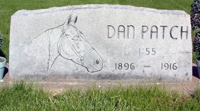
Findagrave.com
On July 11, 1916, he collapsed of a massive heart attack and died. But he is not forgotten. Today there is even a Dan Patch Historical Society.