
Easton’s Brody Orosky recently marked one milestone after another. Homecoming court, high school graduation, and now stepping into the voting process.
“I just registered last week,” Orosky said.
When asked why, he pointed partly to his grandfather’s influence.
“It’s also something I wanted to do because it matters,” he said.
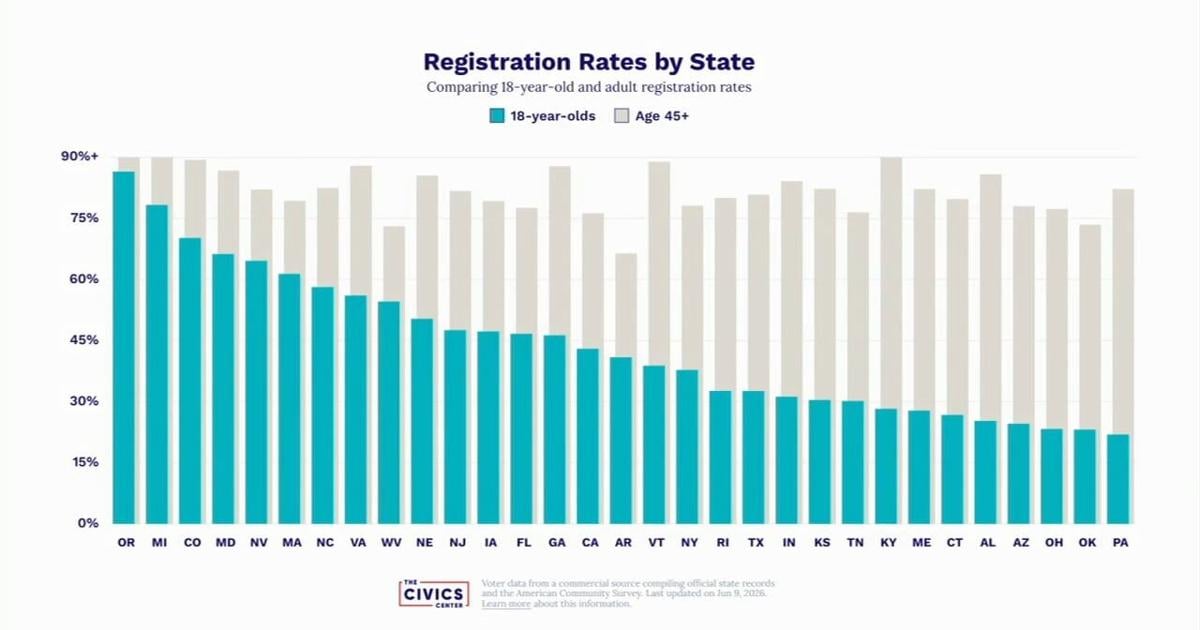
But across Pennsylvania, voices like Orosky’s are in short supply. The nonpartisan nonprofit The Civics Center recently studied voter registration numbers in 30 states. At 22%, Pennsylvania ranked last in registering 18-year-olds to vote.
Laura Brill, founder and CEO of The Civics Center, said the low number is not a reflection of young people lacking interest but…
“We have a systems challenge, a communication challenge, an education challenge, and it’s not the problem inherent in young people,” Brill said.
Brill said that unlike some other states, Pennsylvania teens cannot preregister before they turn 18. She also cited underperforming civic education as part of the challenge.
Angelique Hinton, executive director of PA Youth Vote, said the gap between wealthier and under-resourced school districts leaves many students without the same path to voting.
“If we can get to them and we can educate them, we can get them to register and participate,” Hinton said.
In Allentown, one school has already shown what that kind of outreach can look like.
In 2020, we reported on an annual senior voter registration drive at what was then Building 21 and is now Bridgeview Academy. Social studies teacher Shannon Salter described voting as “intensely personal for students in Allentown.”
In a district long familiar with funding challenges, Bridgeview is one of only 35 public high schools to receive a Governor’s Civic Engagement Award.
For Orosky, the issues of data centers, electricity costs,and water usage are topics his friends already talk about.
His message: Politicians cannot hear young people if they do not know they are here.
“I think it matters,” Orosky said.
He said young voters have a long stake in the decisions being made now.
“We’re going to be around here for the next seven, eight decades,” Orosky said. “So, I find it to be extremely important.”