
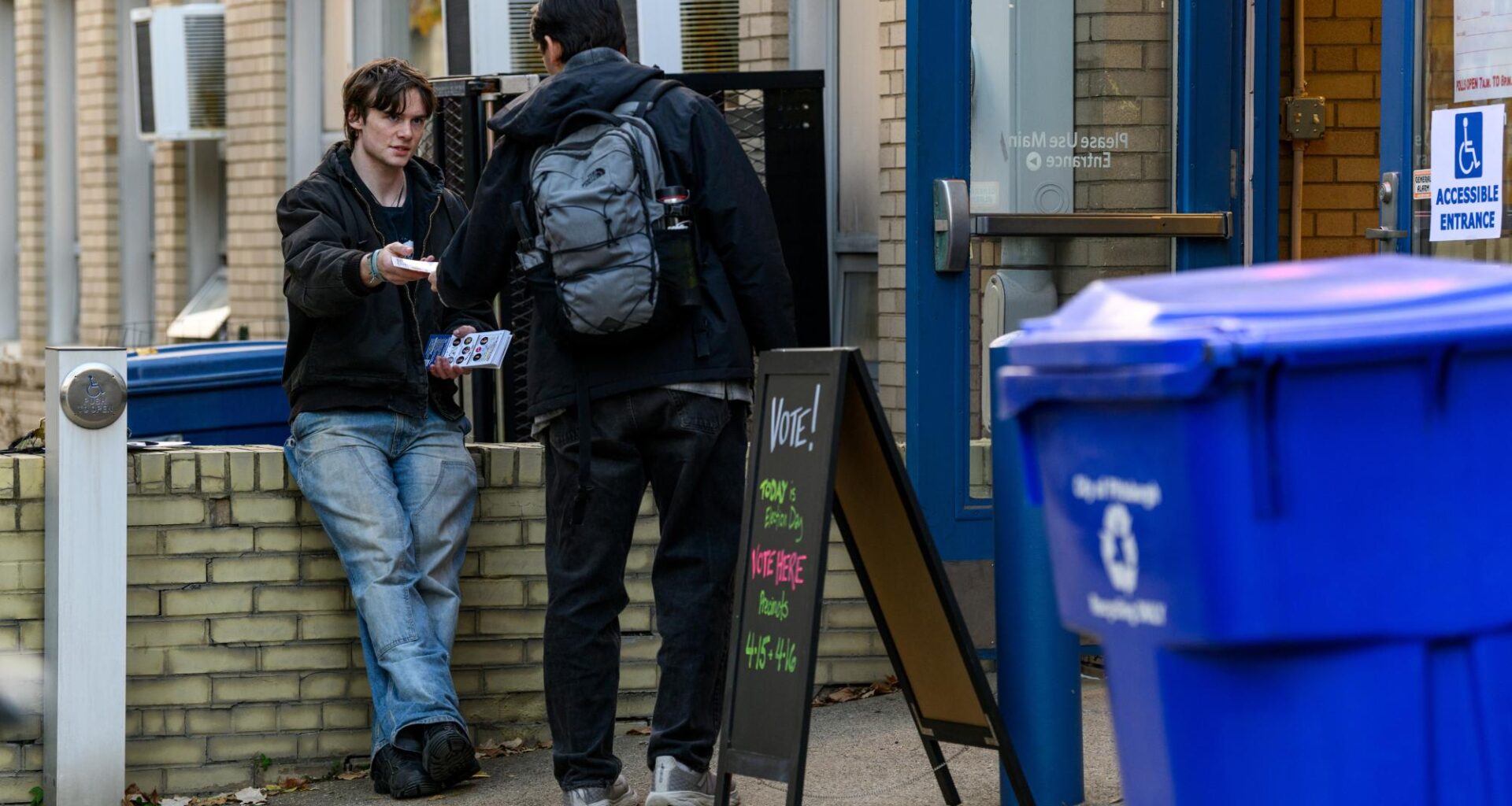
On Tuesday, Nov. 4, residents across Pennsylvania cast their votes in various state and local races, including Pennsylvania’s judicial elections and Pittsburgh’s mayoral race.
Tuesday’s Election Day marked the first major election since President Trump’s 2024 re-election. Major races outside Pennsylvania included New York City’s mayoral race, California’s Proposition 50 and gubernatorial races in New Jersey and Virginia. At 9:53 p.m. on Tuesday, AP News announced that all three PA Supreme Court Justices were retained. In Pittsburgh, the mayoral race was called at 8:26 p.m., announcing Democrat Corey O’Connor’s win over Republican nominee Tony Moreno.
Oakland voters cast their ballots in the William Pitt Union, Bellefield Hall, Posvar Hall and Soldiers and Sailors Memorial Hall and Museum on Tuesday from 7 a.m. to 8 p.m. Many of the voters on Pitt’s campus were college students who found this election particularly important.
Thomas Simione, a sophomore media and professional communications major, acknowledged that the opportunity to vote and have a say in who governs the state he lives in doesn’t come every day.
“I voted because I want to engage politically with my community,” Thomas said. “I’m going to be living here, so I want to have a say in who is controlling my community, who’s in charge.”
Alyssa Hipsky, a first-year computational biology major, values the impact that young voices have in smaller, local elections.
“I think it’s very important to be involved, especially in the current political climate,” Hipsky said. “I ended up voting for mostly the Democratic Party because I agreed with all of their reasonings.”
Ray Salac, a sophomore urban planning major, emphasized the importance for students in particular to show up to the polls.
“We make up a big population in Pittsburgh, so I think we should have our voices here just as much as everyone else,” Salac said.
Judy Cameron, a professor of psychiatry at Pitt, went to the WPU to cast her vote along with many students.
“I am really pleased today to see so many students,” Cameron said. “I come here every year, and frequently, there aren’t a lot of students voting.”
Dan Frankel, a Democratic member of the Pennsylvania House of Representatives, has been representing the 23rd district for 27 years and spent his day at Pitt’s polling locations, chatting with voters.
“It’s great to see people exercising their franchise to vote — something that is fundamental to maintaining our democracy — particularly in an era where we are clearly fraught with challenges to maintaining it,” Frankel said.
According to Frankel, who has been coming to University voting locations since his election almost 30 years ago, noticed a significant increase in voters this year. He suggested that young voters are “picking up an interest” in understanding the importance of non-presidential elections.
“I think kids — young people — get motivated when they find that the things past generations may have taken for granted, can’t be taken for granted anymore,” Frankel said.
Brielle Anderson, a junior psychology major, said she voted because she wanted to “see change” that benefits herself and those around her.
“There were some of my friends today who didn’t register [to vote] in time, and I was like, ‘Guys, come on,’” Anderson said. “I feel like this is the one opportunity where you can put your voice out there, especially in today’s political climate.”
Outside the WPU, College Democrats at Pitt were greeting voters while handing out informational sheets and slate cards of Democratic candidates endorsed by the Allegheny County Democratic Committee.
Tommy Berenson, a senior urban planning major and member of Pitt College Democrats, said voting “yes” to retain the three Democratic Pennsylvania Supreme Court Justices was very important to this election and to supporting national democratic goals.
“They are helping to preserve fair election maps in Pennsylvania, they’re helping to preserve a woman’s right to choose, they’re doing things that students here at the University of Pittsburgh should value as their rights,” Berenson said.
Alexander Briese, a junior mechanical engineering major, said he decided to vote after seeing advertisements and articles about the Pennsylvania judicial election online.
“I did a bit of independent research and learned [about] the different candidates,” Briese said. “From what I understand, the risk with not retaining the judges is that we [would] get people who are a lot more brash and will make decisions that don’t benefit the greater good.”
Jesse Milston, vice president of College Republicans at Pitt and junior political science major, hoped Pennsylvania would vote not to retain the PA Supreme Court Justices.
“Every election is important regardless of what is on the ballot,” Milston said. “For the College Republicans, [this election] means the opportunity to vote ‘no’ on radical judges like Dougherty, Donohue and Wecht.”
Norah Stotz, a sophomore neuroscience and economics student, said she voted for Democratic candidates because they align with her views on “important issues.”
“[Democratic candidates] are the people supporting my rights and the rights of my close friends,” Stotz said. “I want to keep the rights that everyone currently has without being in danger of losing the right to get married or have life-saving care and abortion access.”
Sage Lee, a first-year linguistics major, came to vote in her first election because she wanted to share her voice and “help” in the retention of PA’s Supreme Court Justices.
“Seeing all the news in the past few years and not being able to vote — especially with the last presidential election — I was extremely frustrated that I couldn’t do anything about it,” Lee said.
For Jacob Weiser, a sophomore bioengineering major, this year marked his second election voting.
“Even though this election isn’t as big as last year’s [presidential election], it’s still important to ensure that your voice is heard on the local level,” Weiser said. “My political opinions matter on all levels of government, and so I need to make sure that it’s represented on all of those levels.”
Olivia Hart, a junior majoring in law, criminal justice and society, has voted on-campus all three years that she has been at Pitt, even though she’s originally from Washington, D.C.
“My parents advised me to switch my voting registration to PA [be]cause I’m from D.C., so PA needs my vote a lot more than D.C. does,” Hart said.
Hart said she believes it is her “civic duty” to vote in every election.
“There are a lot of people who can’t vote. There are a lot of countries in which they don’t have this,” Hart said. “I think it’s really important to exercise [the right to vote] as soon as you are able to because every vote counts at the end of the day.”