
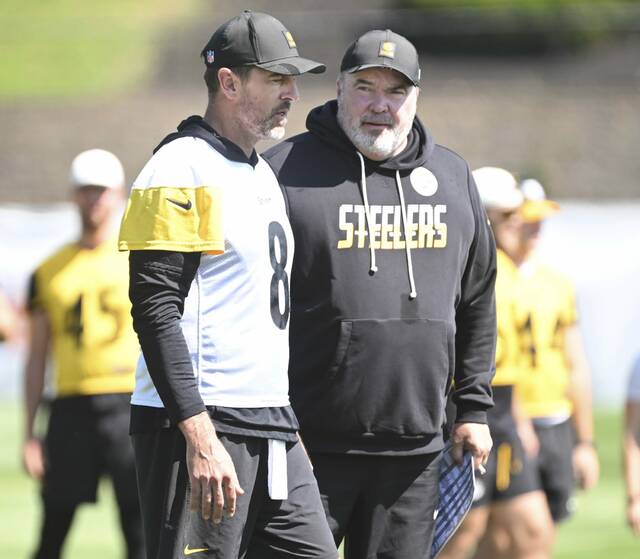
Judging by his choice of topic for addressing the team in a full-squad meeting during the lead-up to the first practice of training camp under his stewardship, Mike McCarthy is eager to emphasize the Pittsburgh of the Pittsburgh Steelers.
“His speech before practice kind of got us all fired up,” center Zach Frazier said on the day camp opened at Saint Vincent. “It went on the history of the steel mills, and he really wanted to embody what it means to be a guy from Pittsburgh.”
To anyone who has followed the Steelers in the six-plus months since McCarthy was hired as just the team’s fourth head coach since the 1970 AFL/NFL merger, it came as little surprise that McCarthy chose his hometown for the subject matter as his final words to his team before it took to the field to embark on a new season in earnest.
A Greenfield native, McCarthy long has worn his Steel City pride like a badge of honor. He had been known to frequently reference Pittsburgh during news conferences while the coach of the Green Bay Packers and Dallas Cowboys. His quarterback for more than a decade in Green Bay — Aaron Rodgers, now with the Steelers — last season liked to talk about how McCarthy would regale him and other Packers about some of the places to visit in Greenfield and Pittsburgh.
And that was before McCarthy was professionally employed by the franchise based in his hometown. Now, as coach of the Steelers? He has made it part of the fabric of his motivational style and the tenets of how he wants his team to operate.
“You can tell he’s from Pittsburgh,” Frazier said, “and it’s pretty cool to have someone that grew up here and has so much passion for the city.
“It makes me excited to play for him.”
Not just a ‘yinzer’
McCarthy is so identifiable with Pittsburgh in part because he so much looks — and leans into — the part. Start with the unmistakable accent. Add in commanding and portly stature that could be out of central casting to match that of any number of high school football coaches across Western Pennsylvania.
Then there’s the history of McCarthy’s Greenfield roots, from that of the corner, shot-and-a-beer bar owned by the family that carried his father’s name, to the regular Sunday Mass he attended with his close-knit Irish Catholic family.
Make no mistake, though. McCarthy is not just some Yinzer caricature standing in as the Stillers coach. He runs the organization with a meticulous precision.
“Mike has been doing a great job of going over every detail of the day, every aspect of (that day’s) practice,” veteran linebacker Patrick Queen said. “Making sure it’s all laid out so that when we go out there, it just flows for us.”
The pace and methodical design of practices is a noticeable difference from how sessions were under previous coach Mike Tomlin. There is little down time. Periods for specific drills are timed out to the minute, and as soon as time’s up, a staffer on a megaphone signals it’s time for players to move on to the ensuing period, seemingly with no questions asked or room for even a slight variation to veer off schedule.
In the past, practice times were typically listed with endings at the top of an hour, but that often was treated more as a suggestion or guide. For the first two days of Camp McCarthy, the session began and ended — to the minute — on time.
Whereas some chuckled when the official camp schedule listed the first practice to end at 12:46 p.m., sure enough, when the final horn sounded to end the first camp practice, it was indeed 12:46 p.m.
“Everything’s calculated,” McCarthy said. “Everything’s regulated.”
“I’m very into maximizing these 21 days here in Latrobe. That’s been echoed from the time we arrived here. So, we’re going to make the most of it.”
Science behind it
McCarthy moved up practice start times to late morning. He banned players tackling teammates to the ground. He’s scheduled “light” work days interspersed within more physical practice sessions.
All were done with purpose.
The morning practice so that the staff has appropriate time to review the film of it afterward before building a plan for the following day. The tackling edict was made based on data regarding injuries. The varied intensity of the daily practices is a nod to a carefully precise schedule of installing offensive and defensive schemes and systems so everyone is on the same page, complete with built-in “review” days to ensure no one is left behind.
“Everybody talks about the physical and the mental stress of a physical camp,” McCarthy said. “Well, what the hell about the nervous system? Who’s training that?
“How you tapping that? How are you pushing that? Where you getting that at? Where’s the mental toughness? Where’s the emotional toughness? How do you train that on a football field? So this is all by design. And a lot a lot of my ideas and a lot of my approaches, the systematic things really come from the days as a quarterbacks coach.”
‘Getting the heart rate going’
McCarthy has been an NFL head coach for 18 of the prior 20 seasons. His days as a quarterbacks coach in the league came over a five-season span in the 1990s.
The regular practice of players wearing GPS monitoring devices during practices was still more than a decade away. It’s a technology that McCarthy leans on in making decisions about everything from practice structure to the depth chart.
But it’s also not something that compels McCarthy to abandon his tendency to lean on the human side of coaching.
“GPS is a tool. Sports science is a tool, but still, it’s a people’s game,” he said. “I think we’ve got to be conscious of that. GPS is part of the evaluation. It’s not going to drive every decision that we make. That’s not realistic. The human part of this is. I think we want to refer more to the steel mill operation than we do to the GPS, so that that won’t change here. Never will.”
It was characteristic of McCarthy to make a reference to a steel mill in the midst of an answer to a question about myriad data gleaned from global positioning system devices attached to professional athletes.
McCarthy has a brilliant mind that works in ways that had him, for example, during March pointing to a specific date in June as a target for an offensive install. But at his core, he’s still eager to play the part of that bar-owner’s yinzer son. Even so much so as during his first formal words to the full team on the eve of serious preparations for its first season under him.
“I talked a lot about the identity of the Pittsburgh Steelers and the city of Pittsburgh,” McCarthy said. “I think the parallels, the comparables, are incredible, growing up here. So I referred to some of the stories from the past, the steel industry (and) how it relates to the game of football.
“Just had a little bit of nostalgia, just to try to get the heart rate going a little bit.”
It seemed to hit its target in connecting with his players.
“The thing that resonated with me is just he’s from Pittsburgh,” longtime Steelers defensive captain Cameron Heyward said. “He has a lot of respect for the tradition here. But he’s (also) trying to afford something new.
“We understand there’s going to be growing pains (with a new coach), but… we’re very big on servant leadership and serving the entire group. Coach McCarthy said to us that he wants to serve us. So we’re all going to be in this together, and we’re all going to put our hands in the pile.”