
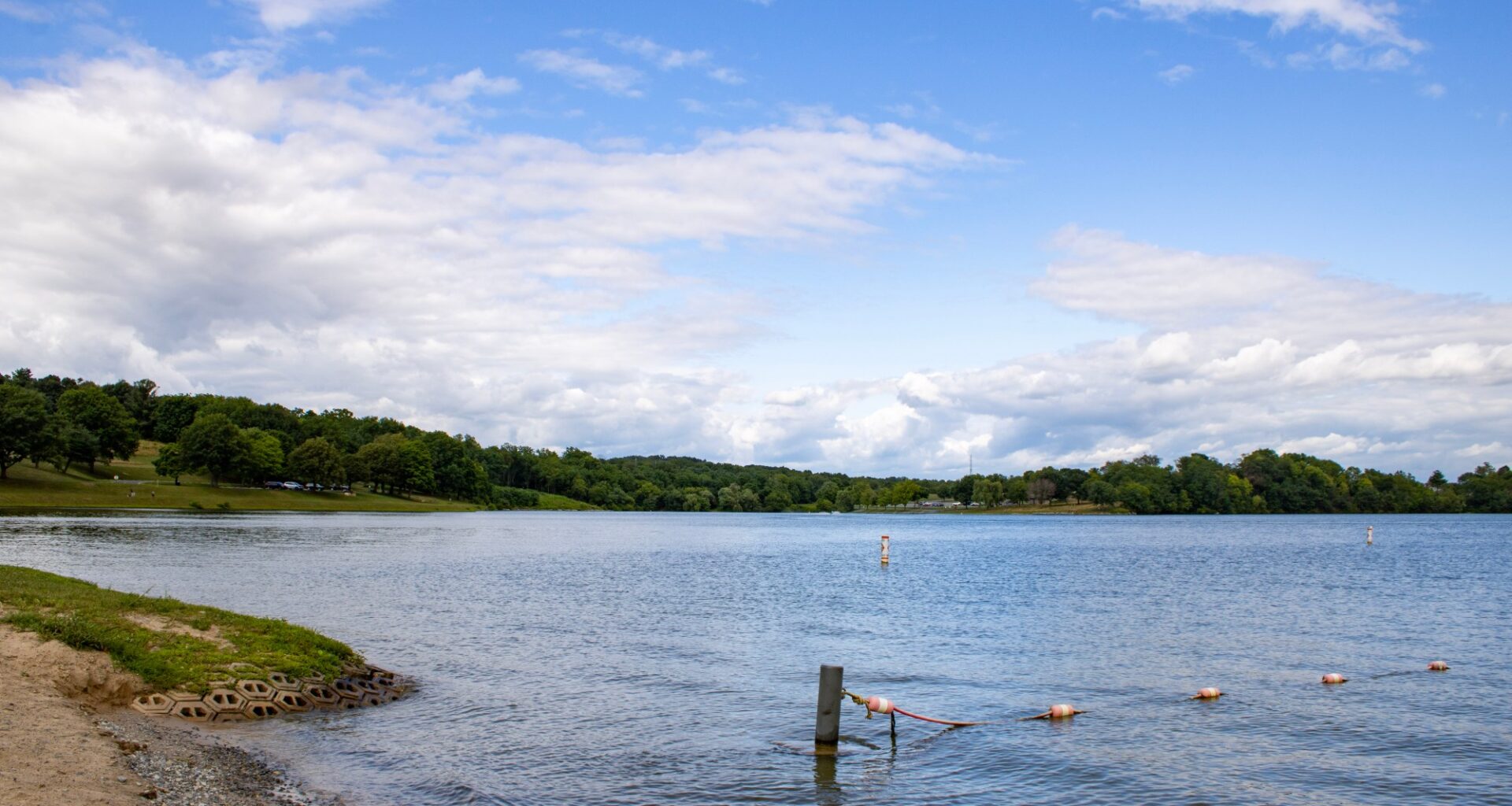
The main beach at Blue Marsh Lake Recreation Area in Berks County shimmered under the sun, the water clear enough to see the sand below. But upstream, in one of the lake’s shallow northern arms, park ranger Brianna Treichler traced her finger along a thin scum line gathering at the surface. It was a subtle indication that harmful algal blooms may be lingering below — a reminder of why the lake stays under a year‑round advisory.
Although the swim beach has tested clear this season, Blue Marsh remains under a lakewide harmful algal bloom advisory because conditions vary dramatically across the reservoir. In the northern arms, where warm water, slow currents and nutrient‑rich runoff collect, cyanobacteria can persist below the surface or gather in small patches that don’t always reach the beach. On busy summer weekends, thousands of visitors swim, paddle and fish at Blue Marsh, often unaware of how quickly conditions can change.

U.S. Army Corps of Engineers ranger Brianna Treichler highlights algae buildup near the bank, noting that cyanobacteria can move within the water column and appear suddenly after nutrient pulses. (AISHWARYA BEHL/STAFF PHOTO)

Calm water and dense summer foliage frame Blue Marsh Lake, where year‑round HAB advisories remain in place. (AISHWARYA BEHL/STAFF PHOTO)

Water appears greener where Tulpehocken Creek and Northkill Creek meet the lake’s main stem, a mixing zone rangers say can carry higher nutrient loads. (AISHWARYA BEHL/STAFF PHOTO)
Show Caption
1 of 3
U.S. Army Corps of Engineers ranger Brianna Treichler highlights algae buildup near the bank, noting that cyanobacteria can move within the water column and appear suddenly after nutrient pulses. (AISHWARYA BEHL/STAFF PHOTO)
Expand
The biology behind the blooms
Harmful algal blooms (HAB) aren’t actually algae at all. The green streaks and surface scum that appear on lakes like Blue Marsh come from cyanobacteria: microscopic organisms that occur naturally in nearly every body of water in the world. By themselves, they’re not harmful.
The problem begins when warm water, sunlight, and nutrient‑rich runoff create the perfect breeding ground for cyanobacteria to multiply. Under those conditions, cyanobacteria can produce cyanotoxins, the compounds that prompt health advisories and beach closures. “It becomes harmful when they are doing something that impacts the health of humans or our pets,” said Kylie Wirebach, an aquatic resource systems analyst with the Pennsylvania Department of Conservation and Natural Resources’ Bureau of State Parks.
The challenge is how quickly blooms can appear, disappear or shift. Cyanobacteria can move vertically through the water column, gather in pockets and concentrate in places that look clear from the surface. “Trying to find a pattern to anticipate what it’s going to look like for the week, or for the month or for the year is almost impossible,” Wirebach said. “There are still so many different aspects of harmful algal blooms that are very surprising and hard to predict.”
How blooms behave at Blue Marsh
At Blue Marsh, that unpredictability plays out across the lake’s coves, arms and deeper main pool. “It’s a little bit different every single year,” Treichler said. “They could be in one area one day and move out to a completely different area the next.”
Up in the northern arms, the water slows and curls around the shoreline, creating pockets where blooms settle. “The natural current itself will push the algae and congregate it into the curves we have within the lake itself,” she said. “So it’s more prone to having blooms in those areas.”
Farther south, the lake behaves differently. Wind and boat traffic break up the algae and push it deeper. “In the main pool … it just distributes throughout the water column,” she said. “Even though you may not see the matting on the surface … there still can be high concentrations.”

Floating buoys create a safety perimeter around the swim beach, where staff conduct routine HAB sampling at ankle, knee and hip depth. (AISHWARYA BEHL/STAFF PHOTO)

A patch of stagnant water shows surface scum and submerged vegetation. Rangers say blooms can shift quickly, sometimes worsening within days after appearing to clear. (AISHWARYA BEHL/STAFF PHOTO)
Show Caption
1 of 2
Floating buoys create a safety perimeter around the swim beach, where staff conduct routine HAB sampling at ankle, knee and hip depth. (AISHWARYA BEHL/STAFF PHOTO)
Expand
A system built on caution
Blue Marsh’s monitoring program is built around consistency and caution, a system that the Army Corps of Engineers began developing in the past several years as it partnered more closely with the Pennsylvania Department of Environmental Protection.
Staff run weekly in‑house toxin tests at the swim beach, while monthly reservoir samples go to DEP for full species identification and toxin analysis. “Any detections that we have had this summer so far have been well within safe standards,” Treichler said.
If toxin levels ever exceed state thresholds, the response is immediate. “We would start with closing down the beach,” she said. Staff update social media and the website, issue a press release and post signs throughout the park.
Wirebach said DCNR follows Department of Health and DEP thresholds for the four cyanotoxins most commonly detected in Pennsylvania lakes: 8 micrograms per liter for microcystin and saxitoxin, and 15 micrograms per liter for cylindrospermopsin and anatoxin‑a.
“We do lakewide advisories because we can’t predict where the blooms are going to be,” Treichler said.

An algae risk notice stands in front of the Blue Marsh Lake welcome display. (AISHWARYA BEHL/STAFF PHOTO)

Large bulletin boards at day‑use areas carry HAB advisories meant to reach visitors before they enter the water.(AISHWARYA BEHL/STAFF PHOTO)
Show Caption
1 of 2
An algae risk notice stands in front of the Blue Marsh Lake welcome display. (AISHWARYA BEHL/STAFF PHOTO)
Expand
Seasonal shifts and longer bloom seasons
Seasonal patterns are shifting in ways that may influence when blooms begin and how long they last. “In years where we’ve had a milder winter, we seem to see the harmful algal blooms starting sooner, around May,” said Wirebach. “If we have a colder winter, it really does take a long time for those blooms to ramp up.”
At Blue Marsh, staff see the same trend. “June is when we’ve had some of the earliest advisory statuses,” Treichler said. “That’s when the lake starts really, as we say, cooking.”
Last year’s bloom season was unusually intense. It caused a weeklong closure of the main beach and lingered long past summer, persisting into November.
More than half of the surrounding land is agricultural or urban, which sends nutrient‑rich runoff into the reservoir during summer storms. Summer also brings the longest days of the year, higher UV levels and warm water. “All of the growing conditions become perfect for them in the summertime,” Treichler said. It is also when the lake is busiest, as visitors head to the water to escape the heat. Those overlapping pressures make summer both the peak recreation season and the peak bloom season, a pattern seen across the country.
Staying safe around the water
Health effects from cyanobacteria vary widely. Pets and children face the highest risk because they’re more likely to swallow the water. Ingesting cyanobacteria is the main way people and animals are exposed, and pets often drink directly from the lake. Severe cases are rare, but high levels of certain cyanotoxins can cause neurological symptoms.
Treichler’s guidance to visitors is simple: “When in doubt, stay out.”
Managing an unpredictable system
Agencies across Pennsylvania are exploring ways to reduce bloom severity, but most long‑term solutions depend on watershed conditions that are difficult to control. Both state and federal staff say monitoring and communication remain the most reliable tools for keeping visitors safe.
Wirebach’s priority is making sure people understand what is happening on the water. “I want people to feel informed,” she said, “and know that a lot of people care to inform them and care to keep them safe.”
The lake will keep shifting with the weather, the watershed and the seasons. What won’t change, staff says, is the effort to stay vigilant and keep visitors prepared for whatever the water brings.