
People who work Downtown for the City of Pittsburgh will now have access to free public transit passes, thanks to a new partnership between the city and Pittsburgh Regional Transit.
The PRTner Pass program offers deep discount prices on bus passes for employers who buy them in bulk for their workers. Through PRT’s partnership with the city, 750 city employees will now be eligible to receive free transit passes. The team-up is funded by money set aside in this year’s city budget.
At a press conference Monday, Mayor Corey O’Connor and County Executive Sara Innamorato praised the program. O’Connor said the partnership would help City employees “get around the city of Pittsburgh a lot faster.”
“When we invest in affordable public transit, people will use it,” O’Connor said. “As we saw with the NFL Draft, hundreds of thousands of Pittsburghers and visitors used our public transit system. And that’s why we have to continue to invest in it.”
Innamorato said the program would make transit “more affordable and accessible.” For employers, she said, the initiative could help attract and retain employees as well as reduce parking demand.
“For residents, it means greater access to jobs, to education, to healthcare, and to opportunity without the burden of owning and operating a personal vehicle,” she said. “Strong public transit is essential for a strong economy.”
PRT’s CEO, Katharine Kelleman, said the program benefits riders, the transit system and the city as a whole.
“Every new transit rider helps reduce congestion, supports local business, and strengthens our economy through stronger connections,” she said.

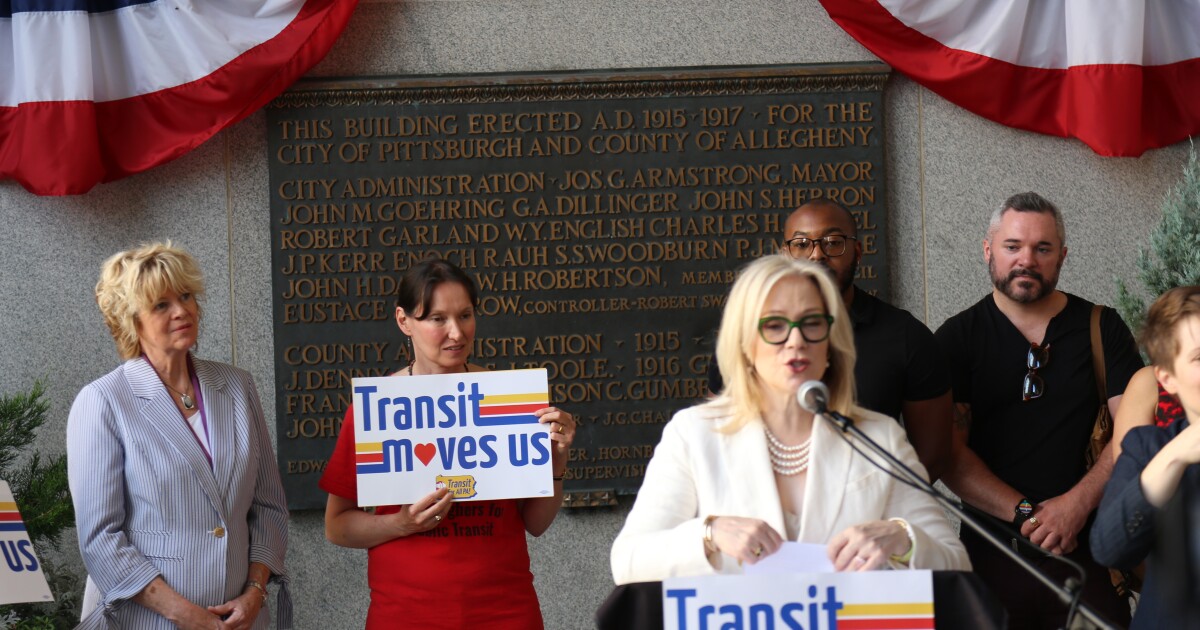
Mayor Corey O’Connor, city and county leaders speak on open enrollment for 750 Downtown City employees into the PRTner Pass Program on Monday, Aug. 3, 2026.
The city of Pittsburgh is the latest and largest organization to sign on to the partnership – and officials hope more organizations join in soon. Entities like schools and housing developments would also be eligible to purchase the bulk passes on behalf of their employees or the people they serve.
“Everybody, every major employer, organization, [and] real estate owner in this city should be investing in this program,” said City Councilor Barb Warwick. “The city of Pittsburgh has set the bar.”
According to Kelsey Shannon, deputy chief of strategic initiatives with PRT, organizations seeking to join the program need only have 10 eligible riders to sign up. Apartment buildings would need to have 10 eligible units. Once they do, they’ll have access to purchase the passes at a more than 70% discount.
Transit advocates helped organize the press conference Monday, after having pushed for years for such partnerships. Cheryl Stephens, community organizing manager with Pittsburghers for Public Transit, called the partnership a “unicorn policy.”
“It enables freedom of movement for working people and grows needed ridership and revenue for our transit system,” she said. “For employers like the City of Pittsburgh, it reduces the pressure and the cost needed for employee parking spaces here Downtown, and supports the recruitment and retention of our hardworking public servants.”
Pittsburghers for Public Transit’s appearance at the press gathering Monday alongside O’Connor marked a sharp contrast from the organization’s recent criticism of a package of tax incentives intended to encourage development Downtown and in adjoining areas of the North Side and Strip District.
The Transit Revitalization Investment District, or TRID, would issue bonds to fund redevelopment, then pay off that debt by using much of the additional property tax revenue created by the development. Some of that money would be set aside for transit-specific purposes, but some advocates criticized the focus on Downtown over other parts of the city.
“Usually TRIDs are building where there is not transit infrastructure,” Stephens said Monday. “We’re not really convinced about how the TRID would be contributing to that.”
But she noted that the bulk pass plan has been a priority of Pittsburghers for Public Transit since long before the TRID was under consideration. She said the advocates hopes more organizations sign on to the initiative.
“The more people on transit, the more riders that we have, the stronger that we can be in saying that transit is a right, it’s necessary,” she said. “We need that investment for all of our futures, whether you ride transit or not.”