
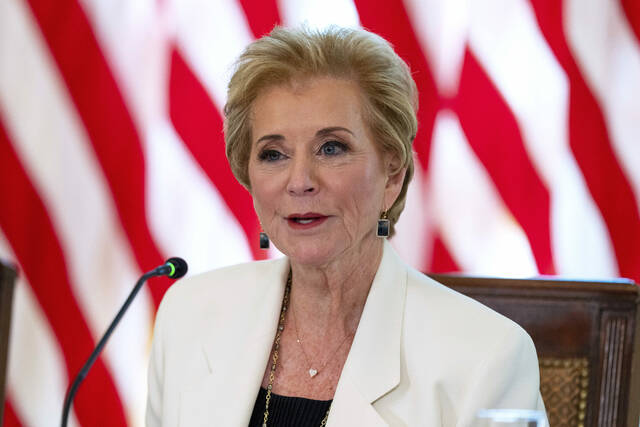
Pittsburgh-area universities are reviewing and planning next steps after the U.S. Department of Education is asking them to agree, in public statements, to reforms involving protests, admissions, tuition and more.
In a letter released Monday, Education Secretary Linda McMahon asks colleges to publicly describe their stances on a variety of issues that include transparency and merit in admissions, free speech and protests, diversity of viewpoints, affordability and student outcomes, academic standards in the age of artificial intelligence, safeguarding research integrity from malign foreign influence, and prioritizing American interests.
The letter represents a second, and milder, effort by the Trump administration to reshape higher education. Last year, the administration proposed the “Compact for Academic Excellence in Higher Education,” which faced pushback from institutions criticizing it as government overreach.
In the new letter, McMahon writes that “bold university reformers will bring excellence and accountability to American higher education. A renewed academy, in turn, will usher in a new era of opportunity, prosperity, and American leadership.”
McMahon requests that colleges respond to questions in the letter by the end of the year. Doing so “is the essential first step toward rebuilding trust in the sector,” she wrote.
Questions include:
“How will your institution ensure that admissions criteria are transparent and wholly described to prospective applicants?”
“How will your institution protect the free exchange of ideas, wide-ranging debate, and open-minded campus discourse?”
“[H]ow will your school ensure the research enterprise is dedicated to advancing knowledge, deepening understanding, and serving the American people who fund it?”
“How will your institution ensure that families can access affordable, high-return, degrees?”
“How will your institution incentivize rigor in the age of AI, combat grade inflation, and prioritize excellence in teaching and learning?”
“How will your school protect academic programs from foreign influence and safeguard the integrity of the research enterprise?”
The current effort from the Department of Education seems to be getting a more positive response than last year’s.
University of Pittsburgh Chancellor Joan Gabel said in a message to staff, faculty and students that the questions themselves “are not unfamiliar.” Pitt seeks input from its community as it thinks about its approach for next steps, Gabel wrote.
“At Pitt, we regularly demonstrate the impact of our mission, our work, and especially our people, to prospective students and their families, research sponsors, patients, alumni, legislators, community partners and the public,” Gabel said, adding much is already documented in the university’s strategic plans.
The university will also communicate with national higher education associations, like the Association of American Universities and the Association of Public and Land-grant Universities. Both organizations offered input while the letter was being developed, Gabel said.
“Public and land-grant universities remain deeply committed to this mission and to delivering on the promise of public higher education,” the Association of Public and Land-grant Universities said in a statement. “We look forward to learning more from the Department of Education about this effort and collaborating to advance shared goals.”
Pitt and Penn State belong to the land-grant association. Penn State spokesman Wyatt DuBois said university leadership is reviewing the letter.
McMahon said that, for centuries, American colleges and universities “were a source of immense national pride,” advancing science and opening opportunities, powering the modern research enterprise and serving “as indispensable repositories of our civilizational inheritance.”
“Yet, as higher education has drifted from the principles that built up so much public esteem, Americans’ trust in universities has reached record lows,” she wrote.
Carnegie Mellon officials are reviewing the letter, said spokesman Chuck Carney.
John Cardone, Carlow spokesman, said his university is reviewing the request and plans to respond by the end of the year.
La Roche spokesman Brady Butler said his university’s administration is reviewing the letter, and communicating with the department“to better understand its implications for higher education.”
“Our mission remains to provide a student-centered education that prepares graduates for rewarding careers, lives of purpose, and service to their communities while keeping that education accessible and affordable, with an actual cost of attendance that is among the lowest of the region’s independent universities,” Butler said. “We will continue to fulfill our mission while complying with applicable federal and state laws.”
Spokespeople for Slippery Rock, Indiana and Pennsylvania Western universities directed requests for comment to the State System of Higher Education. Spokesman Kevin Hensil said the system is committed to affordability, transparency and providing students with a high-quality education.
“We are reviewing the letter together with our university presidents,” he said. “We are excited for the upcoming start of the fall semester and remain proud that our 10 universities provide a high-quality public education that opens doors of opportunity to the people of Pennsylvania.”
Duquesne and Chatham spokespeople did not respond to a request for comment.