
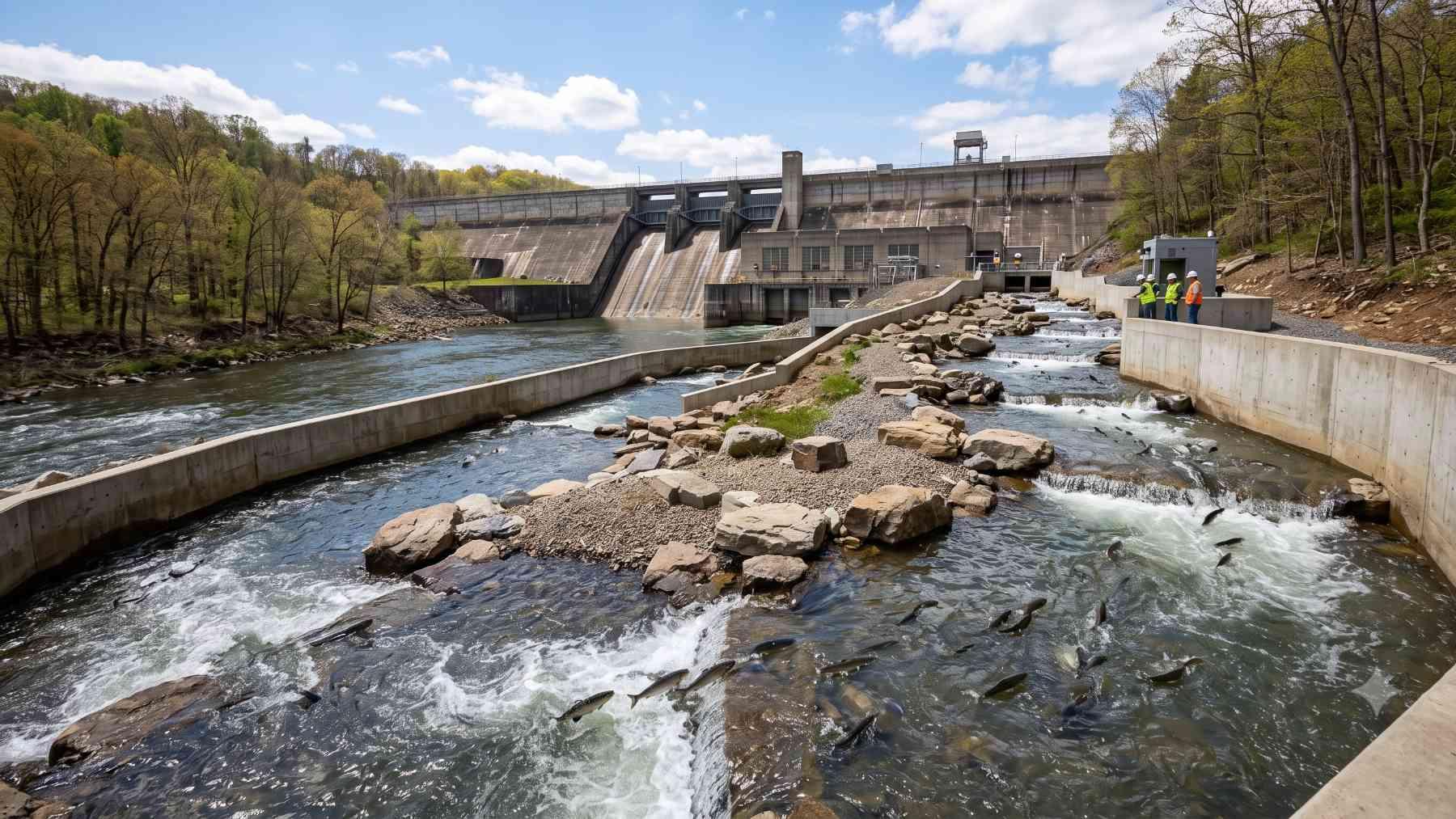
Migratory fish along Pennsylvania’s Susquehanna River have faced the same problem for more than one hundred years.
American shad and river herring are two species that migrate upstream as part of their life cycle. But the York Haven Hydroelectric Project blocks their pathway. Fish needed a way past the dam, but the plant still needed to successfully produce electricity.
Eventually, engineers developed a “nature-like fishway.”
However, did this “fake river” really work?
A dam standing in the way of migratory fish
Under its Federal Energy Regulatory Commission (FERC) license, the plant had to provide upstream passage for migratory fish, including American shad and river herring.
Creating the route was not going to be easy.
The river is almost a mile wide in some locations. Any solution had to handle varying flow conditions, floods, debris, ice, and environmental requirements. Engineers also had to develop the new route around an old dam that had been in operation for decades.
What appeared to be a simple fish-passage project turned out to be much larger and more complex.
Initial plans continually grew and got more complicated
The initial idea was to construct a fishway about 300′ wide within the river. The original plan was expected to require major modifications to the existing dam. As engineering designs continued to evolve and dam safety evaluations proceeded, costs skyrocketed.
The structure also had to withstand extreme river conditions and meet environmental requirements.
Related
The Kleinschmidt Group worked closely with federal and state resource agencies throughout the project.
Alternative options continued to be evaluated as designs evolved.
Throughout construction, Kleinschmidt helped oversee the project as the owner’s engineer.
The goal remained the same: help fish move upstream while allowing the hydroelectric plant to keep generating electricity. Additionally, the new system had to be constructed within the existing dam. That meant the fishway was being built inside an old hydroelectric facility.
They also had to work within infrastructure that was already more than a century old.
Finding a design that satisfied both requirements proved far more challenging than originally envisioned.
The “fake river” was constructed and completed
Ultimately, the solution was to build a new nature-like fishway. The final design was about 60% narrower than the original proposal while still meeting requirements.
Construction was ultimately completed at the York Haven Hydroelectric Project. The finished structure marked a major milestone for fish-passage efforts in the Susquehanna River watershed.
The project fulfilled a fish-passage requirement under the facility’s FERC license.
The completed system was built to provide fish passage without shutting down hydropower generation.
Related
During construction, extremely low river flows allowed a different construction approach while still protecting water quality.
The unanswered question after construction
There is no doubt from reading the available literature that the fishway was completed. It currently provides an upstream passage route for migrating fish. It also allows the hydroelectric plant to continue generating renewable electricity.
The system was intended to help fish move more freely through the river while maintaining power generation.
It was also designed to support both migratory and resident fish species.
Unfortunately, however, none of the available literature reports any monitoring data. The available information does not show whether fish have used the new passage for upstream migration. Therefore, we cannot confirm if fish are using the passage successfully.
Although the solution has been developed and installed, we do not know if it works.
This question will likely be asked again by hydropower operators throughout North America. Older dams are increasingly being forced to improve habitat connectivity or continue producing renewable energy.
Projects like York Haven are not the only ones trying new ways to reconnect migration routes, and in Connecticut, engineers are testing a system designed to help migratory fish move past a dam.