
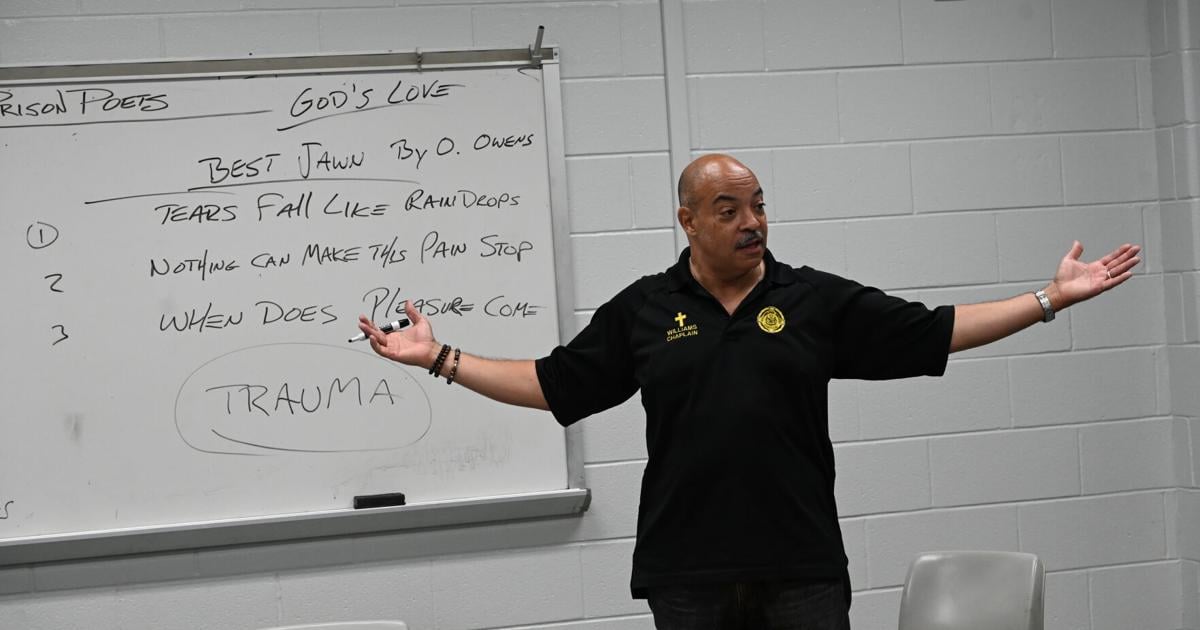
Seth Williams entered the makeshift classroom at Curran-Fromhold Correctional Facility in Northeast Philadelphia — one of four such facilities within city limits and 85 throughout the state — with the calm and hope of a seasoned pastor. His black pullover, marked with “CHAPLAIN” in bold yellow letters, was both a badge and a reminder. Williams had lived on both sides of the law. He was celebrated, disgraced and changed by his experiences.
Few people would choose the journey from Philadelphia’s first Black district attorney to a federal inmate and then to a prison chaplain. Yet here, where the air smells of cinder block and disinfectant, Williams has built something new.
Each Thursday Williams, 59, leads the Prison Poets class, gathering men with different sentences and stories. They meet in a bright gray room with chalk dust and a few empty bookshelves. Across the hall, behind thick glass, the sounds of prison industry continue as men were making stationery for the same city that once had Williams’ name on its letterhead.
Williams greeted the group of inmates with handshakes, hugs, and a wide smile. His arrival felt like an event, giving everyone permission to relax. Officers and officials, even the warden, welcomed him with hugs, handshakes, and jokes. Williams smiled back and greeted many by name.
Former Philadelphia District Attorney Williams once stood as the city’s top prosecutor. Today, he walks the halls of Philadelphia’s prisons offering spiritual guidance to the incarcerated, a role he said was shaped by his own fall from power, time behind bars and a transformative journey of faith.
Williams, the first African American elected as the city’s district attorney in 2009, recently was named director of chaplaincy and religious services for the Philadelphia Department of Prisons.
The appointment marks another chapter in a career that has included service as a criminal attorney, the city’s inspector general and a U.S. Army Judge Advocate General officer.
For Williams, however, the path to prison chaplain began with one of the darkest periods of his life.
In June 2017, Williams pleaded guilty to a federal corruption charge and resigned as district attorney. He admitted accepting cash and gifts, including a Caribbean vacation, from a businessman in exchange for official favors. Although he expected to remain free on bail until sentencing, a judge immediately revoked his bail.
Williams was handcuffed in court and taken directly into federal custody.
“I lost everything in one day,” he told The Philadelphia Tribune. “My house, my car, my pension, my law license, my reputation, time with loved ones, everything.”
A federal judge sentenced Williams to five years. He served nearly three before being released in 2020.

Seth Williams conducts a Prison Poets session about haiku at Curran-Fromhold Correctional Facility in Northeast Philadelphia. The former Philadelphia district attorney now serves as director of chaplaincy and religious services for the Philadelphia Department of Prisons, where he helps incarcerated men develop communication and life skills through creative expression. —TRIBUNE PHOTO/ABDUL R. SULAYMAN
‘When I was in prison’
For the next two hours inside the makeshift classroom at Curran-Fromhold Correctional Facility, the 11 men in Williams’ class — usually there are 14 — could let go of the defenses prison requires. They recited their creed: “Behind us are the challenges we met; before us are new possibilities. Today we choose the direction of our lives.”
For a moment, possibility felt real.
To Williams, poetry is a powerful tool. He begins each session with haiku — 17 syllables, three lines — a small act of order during chaos. “A haiku,” Williams says, “expresses much and suggests more in the fewest possible words.” He reminds the men that even the smallest cell cannot confine the mind. As they write and share their work, the mood in the room changes.
Handshakes. Hugs. Fist bumps.
“Good morning,” Williams bellows. “Good morning,” the 11 respond as if they were a chorus.
One inmate skipped someone in the greeting line. Williams laughed.
“You forgot your only line,” the man now known as “Chap,” quipped.
Laughter filled the room. For a few moments, it felt less like jail and more like a classroom where everyone knew each other’s name.
“So why do we always start class this way?” Williams asked after everyone settled into their seats.
“Respect,” one inmate answered.
“What else?” Williams retorted. “It shows respect,” the inmate stated, and Williams nodded.
“When I was in prison,” Williams relayed, “I never saw so many grown men go out of their way to be polite to each other.”
He paused. “And why?” he asked.
“You don’t want conflict,” the inmate correctly answered.
Another inmate laughed. “You don’t want to get stomped,” he noted.
More laughter. Williams smiled.
“If we practiced those same skills outside these walls,” he said quietly, “we probably wouldn’t be here.”
The class is called Prison Poets, but poetry isn’t their main focus.
For almost an hour, the men focus on life skills. One serves as facilitator. Another gives the weather. Someone delivers sports. Another reports the news.
Each person stands in front of the class. Everyone practices speaking clearly, making eye contact, and accepting feedback without getting defensive.
“I learned while I was incarcerated that about 85% of what helps people keep a job has nothing to do with the actual work,” Williams told them. “It’s showing up on time. It’s how you treat people. It’s how you respond when somebody makes you angry.”
The lesson, he said, isn’t simply about employment.
It’s about getting by and surviving.
“If we can teach people conflict de-escalation,” he said, “we can help them keep jobs. We can help them stay out of prison.”
The men then stood together to recite the class creed, words they knew by heart.
Seth Williams speaks with participants during a Prison Poets class at Curran-Fromhold Correctional Facility in Philadelphia. The weekly program combines creative writing, personal development and conflict de-escalation lessons for incarcerated men.
—TRIBUNE PHOTO/ABDUL R. SULAYMAN
—TRIBUNE PHOTO/ABDUL R. SULAYMAN
Pursuing a doctorate
As director of chaplaincy and religious services, Williams oversees pastoral care, spiritual programming and interfaith services throughout Philadelphia’s correctional facilities. The office coordinates clergy members, religious volunteers and counseling services intended to support incarcerated individuals.
His responsibilities range from leading Bible studies and recovery groups to helping inmates process devastating personal news.
“Sometimes I have to tell people their mother died or their brother was killed,” Williams said. “Other times, I’m helping someone through depression, grief or anger. I just try to spread hope and joy where I can.”
Williams’ interest in prison ministry evolved long before he officially joined the department. Several years ago, he launched a consulting firm focused on helping military veterans and formerly incarcerated people successfully reenter society. He also volunteered within the prison system before being selected for his current position in June.
His work now intersects with his academic pursuits. Williams is pursuing a Doctor of Ministry in Spirituality, Leadership & Justice at Union Theological Seminary in New York, where he plans to focus his dissertation on the relationship between spiritual formation and recidivism reduction.
Reducing repeat offenses has been a passion throughout his career as a prosecutor, defense attorney and reform advocate.
Williams cites research suggesting that consistent participation in faith-based programming can significantly lower recidivism rates. While education, job training and substance-abuse treatment remain critical, he said he believes spiritual development can play an equally important role.
“Learning and practicing your faith has a significant impact on reducing recidivism because it helps people understand forgiveness, reconciliation, hope and love,” Williams said.
His perspective is informed not only by academic study but also by firsthand experience inside prison.
“Despite having been a lawyer, a prosecutor and a defense attorney, it wasn’t until I found myself incarcerated that I actually saw what goes on inside prisons,” he said. “It opened my eyes.”
Seth Williams checks on an inmate at Curran-Fromhold Correctional Facility while delivering religious materials. As director of chaplaincy and religious services for the Philadelphia Department of Prisons, Williams provides spiritual guidance and support to incarcerated individuals throughout the city’s prison system. —PHILADELPHIA DEPARTMENT OF PRISONS PHOTO
Solitary confinement
Back in the classroom Williams calls on student Joseph Reed.
“My gratitude list is always simple,” Reed began as several inmates smiled. They had heard this before.
“The sun shining in my cell,” he posits.
The smiles disappeared. “Water,” he says. Another pause. “People to talk to.”
Williams leaned on a desk.
“Every week he says the sun,” the chaplain said. “When I was in solitary confinement, I spent five months without feeling sunlight.”
Williams remembered the narrow strip of sky he could barely see from an outdoor recreation cage and writing letters to his daughters.
“I’d tell them, ‘Next time it rains, go outside,” he recounted. “Stand there. Let the rain hit your face. Then write me and tell me what it feels like.’”
The room was quiet as Reed explained why gratitude had become so important.
“I’m a negative person,” he said. “I struggle with depression.”
There was a time, Reed admitted, when addiction had left him homeless and alone.
“I thought about killing myself every day because I didn’t think anybody cared if I lived or died,” he remarked.
No one seemed surprised, and no one judged Reed for it.
Across the room sat Ronald Woodward. Thirty-one years old. Five months into his incarceration.
Earlier, he had laughed with everyone else, applauded every presentation, and joked with classmates. Now, his face changed.
He said his social worker encouraged him to join the class after learning what had happened in his life. His mother died of a drug overdose when he was 7 years old.
Years later, after building a family of his own, another betrayal broke him.
“My wife of 10 years had an affair with my father,” he said quietly, redness swelling beneath his eyes.
For several seconds, no one moved.
The room that had been full of laughter moments earlier was now silent.
“You think you’ve survived everything,” Woodward said. “Then the people you love the most hurt you the most.”
An inmate across the room softly shook his head. “That’s enough to break anybody,” the classmate acknowledged.
Williams didn’t interrupt or preach.
Finally, he looked at Woodward. “But you’re still here,” Williams reassured.
“I’m trying,” the devastated prisoner admitted.
Later, Woodward explained why he keeps coming back every week.
“If Seth can do it,” he said, “I can do it.”
Woodward said he hopes the class will help him rebuild his construction business, repair broken relationships and avoid making the same mistakes.
“It’s giving me tools,” he said. “It’s giving me hope.”
Seth Williams listens as an inmate shares his work during a Prison Poets class at Curran-Fromhold Correctional Facility in Philadelphia. Williams leads the weekly program, which uses poetry, discussion and personal reflection to encourage growth and accountability among participants. —TRIBUNE PHOTO/ABDUL R. SULAYMAN
Federal prison shakedown
Williams said he knows what hopelessness feels like.
He told the class about a federal prison shakedown during which officers handcuffed him, dumped his letters across the floor and confiscated the books that had become his escape, including his Bible.
“It was the first time I cried in prison,” Williams said.
He asked the men what would have happened if he had attacked the officer.
“They would’ve beat you,” they said, almost in unison. “They would’ve added time.”
Williams then asked a question.
“So, what was I really in control of?”
Before anyone answered, he did.
“My response,” Williams argued.
That lesson surfaced again after an officer confiscated one inmate’s pen before class.
“What were you thinking?” Williams asked.
“I was mad,” the inmate responded.
“What stopped you?” Williams again asked.
“My daughters,” the young man stated.
He said he realized that getting angry could mean more time in jail and more time away from the people waiting for him outside.
“So, I let it go,” he offered.
“That’s conflict de-escalation,” he said.
Symbol of comfort
During his incarceration, Williams immersed himself in educational and mentoring programs. He taught GED classes, workforce development courses and poetry. He learned to play the saxophone and eventually performed “Amazing Grace” during an Easter Mass.
One achievement remains especially meaningful to him.
“Nineteen of the men I taught earned their GEDs,” he said. “That’s one of the accomplishments I’m most proud of.”
His experiences behind bars also inspired two programs he later developed for incarcerated individuals: Career Keepers, which focuses on employment readiness; and Prison Poets, a creative-writing initiative.
Williams said successful reentry depends on a combination of education, treatment and personal transformation.
Drawing on lessons learned through an Eisenhower Fellowship that took him to Australia and South Africa to study restorative justice, he said the most effective strategies for reducing recidivism include educational attainment, substance-abuse treatment and strong spiritual support systems.
Now, instead of prosecuting defendants, Williams finds himself serving people who often are experiencing the worst moments of their lives.
His chaplain’s shirt has become a symbol of comfort for many inmates.
“People get excited when they see that word ‘Chaplain’ on my back,” he said. “Whether someone is Christian, Muslim, Jewish, another faith or no faith at all, they know there’s someone they can talk to.”
Moments after finishing his interview with The Tribune, Williams said he was preparing to meet with an incarcerated man whose brother had recently been murdered.
Those moments, he said, remind him why he accepted the position.
“When I was in prison, it didn’t matter whether it was a rabbi, a priest or an imam walking through the hallway,” Williams said. “You knew that was someone you could talk to and bare your soul to. I just try to be that person now.”
‘The greatest title’
Finally, it was time to write inside the Prison Poets classroom. Nate Williams stood and unfolded his paper.
“My poem is called ‘Respect,’” he said, reading slowly.
Like leaves carried by the breeze.
The room filled with applause.
“I think the publisher of The Tribune would print that,” Seth Williams joked.
Soon correctional officers were back at the door.
One by one, the men picked up their notebooks, shook hands again, and walked out through another set of steel doors.
Seth Williams stayed behind, stacking his lesson plans before heading across the prison. One inmate waited for news about his child being taken off of life support, and another needed help coping with the loss of a loved one.
Williams said he never imagined this would become his life’s work.
“Every morning,” he said, “I ask God to use me however He sees fit.”
He looked around the empty classroom.
“Other than being called Dad,” he said, “the greatest title I’ve ever had is chaplain.”
Stay informed and connected — subscribe to The Philadelphia Tribune NOW! Click Here