
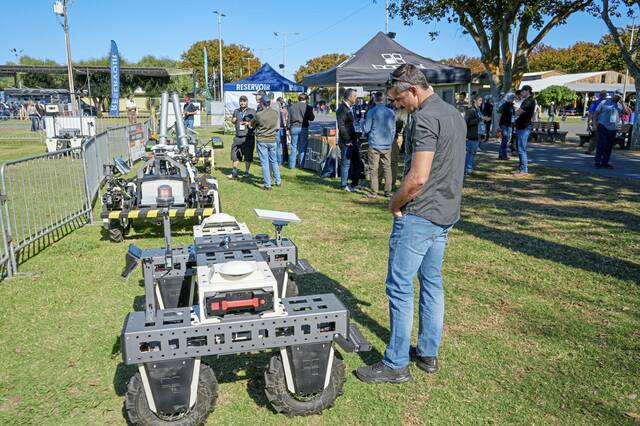
Pittsburgh has become a hotbed of robotics and tech development in recent decades, but you do not have to venture far outside the first-ring suburbs before you hit farmland.
Those two worlds have connected, with companies such as Caterpillar and John Deere working with Carnegie Mellon University robotics researchers over the past several decades. Organizers at the Forum International de la Robotique Agricole, or FIRA, want to connect local robotics companies with the farmers who live only a short drive away.
“Something like a multimillion-dollar John Deere combine is for a big commercial farm,” said Kevin Dowling, managing director at The Robotics Factory in Pittsburgh’s Lawrenceville neighborhood. “The average farm size in Pennsylvania is 250 to 300 acres, and we want to think about how we can get technology into their hands.”
To that end, Dowling and others arranged to bring FIRA’s Robotics Village to the eastern side of the U.S. for the first time. It will be part of Penn State Ag Progress Days from Tuesday through Thursday at the Russell E. Larson Agricultural Research Center in Ferguson Township, Centre County.
The right matchmaking
“We want to develop machines that are affordable for farmers and develop systems to help them in all aspects of their business,” Dowling said. “There are a ton of companies here in Pittsburgh, spun off from Carnegie Mellon and elsewhere, that are really growing — no pun intended.”
Among the technologies on display will be an autonomous robot that works alongside people by carrying, following or towing materials to improve efficiency in production environments, as well as an autonomous tomato-harvesting robot.
“The FIRA Robotics Village reflects the future of agriculture and Penn State’s commitment to bringing together research, innovation and industry to address global challenges,” said Gretta Tritch Roman, senior director of research development and initiatives at Penn State’s College of Agricultural Sciences. “By connecting farmers, researchers, technology developers and ecosystem partners, we are creating opportunities to accelerate solutions that improve agricultural productivity, sustainability and resilience while strengthening the workforce for generations to come.”
Additionally, the exhibit will feature presentations and panel discussions, including farmer-to-farmer insights on robotics in agriculture, the role of dealerships in deploying agricultural robotics and growing adoption, research lightning talks by faculty from various universities and short pitch sessions by companies represented within the Robotics Village.
“Growers are looking for reliable, field-ready solutions that truly address their operational challenges,” said Maialen Cazenave, co-director of Global Organisation for Agricultural Robotics. “The key is not more technology, but the right matchmaking, connecting the right solutions to the right needs to accelerate real adoption and impact in the field.”
FIRA’s events are primarily held in Europe. After attending one in France and later in Sacramento, Calif., Dowling and others began working to persuade organizers to bring it to the East Coast, and to Pennsylvania in particular.
“In no other place could you get 40,000 to 50,000 farmers, growers and producers looking at technology and equipment and providing feedback,” he said.
What do local farmers need?
Joel Milowicki, 42, who grew up in a farming family and grows produce at his Mt. Pleasant Township farm, had one main question for Cazenave, Dowling and others: How would he be able to afford the addition of robotic technology to his farm?
“I’m in a unique situation where my grandparents left the farm to me and my uncle, and it was done through a limited-liability corporation and we didn’t have to pay an inheritance tax,” he said. “I’m very lucky that I’m not paying a farm mortgage. But even with that, if we have extra money left over, I’m much more likely to spend it on upkeep at the farm than on technology.”
If money were no object, Milowicki said, a robot that could sort crops, or could identify and pull weeds, would be helpful.
“I’ve seen robots that look kind of like a lawnmower but with no handlebar, and they go up and down the rows pulling weeds,” he said.
Farmer Neil Palmer, 48, of Unity said one piece of technology that does seem to be growing more popular is drones, but he has not found the need to buy one.
“If I was doing 20 acres of just tomatoes, I could see how a robotic device would be useful,” he said.
When Palmer and a few thousand colleagues attend the annual Mid-Atlantic Fruit and Vegetable Convention in Hershey, however, he does not see many companies showcasing agricultural robotics.
“I see it a lot in the trade magazines, but I can’t say that I’ve ever read anything that’s compelled me to look into it very far,” Palmer said.
Palmer is a fourth-generation farmer, growing produce on about 20 acres.
“I think I might be too small,” he said. “But at the huge winter shows, there are exhibitors from Pennsylvania and all the neighboring states, and precious few of them are showing robotics equipment.”
Milowicki said affordability is the main thing preventing local farmers such as him from connecting with technology created by businesses like The Robotics Factory.
“Farmers don’t want another low-interest loan,” Milowicki said. “And we don’t necessarily need a government bailout. We need people to realize that they can’t buy a box of tomatoes for the same price they paid in the 1970s.”
Milowicki said even something as simple as the cardboard boxes he uses to pack produce have gone up significantly in price.
“Those were $1 when I started — now they’re $4,” he said.
Milowicki said it would be great if there were a way to provide more help to farms of his size — the stated goal of FIRA Robotics Village organizers — but also said that has not been his experience in the past.
“What I’ve learned after 42 years around agriculture is it’s the suppliers — the people who supply fuel, fertilizer, boxes, seed, new technology — that make the most money in this industry. The farmers themselves make very modest pay compared to the suppliers. But we feed this country.”
• • •
Learn more
What: The FIRA Robotics Village
Where: At Penn State Ag Progress Days at the Russell E. Larson Agricultural Research Center, 2710 West Pine Grove Road in Ferguson Township, Centre County.
When: Tuesday through Thursday
Details: AGSCI.psu.edu