
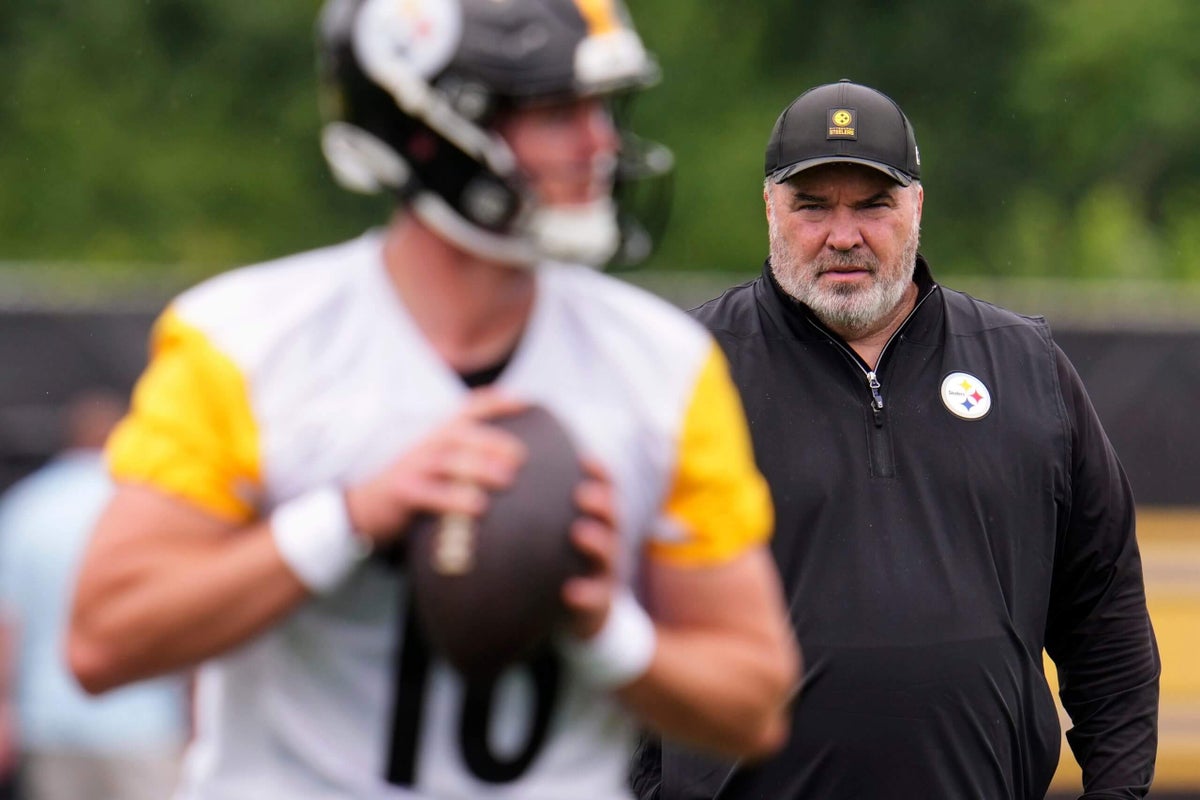
Each grainy VHS tape in Mike McCarthy’s collection is like a time capsule, documenting different moments in a career dedicated to coaching quarterbacks. One clip shows Joe Montana, clad in Kansas City red and gold gym shorts, hopping from side to side over a bag. On another from Green Bay, Brett Favre throws on the run into a multi-colored net. There’s one of Rich Gannon jumping rope in a square and another of Jake Delhomme putting a ball around and between his legs in a figure-eight.
Shortly after the Steelers drafted Drew Allar, McCarthy dug into his archive and sat the rookie down in front of a flickering screen. Allar watched a 23-year-old Packers QB hold the ball up near his ear while taking robotic-like dropbacks. This is what Aaron Rodgers looked like entering his second NFL season in 2006, when McCarthy arrived in Green Bay.
McCarthy enrolled Rodgers in an intensive offseason program that the coach calls “The QB School.” Beginning in late February or early March, the quarterbacks arrived at the facility at 7 a.m. for weight lifting, followed by meetings, on-field work and more meetings.
“It was a crazy workout back then,” Rodgers said. “You’re doing stuff you don’t normally do, like jump rope, which I think is a really important footwork thing. There’s quick feet (drills). Then, the drill work, we’re throwing on the run from different angles and different targets.”
Rodgers (who still holds all the timed records) was officially the last quarterback to complete the classic months-long, all-day version of McCarthy’s QB school. When the 2011 collective bargaining agreement was ratified, it limited the amount of time coaches are permitted to work hands-on with players during the offseason. However, in Phase 1 of the offseason program, Steelers second-year QB Will Howard and veteran backup Mason Rudolph got a taste of the same timed drills: side-to-side jump ropes, step-ups and basketball-like ball handling. They affectionately nicknamed it the “QB Olympics.”
How McCarthy brought Rodgers back to Pittsburgh — and vice versa
Mike DeFabo
“The QB school, whatever he’s calling it now, is not what it was back then,” Rodgers quipped. “They missed out on the real work back then when the rules were different.”
The new rules have forced McCarthy to evolve his approach. Still, the same drills that former Pitt coach Paul Hackett taught when McCarthy was a graduate assistant from 1989-1992, the same fundamentals that helped unlock Rodgers’ Hall of Fame upside, are on display on a practice field at Saint Vincent College. Allar and Howard are the two newest students.
“It’s fundamentals over scheme, particularly early on in the development process,” said Steelers QB coach Tom Arth, who went through the old QB School alongside Rodgers in the mid-2000s. “Just pure fundamentals of playing the position. Which, at the end of the day, that’s what allows you to be accurate and what allows you to throw with velocity.”
The first steps of the developmental process were carefully documented and dissected on what McCarthy calls a profile tape. Just as McCarthy did with Rodgers, the coach filmed Allar, Howard and Rudolph from several different angles: One shot with the QB moving away from the camera, one going toward the camera and one from the side.
Every part of QB play is analyzed. How they carry the ball. How the quarterback draws the ball back. The point of release. The follow-through. Head placement. Arm angle. Flick of wrist. The way the ball looks coming out.
“Everything that he teaches, everything that he coaches is so intricately detailed,” Howard said. “Things in my footwork or in my ball handling that I haven’t even thought about, he brings up.”
Above all else, footwork is always the biggest point of emphasis. In an offense with West Coast roots, the steps of a quarterback’s drop are married to the depths of the receivers’ routes. McCarthy works to ensure quarterbacks are dropping straight back on the mid-line. He evaluates the depth of each step. The timing. The rhythm.
“I haven’t been around anyone who’s been more meticulous,” Rudolph said. “I remember my first few years here. It was kind of like, ‘Do whatever you want for your footwork. Don’t look at Ben (Roethlisberger) because Ben does his own thing.’ He’s very fluid. Sometimes he won’t do the same footwork twice with the same throw just because he’s a different kind of player, kind of a backyard player.”
Every step of the five-step drop has a specific name and purpose:
The drop is initiated by a “punch” with the left foot. Rudolph said he used to simply turn his foot and pivot. But McCarthy, who believes in an athletic and even stance, places an emphasis on doing work early in the drop to get away from the line of scrimmage with a strong punch.
1) Reach: The true first step is the reach step, with the right foot. The QB opens his hips and creates separation from the line of scrimmage.
2) Crossover: The second step, with the left foot crossing over the right.
3) Control step (or Heel-toe): Again, the QB opens up and heel strikes to create more separation from the line, something that was a major change in Rudolph’s mechanics.
4) Dig and 5) Plant: The final steps of the drop; McCarthy often tells his QBs “4-5, 5-4” on the final steps to get them back in position to make a throw.
“The initial part of the drop is where we’re trying to create separation from the line of scrimmage,” Arth said. “Then, at the top of the drop, now we’re trying to get our feet back in position where we’re in balance and we’re capable of making a throw anywhere on the field.”
McCarthy refers to the drop back as a “dance,” in which the QB is moving with flow and rhythm. For both of the Steelers’ young quarterbacks, refining their footwork will be critical. For Howard, who was dinged during the pre-draft process for his arm strength, generating more power from his lower body will help add some necessary zip. For Allar, the most common criticism was that he had inconsistent (and sometimes sloppy) footwork, along with limited experience playing under center.
“The biggest thing with me was not being on my toes in my drop,” Allar said. “Coach McCarthy always says ‘feet in the ground.’ I felt like that helped me play with a wider base consistently.”
On the practice field at Saint Vincent College, The QB School begins when the rest of the team is still stretching. It continues during special teams work and during individual periods.
One common drill is the “build-a-drop,” in which they put together a five-step drop one step at a time. Punch. Then punch-reach. Then, punch-reach-crossover. Then, punch–reach–crossover–heel-to-toe. Many times, they’re just doing punch-reach over and over, in an exaggerated way.
“That’s the thing that I love about QB school, is that you never really can get away from the first step of your drop,” Howard said. “We’re working it every single day. It seems simple. We’re NFL players, but it’s really important, and it really does add up in those little things.”
While quarterbacks work with private coaches in the offseason, many NFL coaching staffs assume the fundamentals are already built in at this level; the Steelers didn’t even employ a quarterbacks coach during Rudolph’s first two years in the league. That a head coach is drilling quarterbacking minutiae is what makes McCarthy’s approach truly unique.
“Most guys don’t get taught proper footwork and proper technique in college, and they certainly don’t get taught in the NFL,” said Ben DiNucci, who went through McCarthy’s QB School in Dallas and now works as an analyst for CBS Sports. “Coaches don’t have enough time, there’s so much other stuff that they’ve got to worry about. I played six different (NFL) teams. Mike was the only one who really hammered that stuff.”
McCarthy makes a point of being the coach standing behind quarterbacks, giving them on-field instruction. He’s in almost every meeting with them after practices. And when they watch the “QB School” segments on film, the head coach is focused on the smallest nuances.
“A lot of people can preach they’re about the quarterback and quarterback fundamentals, but if you never talk about it in the meetings, sometimes that doesn’t really correlate,” Allar said. “We definitely emphasize the very small details.”
It might not be the same QB school that Rodgers enrolled in back in 2006. But this attention to detailed fundamental work and the way McCarthy structures training camp days to give the staff time to focus on development are what separate it from others.
“The most important thing is the time devoted to quarterback training,” Arth said. “There’s a lot of great coaches in the NFL, and everybody’s coaching the quarterbacks at a high level in this league. But I don’t think that everybody has the same amount of time to do that work. Coach (McCarthy) makes it a priority in our schedule.”