
Northeast Pennsylvania counties have yet to register a confirmed case of measles despite cases statewide climbing to 232 as of Monday, with 57 new cases confirmed over the week prior, state Department of Health data shows.
Hospitals and health systems in the region are prepared for potential measles cases, doctors said Tuesday. They said the measles, mumps and rubella (MMR) vaccine remains the best way to protect against the highly contagious viral respiratory disease that’s surging in parts of Pennsylvania and elsewhere after the state recorded just 16 cases all of last year.
“MMR is really a time-honored vaccine with proven efficacy and a proven safety record,” said Gary Decker, M.D., director of infection control services for Commonwealth Health’s hospitals in Lackawanna and Luzerne counties. “It really has been able to essentially eradicate measles as one of the common childhood illnesses as long as we have greater than 95% acceptance of the vaccine.”
State year-to-date statistics show that none of the 232 people confirmed to have contracted measles were fully vaccinated against the disease that has hospitalized 38 in Pennsylvania but resulted in zero deaths so far in 2026. State data that will be updated again Wednesday afternoon shows minors under the age of 18 account for 35% of the measles cases confirmed statewide.
Measles infections can be dangerous, especially for babies and young children, and can cause pneumonia, brain swelling and even death in severe cases, according to the U.S. Centers for Disease Control and Prevention. Common symptoms of the disease, which has become less uncommon in recent years amid declining vaccination rates, include high fever, cough, runny nose, red and watery eyes and rash breakouts, per the CDC.
The organization also warns the virus can linger in the air for two hours after a measles-positive person leaves a space, noting about “9 out of 10 people who come near a person with measles and are not protected by vaccination will also become infected.”
Lancaster County remains the hardest hit in Pennsylvania, accounting for 133 cases this year, followed by Chester County with 23, Lebanon County with 20 and York County with 12. Chester, Lebanon and York counties border Lancaster County, with those four southeast and south-central counties collectively accounting for the majority of Pennsylvania’s measles cases. Only 12 of the state’s 232 total 2026 cases predate April, with the number of new cases increasing each of the past four full months from three in April to 87 in July alone.
None of Lackawanna, Luzerne, Monroe, Pike, Susquehanna, Wayne or Wyoming counties has had a confirmed measles case yet this year, nor has Schuylkill County, though cases have been confirmed in five of the eight counties that touch Schuylkill’s borders. Officials with Geisinger and Commonwealth Health, the local health system acquired earlier this year by the nonprofit Tenor Health Foundation, said their respective teams are ready should Pennsylvania’s measles situation worsen and cases emerge in the region.

The MMR vaccine sits on table in an exam room in the Scranton Primary Health Care Center in Scranton Tuesday, August 11, 2026. (SEAN MCKEAG / STAFF PHOTOGRAPHER)

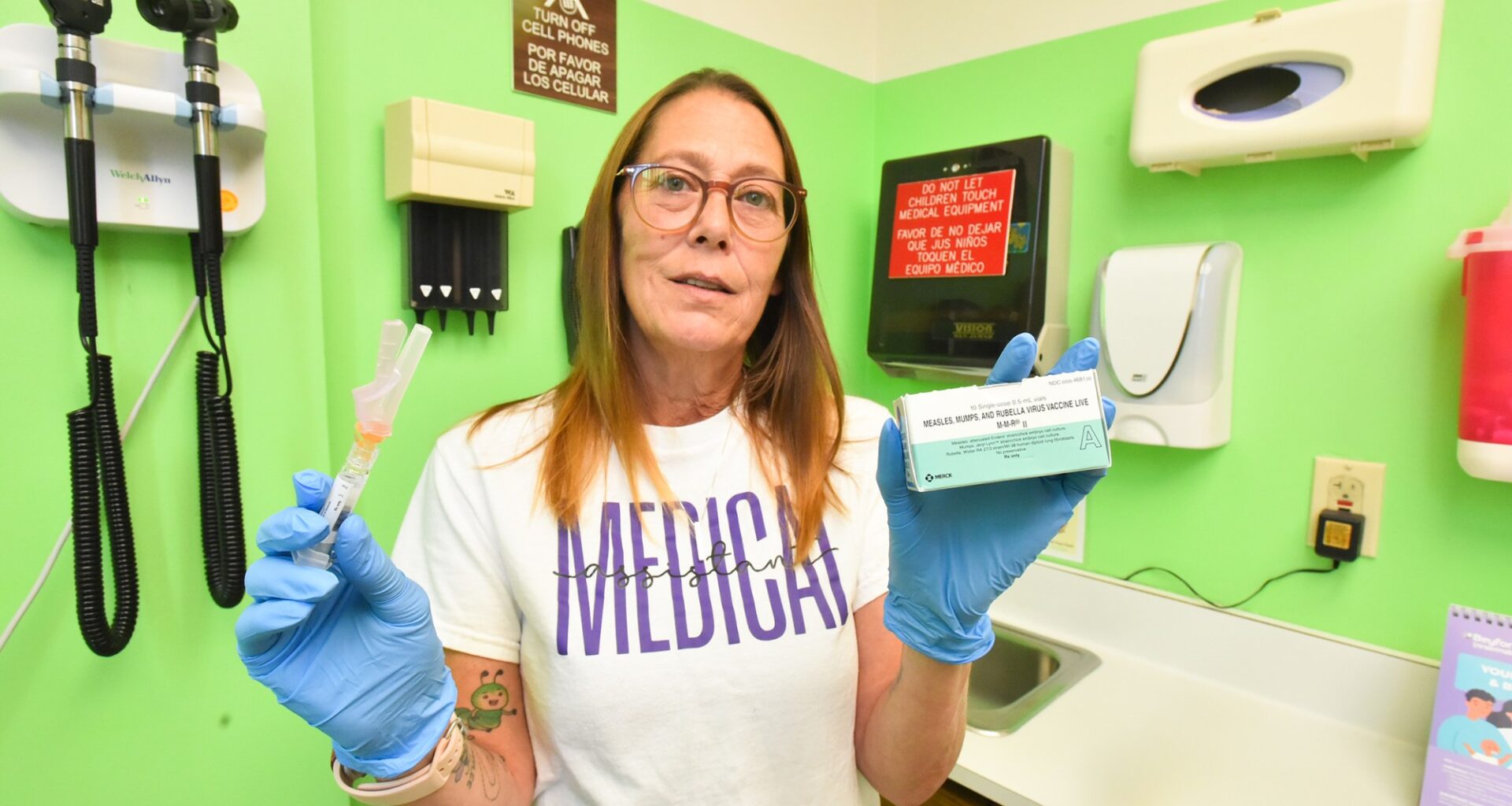
Medical Assistqnt Dawn Dunleavy holds up a syringe with the MMR vaccine in an exam room in the Scranton Primary Health Care Center in Scranton Tuesday, August 11, 2026. (SEAN MCKEAG / STAFF PHOTOGRAPHER)
Show Caption
1 of 2
The MMR vaccine sits on table in an exam room in the Scranton Primary Health Care Center in Scranton Tuesday, August 11, 2026. (SEAN MCKEAG / STAFF PHOTOGRAPHER)
Geisinger encourages its workforce to be vaccinated against measles and works to ensure staff are vigilant about potential measles symptoms in patients, such as fever and a rash, Geisinger Infectious Disease Specialist Mark Shelly, M.D. said. When Geisinger identifies a measles case it puts the patient in a “high-airflow room with a negative pressure,” where flowing air is pulled out of the room, he said.
“We were very used to, with COVID, doing airborne precautions, so we’ve got that in place,” Shelly said. “Once we identify a case, I think we’re in good shape, and identifying a case means ‘hey, this is somebody I’m really worried has disease.”
Decker said Commonwealth Health’s hospitals have specific infection-control plans in place to deal with suspected measles cases.
“We put a special plan in where that patient, from the time they basically come into the hospital until the time they’re discharged, is placed in a higher level of specific isolation so we provide all of our other patient contacts … with the best level of protection against exposure,” he said. “There are multiple levels of isolation in the hospital. The highest level of isolation is what we call airborne isolation precautions, and that’s what we would use for a patient with measles.”
It’s not clear whether or when local hospitals might have to grapple with measles.
“I don’t think at this point in time that we have a tremendously heightened level of concern,” Decker said, noting most cases in Pennsylvania are still largely limited to a handful of counties in another part of the state. “That being said … we basically have plans enacted, which we always have enacted to grapple with any of these type of outbreaks.”