
ALBANY – It began 30 years ago when artist Len Tantillo made a hasty sketch with a pen on a restaurant napkin.
He drew a long, graceful curve of the historic Hudson River shoreline, a bustling commercial waterfront and Albany Yacht Club’s marina in centuries past. It was known as the Albany Basin, but was squared off, as Tantillo depicted with a thick straight line, and filled in for construction of Interstate 787 in the 1950s and ’60s.
The highway walled off the river and turned downtown’s back on one of the city’s greatest natural assets.
Frustrated by a succession of proposals that quietly died as booklets that collected dust on a shelf without reconnecting Albany to the Hudson, Tantillo flipped the script.
Sign up for the Albany Now newsletter
Keep up with the latest happening in communities throughout Albany County.
Instead of trying to bring the city to the river, why not bring the river to the city?
Tantillo became Albany’s Ahab. His elegant concept to dig a canal to bring the river into downtown was his white whale. For the past three decades, he chased his vision despite naysayers and a long fallow period of disinterest.
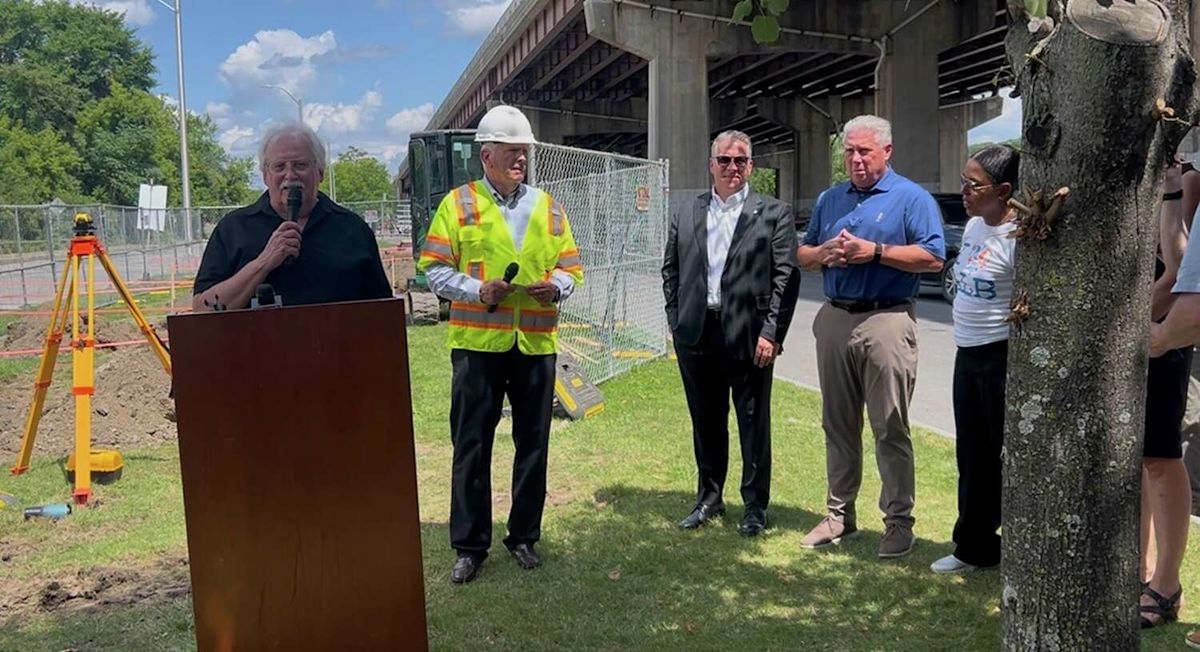
Tantillo was joined at a news conference Thursday with a band of waterway boosters, four elected officials and a few dozen interested onlookers on a small island of grass the size of a two-bedroom apartment along Water Street. High overhead, tractor-trailers and cars rumbled on an Interstate 787 overpass in the shadow of the hulking, crumbling eyesore of Central Warehouse.
Behind him, mounds of dirt were piled around five freshly dug trenches, with thick slabs of Onondaga limestone blocks in pristine condition in each shallow hole.
Beneath two feet of dirt, 200 years of history had been uncovered. Here are the well-preserved, massive stones that created the eastern terminus of the Erie Canal. It made New York the Empire State, the artificial river that transformed America by opening up westward expansion.
Nobody cried, “Thar she blows!” But they should have. Tantillo had harpooned his white whale.
Nobody had touched these 21-foot-tall towers of monumental stones since they were covered with dirt a century ago.
“This really is a dream come true for me,” said Tantillo, who was 50 when he sketched his concept on a napkin. He now has the white hair of an 80-year-old man.
“You should have seen Len out here doing cartwheels,” joked B.J. Costello, chair of Albany WaterWay Inc., a not-for-profit organization with a 16-member board and more than 1,200 Friends of the Waterway. The group is eager to revive the canal as a historic site, tourist attraction and economic driver as has been done with waterways in Buffalo, Providence, San Antonio, Oklahoma City and elsewhere.
Tantillo’s artist’s disposition and resilience earned him the nickname Leonardo. Costello, his co-conspirator, is a force of nature and two years the artist’s senior. He’s nicknamed the Commander. Costello commanded a Navy refueling ship during the Vietnam War and gained prominence in Albany as a lawyer and lobbyist. He is the chair and catalyst of both the USS Slater, the destroyer escort historical museum, and Albany Waterway Inc. He is a bulldog in a Brooks Brothers suit.
Full disclosure: I first wrote about Tantillo’s concept in the mid-1990s, became intrigued, and was invited to join the board. In truth, Tantillo and Costello have done the heavy lifting, including giving illustrated presentations for dozens of community groups to build support. My contribution has been minimal, but it’s been a pleasure observing up close the passion of this small but mighty cohort of civic altruists who want nothing more than to reclaim Albany’s Erie Canal history and leave something of lasting value for the city they love.
Albany County Executive Dan McCoy, no stranger to arm-twisting, relented to the dogged tag-teaming of the Tantillo-Costello dyad. “I went unwillingly. They kept calling me and beat me up,” McCoy said of their two-hour, full-court press. “I’ve seen people go after stuff, but after a while they usually walk away. You’ve been at this for 30 years. You’re not giving up and your passion really resonated.”
McCoy met recently with the owner of Modern Press, an adjacent printing facility built over the former Lock 1, to discuss purchasing the property to move the project forward. “We have to help them get there,” McCoy said, whose Advance Albany County Alliance provided an $85,000 grant to the waterway group for an engineering feasibility study, completed by Clough Harbour.
The politicos reached for superlatives to describe the group’s collective effort and noted the mantra of waterway board member Chet Opalka: Collaborate, collaborate, collaborate.
State Sen. Pat Fahy, an Albany Democrat, invoked Mahatma Gandhi and paraphrased the great Indian leader’s quote about never doubting that a small group of thoughtful, committed citizens can change the world. She added, “Just as Gov. Clinton was dismissed a couple hundred years ago for ‘Clinton’s ditch,’ I know you were dismissed for years.”
“We all have one common goal and that is to move Albany forward and to create a capital city we all can be proud of,” Albany Mayor Dorcey Applyrs said. She referenced the Rev. Martin Luther King Jr.’s “I Have a Dream” speech and called Tantillo a “dreamer and a visionary.”
“The Erie Canal started here in Albany, and this is a great opportunity for economic tourism,” said Assemblyman John McDonald, a Cohoes Democrat, who noted his hometown years ago uncovered its historic locks and built a visitor center, which attracts tourists.
“Albany can uncover its Lock 1 and be part of its next-century story of this national treasure,” said Bob Radliff, executive director of the Erie Canalway National Heritage Corridor.
Board members Denis Foley, an archaeologist, and Andrew Wolfe, associate professor of engineering at SUNY Polytechnic Institute, led the excavation near a small dig they made 25 years ago. “Other communities across the state have uncovered their Erie Canal locks and it has spurred tourism. It’s time Albany does the same,” said Wolfe, who answered questions of curious passersby on breaks from digging.
“This is the most important historic site discovered in Albany in recent memory. We’re not going to let it get covered up with dirt and forgotten again. Onward!” Costello said.
“This is a great leap forward for the creation of a new historic site and a catalyst for further development in the Warehouse Historic District,” said Pam Howard, executive director of Historic Albany Foundation and a waterway board member.
Tantillo panicked briefly when Wolfe didn’t find the lock in his first few tries with the backhoe last Tuesday. “I thought it might end up a bust like Al Capone’s vault,” he said. Suddenly, he saw the backhoe’s claw bucket hit something so solid it tipped Wolfe and the machine’s back wheels off the ground.
Clinton’s Ditch had struck back.
Under an agreement with the state Department of Transportation, which controls the roadway island, the dig site will be temporarily filled in at the end of August.
It will take more years of persistence, clearing bureaucratic hurdles and an investment of millions to create the first stage of Tantillo’s vision of restoring Lock 1 and creating a canal to allow the Hudson River to flow inland as it once did to rewater the basin.
“We need to remember that this city is a canal town and I believe Albany will become a canal town again,” Tantillo said.
Or, as colonial Albany historian Charles Gehring likes to remind Tantillo: “The Dutch would have finished your canal years ago.”
Paul Grondahl is the Opalka Endowed Director of the New York State Writers Institute at the University at Albany and a former Times Union reporter. He can be reached at grondahlpaul@gmail.com
Subscribe
There’s more to Albany with the Times Union. Subscribe today for just 25¢.
This article originally published at Grondahl: Saga as long as the Erie Canal strikes pay dirt.