
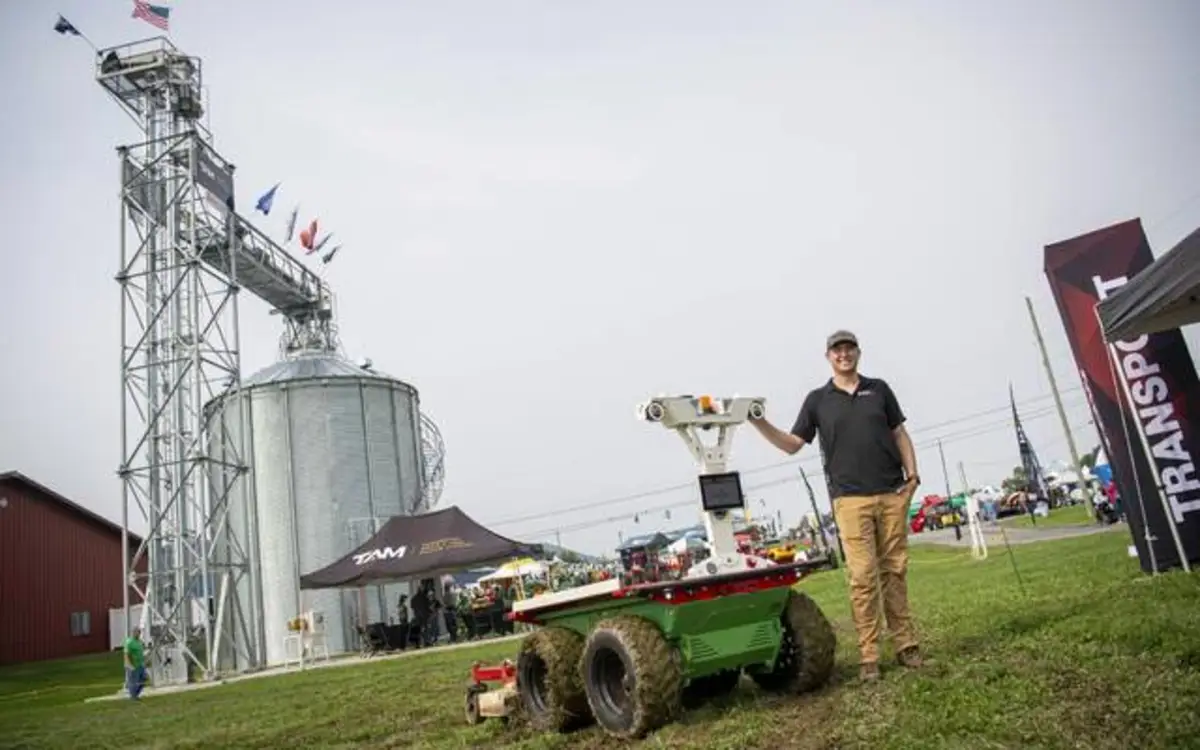
ROCK SPRINGS — In a roped-off field in Centre County, a small, flat, white electronic cart moves along, towing a mower.
The Grande 44 — an autonomous work platform built by Philadelphia-based company Burro — is a 40-horsepower robot. It can tow 6,000 pounds, carry 500 pounds, or pull a sprayer or brush cutter attachment.
Burro is one of 14 companies showcasing agricultural robotics technology this week at the FIRA Robotics Village. It is a new feature this year at the annual Penn State Ag Progress Days, which is open to the public and runs through Thursday at the school’s Russell E. Larson Agricultural Center.
Organizers at the Forum International de la Robotique Agricole, or FIRA, want to connect local robotics companies with the farmers who live within the region. Their showcases have been hosted primarily in Europe, with a few shows on the West Coast in the U.S.
This is the first time FIRA has brought the Robotics Village to the eastern side of the country.
Members of the ag-tech community said their goal is to work with farmers to identify needs, rather than build technology in search of a problem.
“We tried to make the Grande 44 as general use as possible,” said Andrew Edzenga, Burro’s head of products. “The tractor has been around for centuries, and it’s a general-use model that works very well, so adding autonomy on top can really help relieve some of the cost and labor pressure that farmers experience.”
Cost and labor were two issues that came up regularly among members of a panel moderated by Kevin Dowling, managing director at The Robotics Factory in Pittsburgh and one of the people who convinced FIRA officials to bring the Robotics Village to Ag Progress Days.
“You have to have return on investment and a robot that can do at least two or three things,” said Burro CEO Charlie Andersen. “If you’re a one-trick pony, you’re never going to achieve the (return on investment) that farmers need.”
AgriPass, an Israel-based company, brought a weeding machine engineered for small- to medium-sized farms.
“Being able to partner with companies like FIRA and (the Global Organization for Agricultural Robots) helps us bring this technology where local farmers can see it, in their element,” said AgriPass spokesperson Amanda Ditzler. “It’s a tech machine, but it fits in with everything else that’s here.”
The autonomous weeding machine, which costs about $150,000, uses a combination of AI-powered cameras and actuating tools to identify and remove weeds as it moves among rows of crops.
“It was developed by talking to smaller farmers about what they need,” Ditzler said. “A farmer could reasonably lease this, or buy this machine, see the return on investment in a year or two and not be stuck with a million-dollar investment hanging over his head.”
Ditzler said the autonomous weeder could potentially replace the labor of up to 20 people. But not every farm has 20 labor positions that need to be filled.
Smaller family farms also have specific needs, and Dowling said FIRA and its exhibiting companies hope to use feedback from Ag Progress Days to guide their research and development in the future.
“I was at a FIRA event in France, and a vineyard owner was asked about the tech equipment he’d brought and how it was performing and what data he was collecting, and he didn’t know any of those answers,” Dowling said. “He told us, ‘I just wanted to have my weekends back.’ People are buying agricultural robots for a lot of different reasons, and we have to consider all of them.”
Bringing the Robotics Village to Pennsylvania made good sense to Michael Roth, director of innovation at the Pennsylvania Department of Agriculture.
“Pennsylvania has so many different agricultural areas, so it’s a great place to test out different types of ag technology,” he said.
And as show manager Jesse Darlington pointed out, the robots aren’t confined to just the Robotics Village.
“It’s Ag Progress Days, right?” Darlington said. “The name says it all. So we have technology all around the show site. There is a focus this year with bringing FIRA in, but we have exhibitors who’ve been here in the same spot for 50 years – they have technology as part of their exhibit, they’re not just specifically part of the FIRA showcase.”
Darlington said local farmers need technology, autonomous and otherwise, to produce more from the fields they work.
“We have to do that, because the price of what we’re selling has not changed much. But all our input prices are going up, so we have to figure out how to grow more, and technology is allowing us to do that.”
Featured Local Businesses
Connecting with tech
One of the most important pieces of the puzzle is the support network connecting farmers with the increasingly complex technology they are using.
“We’re probably not going to have a robotics service tech available every 15 miles,” said Luke Zerby, product manager at Pennsylvania agricultural equipment company New Holland. “These are machines, and they’re going to break down and need serviced. A lot of the electronic issues you run into can be fixed fairly easily, or can be explained over the phone, but you need a user interface that farmers and workers can use.”
To that end, people such as Gretta Tritch Roman, senior director of research development and initiatives at Penn State’s College of Agricultural Sciences, are asking questions such as: What does an ag-tech ecosystem look like in Pennsylvania?
“It’s going to look different than in Nebraska or out on the West Coast,” Roman said. “We need to rethink what that pipeline looks like, and we want to also look at what we need to build at the university to be prepared to train people in these careers as they develop.”
Andersen said that while it might not be the flashiest approach, the best way to build out that ecosystem is to first focus on what he called “basic, boring, ubiquitous stuff.”
“In Pennsylvania and the Northeast in general, there’s a lot of vegetation management and hauling things around,” he said. “And I think the best bet is to focus on those everyday things that are mundane, but important, before we get to something like autonomous labor doing all the work on a farm.”