
Less than half (46.7 percent) of Bethlehem Area School District (BASD) juniors scored at least Proficient on last year’s state Keystone exam for Literature, down almost 20 percentage points from 2018, when 65.5 percent of juniors achieved that passing score. The falling scores have reopened a question that new superintendent Dr. Renato M. Lajara will have to contend with: whether standardized tests are a valuable objective measure of where the district’s students stand, or just a reflection of the hurdles many of them face.
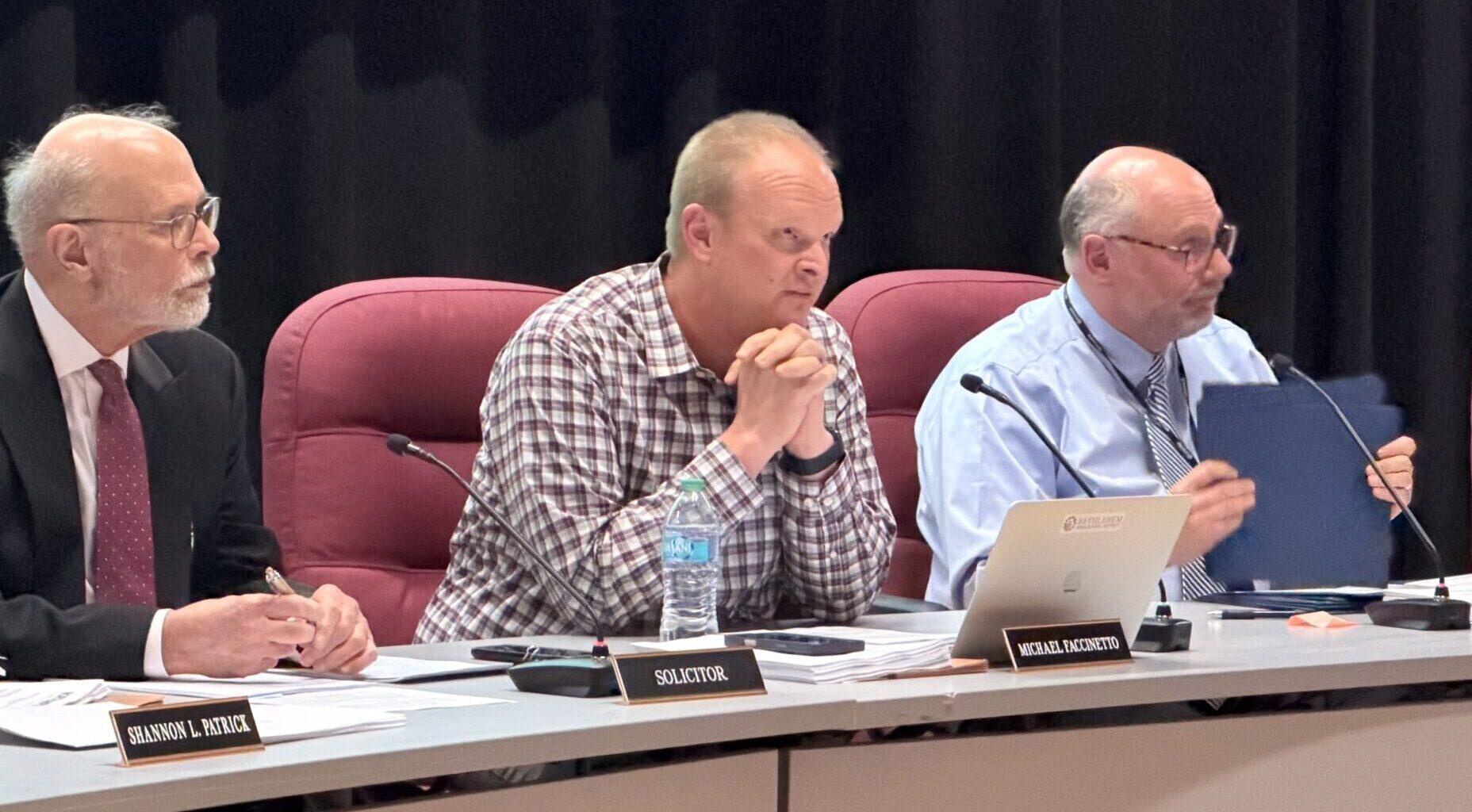
For School Board President Dr. Michael Faccinetto, state exams like the Pennsylvania System of School Assessment (PSSA) for Language Arts, which is given to grades 3-8, or the Keystone for Literature don’t accurately capture the school’s story.
“I think [PSSAs] are a waste of time and they’re a waste of money,” Faccinetto said. Before the recent transition to digital testing, the cost to taxpayers for PSSAs was nearly $50 million in 2023. “I’m a hundred percent opposed to PSSAs. I think there are ways that we can, across the board, measure student success, teacher effectiveness, [and] student growth and learning, without boiling it down to a standardized test that, you know, three days in April are going to tell us what you know in Language Arts.”
Faccinetto said the district’s high-poverty population – a fifth of its teenagers live under the poverty line, about 1.3 times the national average, and 54.7 percent of its students are “economically disadvantaged” – means that student performance often varies dramatically among its over-12,000 K-12 students.
A better way, according to Faccinetto, is what’s called a competency-based education, wherein teachers use brief assessments, often administered three times a year, to track a student’s growth and identify which students are at risk for literacy difficulties.
Stay informed on Lehigh Valley education
Get the latest education news and updates from across the Valley.
By subscribing, you agree to our Privacy Policy and consent to receive updates.
“If you were at Below Basic and you grew to Basic, that’s a lot of growth; that [means] something is working,” Faccinetto said. “So many kids… come from various family backgrounds, various levels of education in the community. Not everybody [is] coming in, obviously, at the same level when it comes to literacy and the ability to read, and [we’re] seeing that across the board.”
In last year’s Keystone Literature exams, only 33.2 percent of “economically disadvantaged” juniors achieved at least Proficient, more than ten percentage points lower than the general rate. A staggering 36 percent of juniors in that category scored Below Basic, the lowest possible mark, and only 2.9 percent scored Advanced, the highest possible mark.
According to Max Kraft, an Advanced Placement (AP) World History and German teacher at Freedom High School, some form of standardization is necessary.
“There needs to be an objective standard,” Kraft, who noted he’s speaking as a private citizen and not on behalf of BASD, said, in reference to the SAT. “It’s important to have objective ways to measure kids and where they’re at.”
As a social studies teacher, though, Kraft doesn’t prepare students for a Keystone exam. He said the test holds its weight for the state – the Every Student Succeeds Act (ESSA), passed in 2015, mandated that every state provide standardized tests to measure performance in reading, math, and science. But students, parents, and colleges, Kraft said, care more about the SAT, ACT, and – most interesting to him – an AP test.
Stay informed on Lehigh Valley education
Get the latest education news and updates from across the Valley.
By subscribing, you agree to our Privacy Policy and consent to receive updates.
Freedom offers more than 25 AP courses, for subjects that span from U.S. history (which is Kraft’s course) and English literature to biology and computer science.
The now-ubiquitous courses are designed by the educational nonprofit College Board – which also produces the SAT – to emulate the rigor and speed of a college course, and Kraft says that a student can’t pass one without being literate.
“[AP classes] don’t try to measure literacy,” Kraft said. “They try to say ‘how well do you know AP [English Language and Composition]?’ And they make a hard test that you have to be literate to pass. You know, AP World History is not testing kids on literacy, but there’s no way you could learn all that in AP World History without being literate. You’re not going to pass an AP test if you’re not literate.”
At the end of the year, more than 3 million students nationwide take their AP exams and are awarded scores from 1 to 5, with 5 being the best. Most colleges offer credit to students who pass – which typically means receiving a 4 or a 5 – an exam, depending on the course.
Kraft said he’s observed that his students who read often pass.
“You can tell who’s going to do really well on the exam after week two or three, and they tend to be the one that comes with a book in their hand,” Kraft said. Kraft’s AP World History course is one of the only AP courses offered to Freedom sophomores. “And I’m telling you, brother, I’m rarely wrong. Every single kid who’s ever gotten a 5 that I can think of, the highest scorers, they’re all readers. Every single one.”
For Kraft, the AP program is a beacon of light in a troubling sea of inflated grades. According to Christian Curet, an 11th-grade English teacher at Liberty High School, the COVID-19 pandemic created the perfect environment for schools to inflate grades “to make sure that the kids got through it.”
“Right after COVID, there was a lot of what they were calling grace and compassion; it was a tough time for everyone,” Curet said. “But then, the next two years, all those standards that we had before that were never really put back into place. A lot of the grading became a lot easier, and that allowed people to basically put in half as much effort to get the same grade that they would before.”
Colleges take into consideration a student’s Grade Point Average (GPA), or their average grade across all of the classes they took, heavily in admissions decisions. Kraft said that means districts and schools are also incentivized to graduate students with rockstar grades, so that the students who want to go to college have a better chance of acceptance.
“If you’re trying to be the most competitive applicant, you go to an AP class and get the A,” Kraft said. Because GPA at Freedom is weighted, an A in an AP class allows for the chance at a 5.0, rather than the standard 4.0. “The pressure to get the A is huge for the kids, because they’re so competitive, because they want to go to the university.”
For Kraft, trying to get kids to score a 4 or 5 on an AP exam in May, which colleges also consider up to a student’s junior courses, eliminates the noise.
“I don’t have any power to alter that test, so I have to bring kids to that standard,” Kraft said. “That’s a great example of where… the relationship hasn’t changed. The AP test doesn’t have to accommodate to where [kids are] at. And I have the ability to – if the parents are frustrated with a grade for a project or something like that – say, well listen, I’m trying to prepare your kid for this test, and if you don’t want them prepared then that’s fine, but that test is that test.”
In the past few years, though, the College Board has recalibrated its AP exams, leading to noticeable decreases in fail rates that have drawn criticism for jeopardizing the program’s validity. The rate of 1s on AP U.S. History, for example, dropped from 29.8 percent in 2023 to 8.4 percent in 2024.
Critics of standardized tests, like an AP exam or a Keystone exam, also argue that passing one doesn’t only take aptitude, but also test-taking ability as well as knowledge of – according to policy analyst Richard Rothstein – “the relatively narrow set of topics that are most heavily represented on the high-stakes tests.”
“The assessments that we’re given, through Keystones, typically are one of the least effective ways of measuring what the students know,” Curet said. “A lot of students just don’t test well when it comes to multiple-choice questions. The standardized test is not as accurate, but it’s standardized, so it’s a tool that we use.”
Curet added that although English Language Learners – which represent almost 10 percent of the district’s population – can be average or even above average with their understanding of the language and grammar, they can still struggle with “the phrasing of the words and the answers.”
“They understand the concepts, they understand the themes,” Curet said. “When we talk about those things, they’re right on. It’s almost always the specific phrasing on the test that causes some of the issues.”
The questions on a state exam, created and approved by teachers and curriculum directors across Pennsylvania, aim to measure a student’s command of the state’s Common Core Standards. Faccinetto validated Pennsylvania’s Core Standards, and said that the bigger issue was using standardized test scores as a yardstick.
“I think Common Core was a big scary word fifteen years ago, [but] even at the time, Pennsylvania had a very good set of standards, believe it or not,” Faccinetto said. “We’re a mess at a lot of things, but the PA standards are very good. I don’t think Common Core had a detrimental or negative impact on what we teach in our classrooms, talking about language arts and math. I think the bigger issue is this reliance on standardized testing to judge a school.”
Kraft admitted that the students who take AP classes are “definitely more literate to start with”, although he argued that AP classes can push even the students that don’t come in literate to succeed. Regardless, the students who take AP classes are only a subsection of the general student population that’s required to take the state exam.
Kraft noted a definite “loss of the middle”, an observation supported by recent trends in Keystone data. Where 10.1 percent of juniors were at Below Basic, the lowest mark, in 2018’s Keystone for Literature, 24.6 percent were at that mark in 2025.
“I am not naive to the fact – I don’t think the district is – that some kids are bound to be successful, and we’re preparing them, but they’re going to be prepared with or without us,” Faccinetto said. “[But] what’s the accountability of the district to graduate the students from 12th grade who can maybe only read at an 8th grade level?”
Faccinetto noted a number of programs that districts can use to instead benchmark students throughout the school year, including IXL, STAR testing, Measures of Academic Progress Growth (MAP) testing, and Lexia. This software, he said, provides “boatloads of data in real time” – like if a student struggles with contractions or evaluating themes – that teachers can use to direct their instruction going forward.
Regular assessments, Faccinetto argued, can help the district fully understand and work with a student in a way end-of-year exams can’t.
“Far more valuable than PSSA, if I pull up a student on a STAR test, I can go into their winter STAR screener, I can see what their overall score was, and then I can see how individual standards align with the state standards, [and] where they struggled,” Faccinetto said. “This is what teachers do every day; they use that data to group students so they’re giving targeted instruction. It’s far more valuable than a once-a-year PSSA test that takes several months to get results.”
In 2024, Gov. Josh Shapiro deliberately eased the transition to benchmark testing by beginning the two-year process of moving the PSSA and Keystone exams online. Shapiro even said he would get rid of the PSSAs altogether if it didn’t remove access to $600 million in ESSA federal funding.
A year earlier, Rep. Eric Nelson (R-Westmoreland) and Rep. Martina White (R-Philadelphia) introduced a bill that would enable a minimum of three benchmark assessments throughout the school year.
Faccinetto noted that teachers in high-scoring classrooms are often reluctant to bring their skills to a struggling classroom when their job performance is directly tied to those students’ performance. A wide corpus of research also shows that teachers in high-poverty districts are more likely to leave for wealthier districts.
Alongside his role on the School Board, Faccinetto teaches fifth-grade ELA and Social Studies at Joseph P. Liberati Intermediate School in Bethlehem. His ELA department, he said, is evaluated based on whether or not they’ve achieved a certain growth percentage with their IXL numbers.
A competency-based education, Faccinetto argued, can take some undue pressure off of teachers.
“If I am an incredible teacher and I have great data and I’m very confident where I’m working, why do I want to pick up and make the move and bring my skills to a classroom that struggles, in a high-poverty school?” Faccinetto said. “I don’t think it’s fair to hold teachers accountable to say, well, you’re teaching 5th grade and that student can only read at a 4th grade level. If they came to me at a 2nd grade level, and I grew them two grade levels in a year, that’s pretty good instruction.”
A school’s reputation can also take a hit when it’s not reporting good data, which has made charter schools, which already receive a portion of public school funds, and private schools enticing alternatives for parents. When strong students are pulled by their parents, Kraft said, that can create a “downward spiral” that reduces the school’s reported test scores, and ultimately gives students leverage on the district.
“That’s the thing, is that it’s a fight,” Kraft said. “It’s unfair that it’s a fight. Why would we compare? It seems a foolish thing to say that education is going to be this winner-take-all system; that’s not what it’s supposed to be.”
Although BASD uses benchmark testing already, Faccinetto argued that schools should be assessed entirely based on how successful they are at meeting students where they are, not on where they end up. The state is unlikely, though, to ever remove state exams due to ESSA, a reality Faccinetto admitted.
“Lawmakers like to have a number – they’re used to having a number – to say good or bad, pass or fail,” Faccinetto said. “I don’t see it going away. I kind of think we’re at where we’re going to be now for a while, so that’s a challenge.”
The district’s decreasing numbers, though, especially for its “economically disadvantaged” students, are still alarming. The end-of-year PSSAs and Keystones must eventually reflect a district that is growing, not getting worse.
“There are two fundamental skills in education, literacy and numeracy,” Kraft said. “That’s it, that’s all education is about. And if we aren’t doing things that increase either one or both of those, what are we doing?”
Stay informed on Lehigh Valley education
Get the latest education news and updates from across the Valley.
By subscribing, you agree to our Privacy Policy and consent to receive updates.