
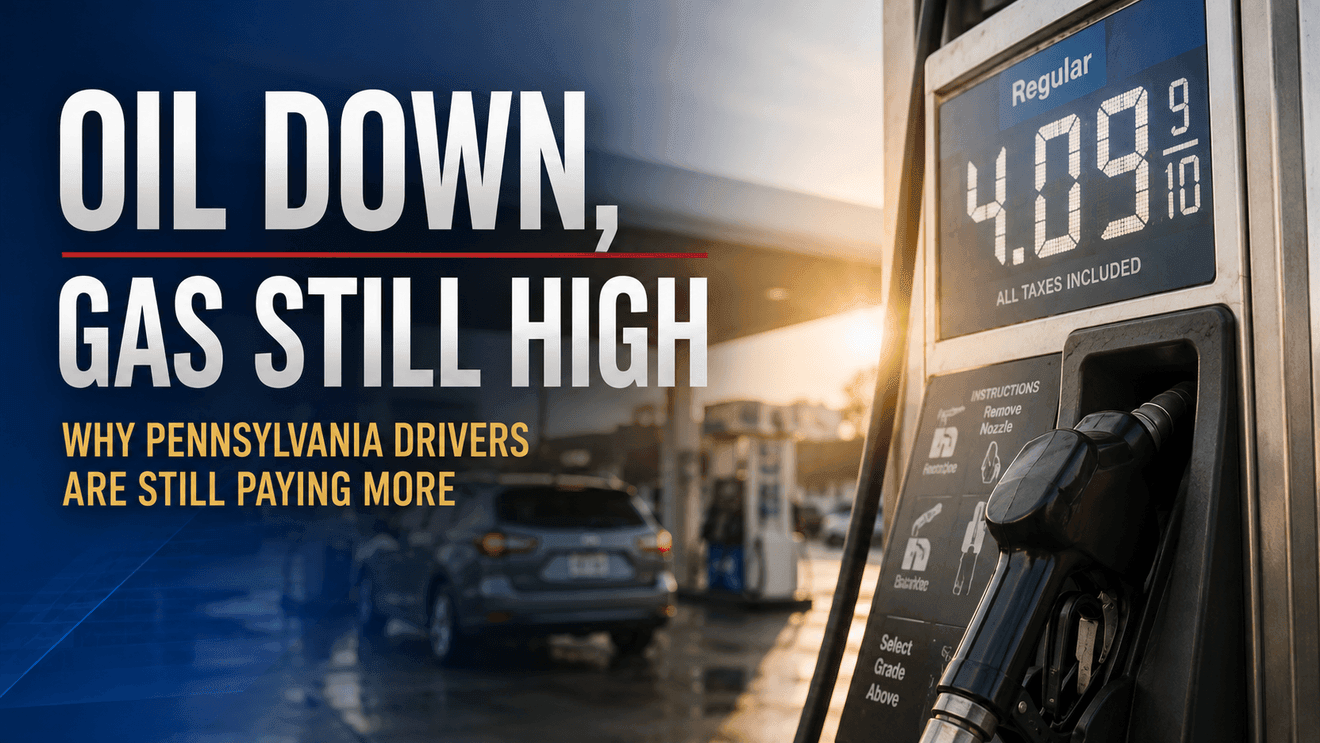
PLAINS, LUZERNE CO. (WOLF) — Crude oil prices have fallen sharply from their spring highs, but drivers in Pennsylvania may be wondering why they aren’t seeing the same dramatic decline on the signs outside their local gas stations.
It’s a reasonable question.
Crude oil traditionally accounts for roughly half the cost of a gallon of gasoline, and the old rule of thumb would suggest that oil around $80 a barrel should translate into considerably cheaper gasoline than when crude was trading above $100.
But in 2026, the relationship between the price of oil and what drivers pay at the pump has become more complicated.
The answer involves everything from refinery margins and wholesale gasoline prices to transportation costs and Pennsylvania’s relatively high fuel tax.
$80 oil doesn’t mean $1.90 gasoline
One barrel of crude oil contains 42 gallons.
At $80 per barrel, that works out to about $1.90 per gallon of crude oil.
That doesn’t mean refiners can simply turn each gallon of crude into a gallon of gasoline for $1.90. Refining, transportation, ethanol blending, marketing, retail expenses and taxes are all added before gasoline reaches a driver’s tank.
Still, crude oil historically has been the largest component of gasoline prices.
The U.S. Energy Information Administration says the cost of crude oil has represented slightly more than half of the average retail gasoline price over the previous decade.
That historical relationship is why falling oil prices normally lead to lower gasoline prices.
The 2026 gasoline market has been different
EIA data illustrate just how unusual the gasoline market became earlier this year.
The national average price for regular gasoline jumped from $2.81 per gallon in January to $4.48 in May.
In May, crude oil accounted for about 51.9% of the price of gasoline. But another 21.7% went toward refining costs and profits, while 14.8% was attributed to distribution and marketing.
Combined, refining and distribution represented more than 36% of the pump price.
That matters because crude oil can fall without the other components immediately following it lower.
EIA says refining costs and profits fluctuate based on factors including refinery operations, seasonal gasoline requirements, the types of crude being processed and the cost of ingredients such as ethanol. Summer demand can also contribute to higher prices.
The agency has specifically pointed to higher refinery margins as another reason petroleum products became more expensive this year.
Wholesale gasoline remains part of the problem
Another way to understand the disconnect is to look at gasoline before it ever reaches a station.
EIA’s summer outlook projected wholesale gasoline at roughly $3.22 per gallon during the third quarter of 2026, compared with $2.22 during the same period last year.
That’s an increase of approximately 45%.
The wholesale price is important because it represents roughly what gasoline is worth when it leaves the refining stage. Stations then have transportation, operating and retail costs before selling it to motorists.
So even with crude falling, gasoline itself can remain relatively expensive.
Pennsylvania starts with nearly 77 cents in taxes and fees
Pennsylvania drivers also face one of the higher fixed costs at the pump.
The state’s 2026 gasoline tax is 57.6 cents per gallon.
Pennsylvania also assesses a 1.1-cent-per-gallon underground storage tank fee.
The federal gasoline tax and federal underground-storage fee add another 18.4 cents per gallon.
Combined, that’s approximately:
77.1 cents per gallon in Pennsylvania and federal gasoline taxes and fees.
Those charges don’t decline when oil prices fall.
For a driver buying 15 gallons, the taxes and fees alone amount to about $11.57.
Where does the rest of the money go?
EIA divides the price of gasoline into four broad categories:
Crude oil + refining + distribution and marketing + taxes = pump price.
Distribution and marketing include pipelines, terminals, tanker-truck deliveries and the expenses associated with operating a gas station.
Retailers have to cover wages, insurance, equipment, rent or property costs and other overhead. Competition and where individual stations obtain their gasoline can also cause noticeable price differences between stations in the same community.
That’s one reason a driver can sometimes find a 20- or 30-cent difference between stations only a few miles apart.
The ‘rockets and feathers’ effect: Why gas prices rise faster than they fall
There is a name for something drivers have probably noticed for years: the “rockets and feathers” effect. Gasoline prices often seem to shoot upward like a rocket when crude oil or wholesale fuel prices increase, but then float downward like a feather when those costs decline.
The phenomenon has been studied by economists and federal regulators, including the Federal Trade Commission. It does not, by itself, prove price gouging. Several factors can cause retail prices to decline more slowly, including gasoline already purchased by stations at higher wholesale prices, refinery costs, inventories, transportation expenses and changes in local competition.
The lag can nevertheless be frustrating when crude oil prices fall substantially while drivers continue seeing elevated prices at the pump. Research from the U.S. Energy Information Administration has found that, all other factors being equal, roughly half of a change in crude oil prices typically reaches retail gasoline prices within about two weeks.
The unusually large gap between falling crude prices and stubborn gasoline prices in 2026 has also attracted federal scrutiny over possible price gouging. But high prices or unusually large refining and retail margins alone are not evidence of illegal activity. Determining whether gouging or market manipulation is occurring requires examining what refiners, wholesalers and retailers are actually paying and whether price increases can be justified by market conditions.
For Pennsylvania motorists, the “rockets and feathers” effect helps explain why an $80 barrel of oil doesn’t immediately translate into dramatically cheaper gasoline — oil prices may fall today, but the savings can take considerably longer to work their way through refineries, wholesalers, distributors and eventually to the neighborhood gas station.
Should prices fall if oil stays around $80?
The fundamentals suggest there should be downward pressure on gasoline if crude remains near $80 and refinery and wholesale gasoline markets continue to normalize.
But the decline doesn’t necessarily happen dollar-for-dollar or immediately.
A $80 barrel of oil is only the starting point for gasoline. Refinery margins, wholesale gasoline prices, inventories, transportation costs, summer demand and taxes determine how much of that crude-price decline eventually reaches motorists.
And Pennsylvania’s roughly 77 cents in state and federal taxes and fees effectively establishes a sizable portion of the pump price before refining, transportation or retail expenses are considered.
So drivers looking at $4 gasoline while hearing that oil has returned to around $80 aren’t imagining a disconnect.
Oil has gotten considerably cheaper. Gasoline just hasn’t fully followed it down yet.