
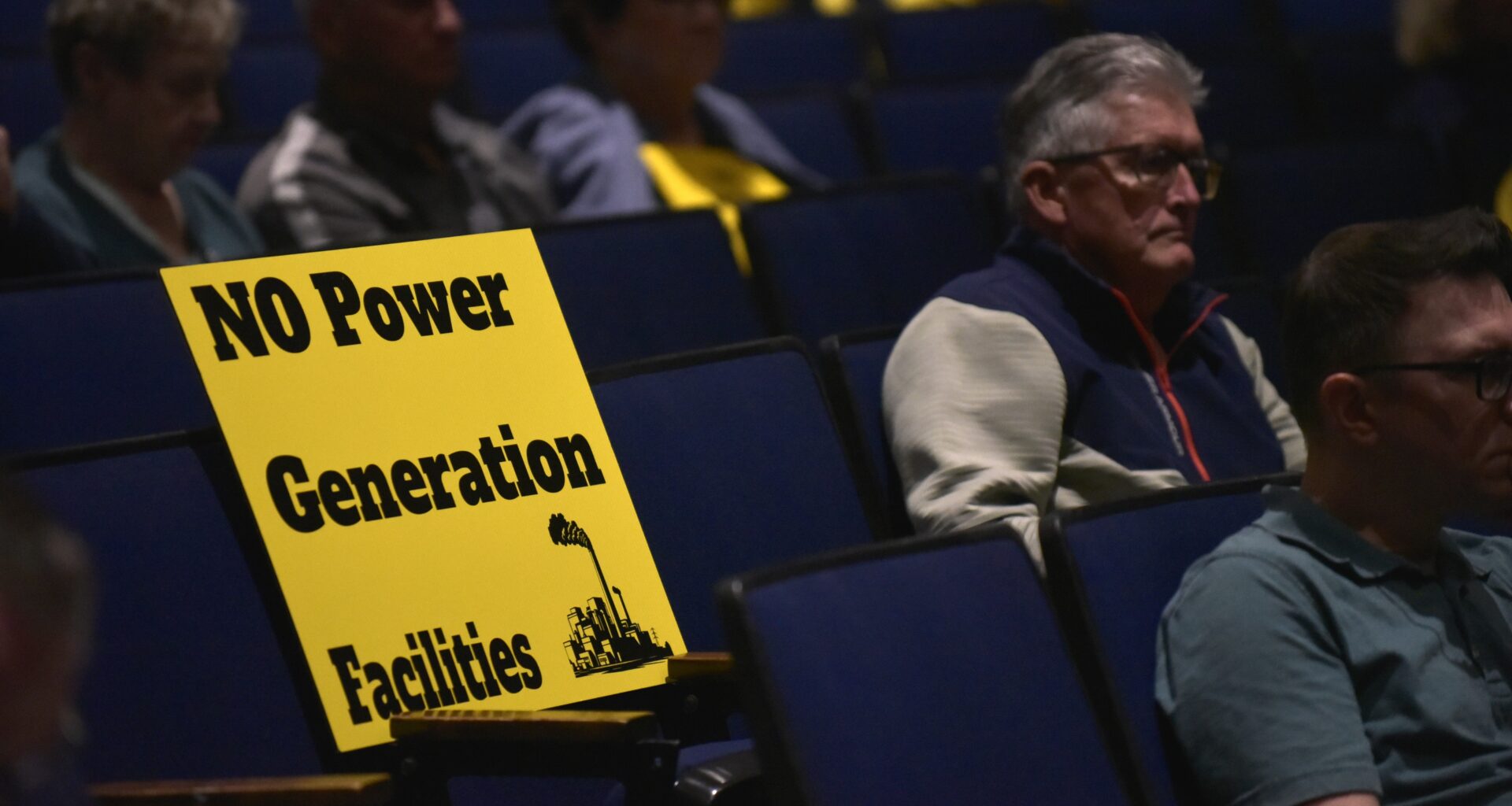
A controversial natural gas power plant will once again take center stage Tuesday at Valley View High School as Archbald holds its fifth hearing on a project looking to generate hundreds of megawatts of electricity on Eynon Jermyn Road.
Cross-examination will resume at 5 p.m. Tuesday in the high school auditorium, 1 Columbus Drive, Archbald, as borough council weighs a conditional use application for the roughly 400-megawatt power plant. Council has so far held four hearings on the project, which is proposed by Essential Energy LLC — a company linked to Kriger Construction Inc. and its executive leadership. Archbald received an initial zoning permit application for the power generating plant on March 12, signed by Kriger Construction President Jim Marzolino.
Archbald has since heard testimony on Essential Energy on April 27, May 21, June 22 and most recently July 21.
With the highest concentration of data center proposals of any Lackawanna County community, Archbald is navigating six data center projects totaling 51 individual data centers, including the nearly 620,000-square-foot Project Boson. Proposed by another Kriger-linked firm, Project Boson would be located on the opposite side of Eynon Jermyn Road from the power plant. Another developer plans to apply for two data centers in the Valley View Business Park, bringing the borough’s total to 53.
Other companies tied to the developer want to build four data centers and three power plants on Bell Mountain above Business Route 6 in Dickson City.
Contentions surrounding the power plant underscore two central debates around data centers and related developments: their proximity to sensitive uses like parks, homes and schools, and the amount of detail and information that a developer is required to provide during conditional use proceedings.
Residents and an attorney representing Stop Archbald Data Centers members have pushed back against the power plant because it is next to Archbald’s Staback Park, across Eynon Jermyn Road from the Highlands Archbald housing development, and about half a mile from the Valley View Intermediate School. They often emphasize language in Archbald’s zoning intended to protect the health, safety and welfare of residents, advocating for details and guarantees to ensure those protections if the project were approved.
Last month, attorney Justin Richards of Elliott Greenleaf PC in Wilkes-Barre, who represents Archbald residents opposing data centers, read from Archbald’s zoning ordinance, noting that it states an “applicant shall establish by credible evidence that the application complies with all applicable requirements.” The ordinance requires that the proposed use won’t substantially negatively change the character of the surrounding residential neighborhood. It also mandates that projects “shall not create a significant hazard to the public health and safety such as fire, toxic or explosive hazards,” Richards said.
Representatives for the developer have contended throughout the proceedings that the site is suitable for a power plant, and that the state and federal permitting would provide those protections.
Data center opponents and council members alike have frequently pressed the developer for additional information throughout the proceedings, like the specific equipment the power plant would use.
However, Essential Energy’s witnesses often note that they don’t know the exact equipment or details of the project — those will come at a later stage after the power plant receives conditional approval.
In May, engineer Nicole Wilson of engineering firm Earthres testified about the project’s air emissions.
“Yes, this would be considered a new, state-of-the-art plant, but again, we don’t know what specific equipment will go into this particular plant,” she said.
During that same hearing, a traffic study for the power plant looked at post-construction traffic for up to a dozen employees working on the site but did not cover the traffic impacts on the community and nearby Valley View School District during the construction of the power plant — an issue council members scrutinized during their questioning.
At a sound study presentation in June, when asked why the study excluded information on sound contours, engineer James D. Barnes of Cambridge, Massachusetts-based Acentech replied, “How much detail does one really need at this stage of the project?”
When Barnes said noise is subjective, council Vice President Joseph Altier III asked who would enjoy the sound of a natural gas power plant at night.
“I can imagine somebody,” Barnes said. “Not to be flip or anything, but the plant operator.”
Project details have also shifted across hearings. For example, in April, when asked why initial plans submitted to Archbald showed four 66,000-square-foot turbine pads, but an updated site plan displayed during the presentation showed two, subject matter witness Jennifer Leonard, a senior program manager at KCI Technologies in Mechanicsburg, said, “It appears I was able to more efficiently design the site.”
At the latest hearing last month, civil engineer W. Casey Deller, a vice president at KCI Technologies, deferred questions on topics including how much electricity the power plant would generate; expected emissions; what equipment it would use, including the specific number of turbines; its natural gas source; how a natural gas pipeline would connect to the site; impacts on a nearby residential development during rock blasting; and the power plant’s water source and water consumption.
At every prior hearing, Essential Energy was referred to by its witnesses and represenatives as a 400-megawatt power plant, but in July, Deller pointed out, “We believe that the site will be suitable to produce power to somewhere in that range.”
“It could be less,” he said. “It could be more.”
Deller defended that the permitting process, not the zoning process, would determine specific details.
“The permitting tract and everything that we’re required to do from a design standpoint requires us to show compliance or exceedance of standards across the board, whether that’s air or stormwater or environmental,” he said. “If we don’t show those standards during the permitting process, we don’t get our permit. We don’t build this facility.”
When Tuesday’s hearing resumes, Deller will face cross-examination from Archbald’s special counsel, attorney Brett C. Flower, and resident Meg Nudelman.