
It’s 1953 and American music, depending on what you liked, was at a high point or a low point. Patti Page and Perry Como are at the top of the Hit Parade with “How Much Is That Doggie in the Window?” and “Don’t Let the Stars Get in Your Eyes.” A young fellow named Tony Bennett was belting out “Rags to Riches” and for those who wanted something a little calmer there was Les Paul and Mary Ford on a mellow guitar with “Vaya Con Dios.”
It was still two years before a young singer named Elvis Presley would team up with a manager known as Colonel Parker and change the course of popular music forever with a song called “Heartbreak Hotel.” Rock and Roll was here to stay.
But for members of the Allentown Symphony Association, founded in 1951, it was the best year for their new organization.

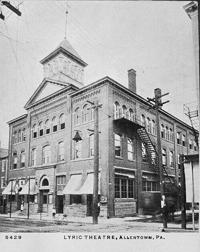
Postcard for Allentown’s Lyric Theatre (future Miller Symphony Hall)
The old Lyric theatre that looked like it was doomed to the wrecker’s ball was saved by the actions of the group and by the vigorous actions of Donald Voorhees. As a young man he had often conducted music for the Lyric’s orchestra. By the 1950s he was known nationally as conductor of the orchestra for the Bell Telephone Hour’s musical program, then broadcast on the radio.
In 1959 it would move to television.
The appeal to the Lyric property’s owner Donld Miller by the association members was successful. But they also wanted a way to christen its new function for what most recently had been a burlesque house with performers like Busty Russell and Ding Dong Belle, doing striptease acts. It was now called Symphony Hall and needed a little class.
So, they went to Voorhees’ contacts in the music business to find an act that would appeal to a broader audience, someone at home with classical music but also comfortable with popular songs. Fortunately, he found the ideal choice in Ezio Pinza (1892-1957).
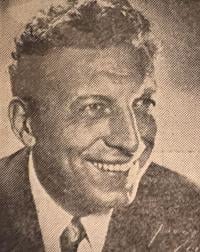
Ezio Pinza’s picture as it appeared on a flyer for the Allentown concert in 1953
Allentown Symphony Association
Born into a large working class Italian family in Rome, he was the first of seven children to survive beyond infancy. Pinza, according to his Wikipedia bio, moved with his family to the ancient city of Ravenna, where he grew up taking several working-class jobs and also had a passion for bicycle racing. “Although I did not know it at the time…I was developing the lung power which makes people hear me even up in the top row of the peanut gallery,” he noted much later.
Pinza’s father told him he should take up singing in the shower. His first teacher told him he should give it up because he had no voice. Another rejected him and then died. Finally, according to his New York Times obituary, Pinza got a small scholarship that required him to adopt the tasks of grounds keeper and carpenter. At the outbreak of World War in 1914 he joined the Italian Army and eventually reached the rank of captain.
But he continued his opera studies and in the early 1920s under Arturo Toscanini at Milan’s La Scala theater he blossomed. Here in 1926, he was “discovered” by the talent scout for New York’s Metropolitan Opera. He appeared on stage that November and was a hit with opera audiences.
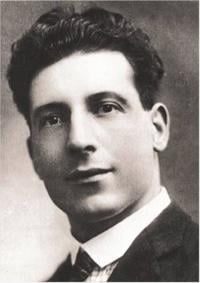
Ezio Pinza as a young man
The 1930s were very good years for Pinza. According to his Wikipedia bio he took over the role of Don Giovanni and made it his own. He also appeared in Royal Opera House in Covent Garden in 1930 and 1939 and sang at the Salzburg Festival from 1934 to 1937 under the baton of the celebrated German conductor Bruno Walter.
With the outbreak of World War II in Europe and particularly after America’s entry into the war, Pinza, as an Italian and because of Mussolini’s alliance with Hitler, became a subject of suspicion to the FBI. In 1942 he was arrested at his New York home. With other Italian Americans he spent three months in prison on Ellis Island.
Norman Cordon, a rival of Pinza’s at the Met, boasted that he had informed the FBI about Pinza’s supposed Fascist leanings. Four months away from becoming an American citizen at the time of his arrest, Pinza was severely depressed, particularly because he was largely apolitical. He suffered from attacks of depression for the rest of his life.
But Pinza was to have a second career that, if anything, would make him far better known than his first. Resigning from the Met in 1948, he was selected for a leading role opposite Mary Martin in “South Pacific” set during World War II.
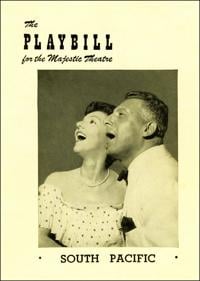
1949 Playbill for South Pacific
Playbill.com
The musical play by Richard Rogers and Oscar Hammerstein II was based on James Michner’s popular book of short stories, “Tales of the South Pacific.” The play was considered controversial at first because it included a love affair between a white American pilot and a native island woman. But that was later given a secondary place to the love affair between Mary Martin as a nurse and Pinza as a colonial French planter.
“South Pacific,” opening on April 7, 1949, was the hit of hits for Pinza. “For 20 years I sang in grand opera, and nobody knew me; I sang one night in “South Pacific”, and I can’t walk down the street without being mobbed.” In 1950 he received a Tony Award for the best leading actor in a musical.
By the early 1950s Pinza was stepping into the new black and white world of television. Something known as the “Ezio Pinza Show” appeared in homes across the country from 1950 to 1952. Another TV venture, a sitcom called “Bonio” lasted about a year.
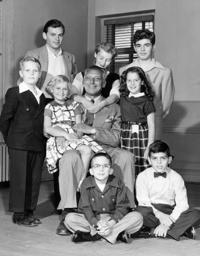
Cast photo of the television comedy Bonino. Ezio Pinza (center) was the star of the show.
It was a sold-out crowd that greeted Pinza on the Sunday afternoon of February 8, 1953, in Allentown. “Ezio ‘wowed” everybody young and old in the audience and members of the orchestra,” reported the Morning Call’s Jack Haring.
“Scores of teenagers and some older folks too caused a virtual stampede in the aisles as they helter-skeltered for close up view (sigh) of (Dreamboat) Pinza.”
One prominent Allentown resident noted, “It’s such a pleasure to hear a man who really sings like a man, instead of these fellows who wail all the time.”
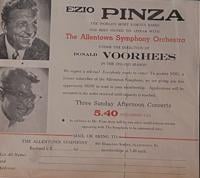
Flyer announcing Pinza’s appearance in 1953
Allentown Symphony Association
His performance of “This Nearly was Mine” and “Some Enchanted Evening” from “South Pacific” brought the crowd to its feet. The concert was followed by a reception and dinner at the home of Mr. and Mrs. Samuel Miller at 211 North 29th Street.
As the president of the Allentown Symphony Association was overheard saying by a reporter for the Allentown’s Evening Chronicle, “We actually got Ezio Pinza.”
In 1954 Pinza appeared in a production of “Fanny” with Florence Henderson and on a television special “Salute to Rogers and Hammerstein.”
But a series of heart attacks were beginning to wear him down. Finally on May 9, 1957, he died in his sleep at age 64.