
DUNMORE — Much of the Lackawanna Valley’s drinking water today flows from actions taken in the mid- and late-1800s, when Lake Scranton and its feeder reservoirs were built.
At that time, industry growing the area and its population also brought pollution and required creation of new sources of clean tap water. Between 1845 and 1898, 10 reservoirs were created by damming Roaring Brook, Little Roaring Brook and Stafford Meadow Brook, and an 11th reservoir was added in 1927 on Little Roaring Brook.
Today, these reservoirs are all owned by Pennsylvania American Water as part of its Lake Scranton water supply, distribution and treatment system. The Lake Scranton water treatment plant, which serves 55,000 customer connections in Scranton and surrounding areas, is the largest PAW treatment plant in eastern Pennsylvania and PAW’s third largest in the state, company spokeswoman Alana Roberts said. The largest two serve Pittsburgh.
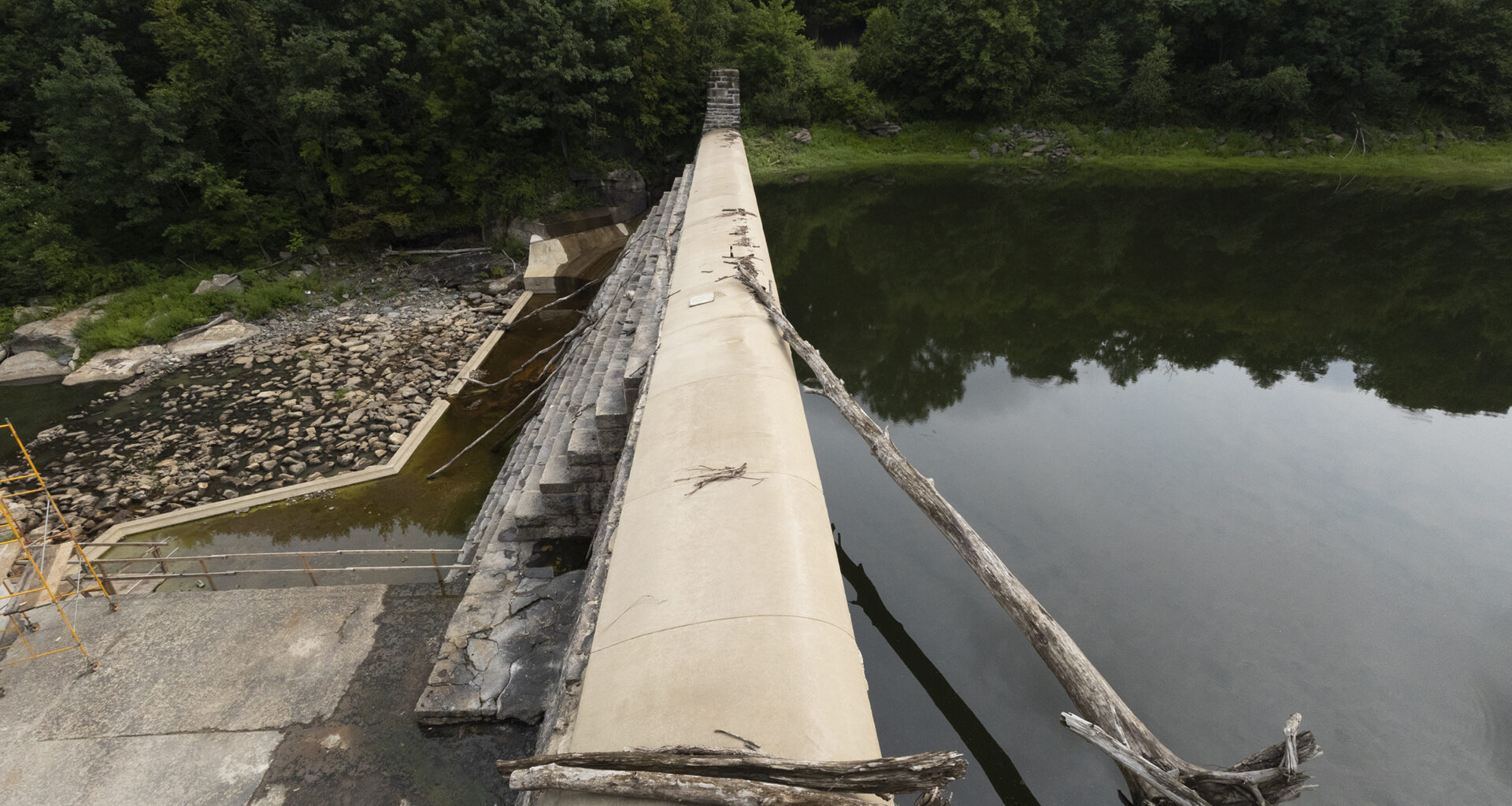
The water company has been under state mandate over the past 20 years to rehabilitate old dams throughout the state to ensure their structural integrity and water supplies for the next century and longer, said Kurt Staller, PAW’s engineering manager of dams. Since 2012, the company has spent nearly $100 million on dam rehabilitations, Staller said. PAW offered a tour of three dams — at the Elmhurst Reservoir, Dunmore No. 7 Reservoir and Curtis Reservoir — to the The Sunday Times to highlight infrastructure improvements the company has made and is making. These dams represent one already rehabilitated, one wrapping up work and one getting removed entirely.
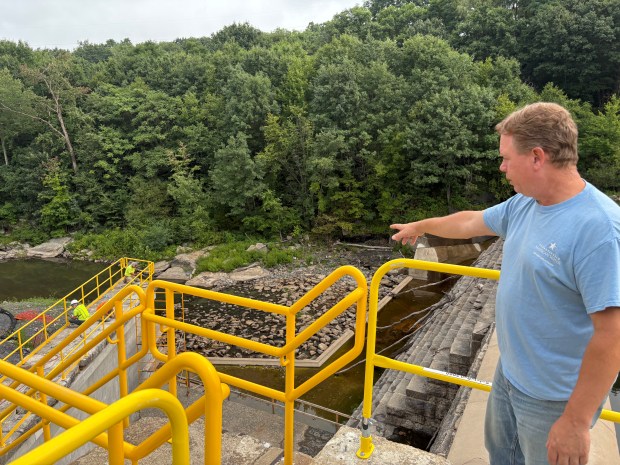 Kurt Staller, Pennsylvania American Water’s chief engineer for dams, discusses the company’s No. 7 Reservoir Dam in Dunmore on Wednesday, Aug. 12, 2026. (JIM LOCKWOOD / STAFF PHOTO)
The company’s 47 dams statewide have an average age of 107 years, he said. In Lackawanna County, the mandate affected the Lake Scranton system and its feeder reservoirs and dams. The oldest two reservoirs in the Lake Scranton system were built by coal companies, and later ones done by the former Scranton Gas and Water Co. or prior entities, Staller said.
“Back in the 1800s, the coal mining days, it started as springs and river intakes and as the communities expanded they needed more (drinking) water, so then they started building storage reservoirs,” Staller said. “All of these reservoirs are on smaller streams because the main corridor (primarily the Lackawanna River) was getting heavily polluted, so they moved to these smaller watersheds for cleaner water.”
The reservoirs in the Lake Scranton system include:
• Dunmore No. 3 Reservoir: constructed 1845; 9 acres surface area; 55 acre-feet storage.
• Dunmore No. 4 Reservoir: constructed 1847; 6 acres surface area; 31 acre-feet storage.
• Dunmore No. 7 Reservoir: constructed 1872; 18 acres surface area; 310 acre-feet storage.
• Dunmore No. 1 Reservoir: constructed 1877; 23 acres surface area; 230 acre-feet storage.
• Elmhurst Reservoir: constructed 1889; 181 acres surface area; 2,115 acre-feet storage.
• Williams Bridge Reservoir: constructed 1893; 43 acres surface area; 1,034 acre-feet storage.
• Lake Scranton Reservoir: constructed 1898; 225 acres surface area; 7,642 acre-feet storage.
• Marshwood Reservoir: constructed 1927; 37 acres surface area; 113 acre-feet storage.
• Johnson’s Pond Reservoir: no historical or capacity info provided on this smaller body upstream of the former Hollister Reservoir.
• Hollister Reservoir: Beset from sinkhole failure at the outset of its construction in the 1970s, this dam was never fully rehabilitated before PAW ownership and the company finally removed it a few years ago, returning that area to its natural stream.
• Curtis Reservoir: Currently being removed because of a recent slope failure and the body of water will return to its natural stream.
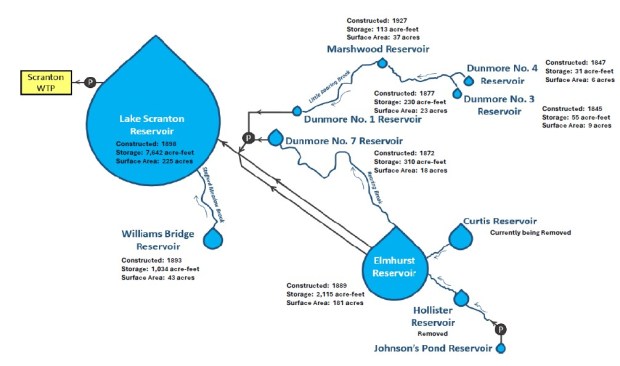 Pennsylvania American Water reservoirs in the Lake Scranton system. (IMAGE PROVIDED / PENNSYLVANIA AMERICAN WATER)
Each reservoir started out as very localized, but over time mergers combined them into one system. They eventually all ended up under the successor system owned and operated by Pennsylvania American Water. The system feeds Lake Scranton by gravity, pumping and in some cases miles of direct piping.
“This is how our customers in the (Lackawanna River) valley are getting their drinking water, through all of these dams eventually leading down to the Lake Scranton plant,” Roberts said.
Each dam also is unique, Staller said.
“They all kind of have their own personality,” Staller said. “They have their own geology, hydrology, how they were built and where they were sited, which makes each one unique.”
Construction in the 1800s often involved cut-stone masonry, and these dams are built of large stone blocks. The interiors often were filled with rubble. At the No. 7 Reservoir, the company drilled down through the top of the dam at intervals across its length, and down into the bedrock, and installed steel tension strand anchors for additional support, “to essentially hold the dam to the bedrock,” Staller said.
Some of the local reservoirs are fairly remote and have no public access. But some others, including Lake Scranton and Dunmore No. 1 Reservoir, have walking trails and are popular outdoor recreation respites for the public. To highlight the history of the system, the company plans to install at Lake Scranton in a year or so informational signs with historical photos, facts and figures to tell the story of the precursor Scranton Gas and Water and Spring Brook water companies, Staller said.
“We’re going to lay it out across the trail (at Lake Scranton) so people walking the trail can kind of essentially follow the history,” Staller said.

Pennsylvania American Water’s No. 7 Reservoir Dam in Dunmore on Wednesday, Aug. 12, 2026. (JIM LOCKWOOD / STAFF PHOTO)

An 1872 Scranton Gas & Water Company plaque engraved with names of the company president and directors, on Pennsylvania American Water’s No. 7 Reservoir Dam in Dunmore on Wednesday, Aug. 12, 2026. (JIM LOCKWOOD / STAFF PHOTO)

Pennsylvania American Water’s No. 7 Reservoir Dam in Dunmore on Wednesday, Aug. 12, 2026. (JIM LOCKWOOD / STAFF PHOTO)

Kurt Staller, Pennsylvania American Water’s chief engineer for dams, discusses the company’s No. 7 Reservoir Dam in Dunmore on Wednesday, Aug. 12, 2026. (JIM LOCKWOOD / STAFF PHOTO)

Workers at Pennsylvania American Water’s No. 7 Reservoir Dam in Dunmore on Wednesday, Aug. 12, 2026. (JIM LOCKWOOD / STAFF PHOTO)

Workers at Pennsylvania American Water’s No. 7 Reservoir Dam in Dunmore on Wednesday, Aug. 12, 2026. (JIM LOCKWOOD / STAFF PHOTO)

Geese in grass near the dam of Pennsylvania American Water’s Elmhurst Reservoir in Elmhurst Township, Lackawanna County on Wednesday, Aug. 12, 2026. (JIM LOCKWOOD / STAFF PHOTO)

A zigzag spillway weir at the dam of Pennsylvania American Water’s Elmhurst Reservoir in Elmhurst Township, Lackawanna County on Wednesday, Aug. 12, 2026. (JIM LOCKWOOD / STAFF PHOTO)

Geese in grass near the dam of Pennsylvania American Water’s Elmhurst Reservoir in Elmhurst Township, Lackawanna County on Wednesday, Aug. 12, 2026. (JIM LOCKWOOD / STAFF PHOTO)
Show Caption
1 of 9
Pennsylvania American Water’s No. 7 Reservoir Dam in Dunmore on Wednesday, Aug. 12, 2026. (JIM LOCKWOOD / STAFF PHOTO)

Quandel crew members work on Pennylvania American Water-owned Dunmore No. 7 Dam, in Dunmore Tuesday, August 11, 2026. (SEAN MCKEAG / STAFF PHOTOGRAPHER)

Quandel crew members work on Pennylvania American Water-owned Dunmore No. 7 Dam, in Dunmore Tuesday, August 11, 2026. (SEAN MCKEAG / STAFF PHOTOGRAPHER)

A plaque was placed into the structure of the Dunmore No. 7 Dam by the Scranton Gas and Water Company Tuesday, August 11, 2026. (SEAN MCKEAG / STAFF PHOTOGRAPHER)

The Dunmore No. 7 Dam is seen in Dunmore Tuesday, August 11, 2026. (SEAN MCKEAG / STAFF PHOTOGRAPHER)

A water pipeline connects Dunmore No. 1 Reservoir to Dunmore No. 7 Reservoir in Dunmore Tuesday, August 11, 2026. (SEAN MCKEAG / STAFF PHOTOGRAPHER)

Tbe Dunmore No. 7 Reservoir in Dunmore Tuesday, August 11, 2026. (SEAN MCKEAG / STAFF PHOTOGRAPHER)

The Elmhurst Reservoir in Elmhurst Twp. Tuesday, August 11, 2026. (SEAN MCKEAG / STAFF PHOTOGRAPHER)

The Elmhurst Reservoir in Elmhurst Twp. Tuesday, August 11, 2026. (SEAN MCKEAG / STAFF PHOTOGRAPHER)

The Elmhurst Reservoir in Elmhurst Twp. Tuesday, August 11, 2026. (SEAN MCKEAG / STAFF PHOTOGRAPHER)

A pumphouse sits on the edge of the Curtis Reservoir in Jefferson Twp. Tuesday, August 11, 2026. (SEAN MCKEAG / STAFF PHOTOGRAPHER)

The Curtis Reservoir in Jefferson Twp. Tuesday, August 11, 2026. (SEAN MCKEAG / STAFF PHOTOGRAPHER)

Pennsylvania American Water reservoirs in the Lake Scranton system. (IMAGE PROVIDED / PENNSYLVANIA AMERICAN WATER)
Show Caption
1 of 12
Quandel crew members work on Pennylvania American Water-owned Dunmore No. 7 Dam, in Dunmore Tuesday, August 11, 2026. (SEAN MCKEAG / STAFF PHOTOGRAPHER)