
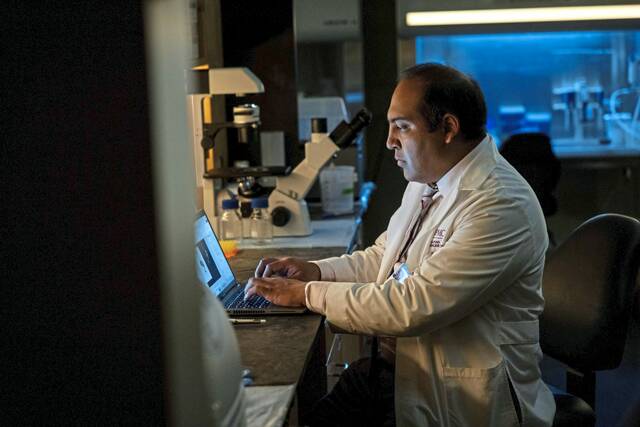
University of Pittsburgh researchers could be making headway against a cancer most commonly diagnosed in infants. And they’re testing a new combination of two treatments that could also prove useful against other cancers.
In a preclinical study using lab models, Pitt, UPMC Hillman Cancer Center and National Cancer Institute researchers found that combining radiopharmaceutical and CAR T-cell therapies reduced tumors in relapsed neuroblastoma by 80% more than either treatment alone. The results were recently published in Cell Reports Medicine.
Researchers cautioned that the findings are preclinical and have not been demonstrated in humans yet.
With further study and eventual human trials, researchers who worked on the year-and-a-half-long study believe the results could one day show promise not only for children with neuroblastoma — an aggressive pediatric cancer of nerve tissues — but potentially for other cancers featuring solid tumors, such as breast and lung cancers.
Previously, CAR T-cell therapy alone had shown only “limited”
effectiveness in solid tumor cancers. It is FDA-approved only for treatment of blood cancers.
“The goal is to potentially get a cure, but, No. 1, extend survival,” said senior author Ravi Patel, director of radiopharmaceutical therapy in the Department of Radiation Oncology at UPMC Hillman Cancer Center. “In some of the studies, we had a cure rate as high as 5 out of 7. And then in one study, we had 8 out of 10. So that’s pretty high tumor control and cure rate.”
High-risk neuroblastoma — which comprises about half of neuroblastoma cases — comes with a five-year survival rate of 63%, according to the Mayo Clinic.
“Right now, few patients are being cured of metastatic cancer,” said Patel. “So, if we come up with strategies where we can eradicate even residual sites of tumor, that’s something that can be very
beneficial. Obviously, a lot of work (must be done) before we get to even testing that kind of approach.”
In the study, CAR T-cell therapy and radiopharmaceuticals worked together in two distinct ways.
Alone, CAR T-cell therapy sees immune cells extracted, reprogrammed in a lab and then reintroduced to destroy cancer cells in a high-risk, two-part inpatient procedure that’s been used to treat 35,000 blood cancer patients since it received FDA approval in 2017. Radiopharmaceuticals — which Patel called “usually pretty well tolerated in general” aside from the risk to the kidneys — seek out cancer cells “like a bounty hunter” throughout the body and build up in problem areas.
The study found that when encountering radiation-sensitive tumors, the combo damaged tumor cells to soften them up for immune attack. In radiation-resistant tumors, the radiopharmaceutical changed the tumor environment to allow “T cells” to penetrate them.
According to a release from UPMC, the team’s next steps include establishing safe dosing and toxicity profiles before conceptualizing human trials.
If it clears years’ worth of hurdles, focus may eventually shift to other solid tumor cancers.
Patel said researchers are at least two years away from a clinical trial.
One family’s journey
For 9-year-old Luelle Kennedy and her parents, Walt and Jodi, of Cecil, the past several years have been a whirlwind of appointments, hospital stays and adjusting to life after cancer.
Now an energetic fourth grader, Luelle faced uncertain odds of reaching this point.
“When you spend as much time on the ninth floor of Children’s Hospital and see every single room filled with a little bald-headed kid for a year and a half — and then knowing people through the community and watching them put their kid through the same thing I’ve seen my kid go through — I’m pretty well sick of seeing that,” Jodi Kennedy said of her family’s journey.
In 2019, at just 2 years old, Luelle was diagnosed with widespread stage 4, high-risk neuroblastoma. Doctors found a large mass on her adrenal gland and gave her a 50-50 chance to live.
“They called me from the pediatrician’s office and my husband is sobbing,” Jodi Kennedy remembered. “My husband is a very intimidating-looking man and so to hear him crying on the phone, I knew right away. My heart was in my stomach. And he said, ‘You need to come here right now. This doctor is saying she thinks that Luelle has cancer.’”
“[That night] I laid in the bed and I held her and just cried and thought, like, how do you get through this?”
In the months that followed, out of necessity, Jodi left her administrative job as Luelle was subjected to numerous procedures and treatments, including surgical installation of a dual Broviac port for treatment administration, a risky two-part autologous stem cell therapy (each procedure requiring a 30-day stay at UPMC Children’s Hospital in Lawrenceville), seven week-long rounds of chemotherapy, a procedure to remove both the tumor and her adrenal gland and 12 days of radiation targeted to her abdomen.
“I didn’t think I could do it. I didn’t think I could survive putting my child through what they told me it was going to be like,” said Kennedy. “But then you just start putting one foot in front of the other and then the next thing you know, you’re at the end of it.
“Except for the little bald head and skinny face, she was a maniac. She just acted like a total normal kid. You know what I mean? You’d never know. As soon as the chemo started shrinking the tumor in her leg, she was back at it.”
Collectively, the lifesaving interventions produced lasting effects Luelle will carry forever, including partial hearing loss likely due to chemo, a damaged kidney, and blood pressure and dental development issues. Today, Luelle wears a hearing aid to hear sharp sounds and attends speech therapy after having attended Western Pennsylvania School for the Deaf for preschool. She takes medications to manage her blood pressure, and her mother expects numerous dental procedures in the years to come.
“At the time, it was a lot to put her through and for us to go through. It was a really hard time,” Jodi Kennedy said. “But she’s here with us, so I am grateful.”
These days, Kennedy is hopeful about any potential advancement in pediatric cancer treatment that might make the path relatively easier to walk.
“The fact that it’s something that would affect so many little kids, I’m really excited about it and I truly hope it’s something. If you don’t have to do a year’s worth of chemo — I just think these little kids’ bodies are being put through so much,” Jodi Kennedy said. “Any development to me is exciting. They deserve it.”