
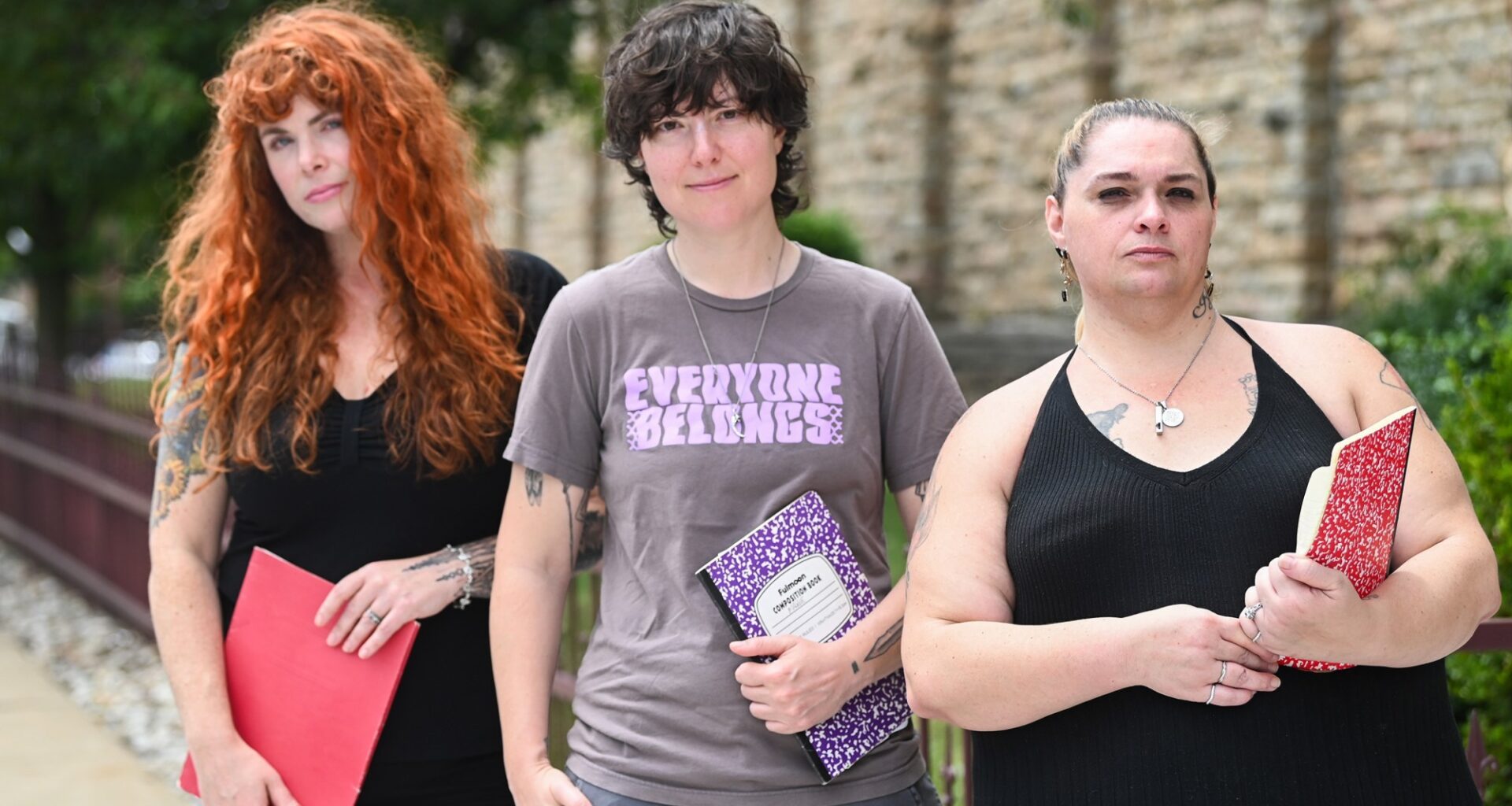
In an environment designed to strip away identity and connection to the outside world, reading materials have become the latest battleground for inmate advocacy in Lackawanna County.
Beyond basic rehabilitation, access to newspapers and other reading materials provides incarcerated men and women with something far rarer behind bars: the information required to exercise their civil rights.
In 2023, Lackawanna County Prison advocate Beverly DeBarros registered inmates to vote and then successfully lobbied officials to ensure the inmates could exercise that right.
DeBarros believed the printed word equipped inmates to cast informed votes. She secured delivery of a local newspaper to the prison.
Now, DeBarros wants to go one step further. At July’s meeting of the Lackawanna County Prison Board, she asked that printed copies of The Philadelphia Inquirer be made available to inmates.
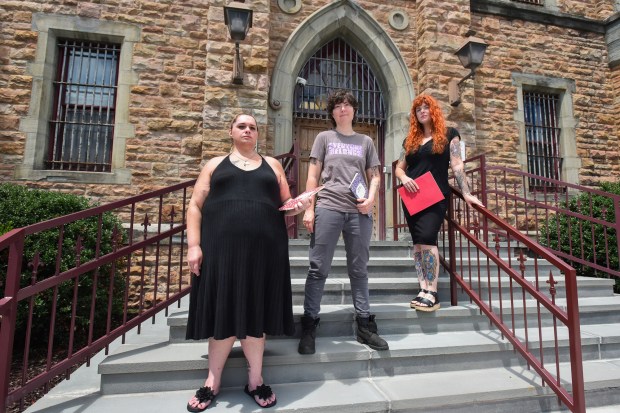 Former inmate Leslie Smith, with writing teachers Maggie Craig and Allison Horrocks stand at the entrance of the Lackawanna County Prison in Scranton Thursday, July 30, 2026. (SEAN MCKEAG / STAFF PHOTOGRAPHER)
Newspapers, she said, provide information necessary for informed voting.
“They could do with more news. All of us could do with more news,” she said.
Judge Michael Barrasse, who oversees the board, approved the provision of the Philadelphia paper, dependent on inmate interest.
Deputy Sheriff Colleen Orzel said she would provide a survey on inmate iPads to determine if inmates would be interested in reading the additional paper.
On Aug. 19, not having heard back about the results of the survey, DeBarros again stepped to the podium to request that The Philadelphia Inquirer be delivered to the prison.
She pointed out that, in addition to political information, the Inquirer provides inmates with an understanding of the world at large and access to resources.
“These people are in and out of jail. They can see what jobs are available, what housing is available, what a used car sells for, stuff like that,” she said. “It’s important to keep up with current events so when you get out you’re not astounded with everything.”
DeBarros questioned what impact the survey about the need for an additional newspaper would have on the board’s decision regarding whether it would purchase the additional subscription.
Connection in a solitary cell
Much of DeBarros’ advocacy work focuses on female inmates she meets through a Bible study she holds Tuesday evenings.
Many of the women participating in the weekly study go on to advocate for others upon their release.
Leslie Smith is one of those students. After doing 15 months at the prison on drug-related charges, Smith views her release as an opportunity to inspire others to participate in the process.
For 15 months — from December 2023 through March 2025 — Smith attempted to navigate her life from behind bars.
After a fight with another inmate, Smith found herself in lockdown.
For three weeks, her entire world was compressed into a solitary cell, where the only connection to the outside — and her own sanity — came down to three things: a newspaper, a Bible and the Alcoholics Anonymous Big Book.
Smith was released from solitary confinement into the general population with a commitment to serving as an example to other inmates. She attended Bible study, creative writing class and support groups.
Smith, who went to jail for the first time at 45 following a drug conviction, said the culture shock was immediate the moment she was incarcerated.
Not only did she lose her freedom, but she felt her identity being stripped away. Between simple meals, steep prices at commissary and a strict adherence to routine, she struggled with despair.
Now, she keeps in touch with other inmates through social media and by phone. She attends prison board meetings and encourages other former inmates to attend the meetings and participate in government.
She acknowledges that life after incarceration presents multiple challenges — financial challenges, employment challenges, family challenges, transportation challenges. But she encourages other former inmates to not give up, assuring them of rewards sought through consistent effort.
“There is light, and where there is light there can be no more darkness,” she said. “And when you make it out, don’t take the easy way out by forgetting. I didn’t. I’m here, I’m fighting back, and I’m not being quiet.”
A safe place to speak
Maggie Craig runs a weekly women’s writing class at the prison, which provides an opportunity for female inmates to voice their feelings, often through poetry.
Before Craig began facilitating the group in November 2024, she was an advocate for the rights of inmates, specifically female inmates of Lackawanna County Prison.
When the prison board voted to provide a space for programming that year, the next question was what kind of programming.
Craig, who has a background in English, suggested that she could offer a writing class.
So she showed up every Wednesday night, notebook in hand, ready to not simply teach, but to listen to women’s stories and help them express their feelings in the written word.
With permission of the inmates, Craig has presented their words to the prison board to inform and inspire change.
In 2025, before an audience that included the warden and county officials, she shared “Cup and Towel” — a poem that described both the grim hardships of incarceration and quiet moments of gratitude, reflecting on “those lonely nights in the cold thinking that God was my only friend.”
The Wednesday evening writing class gives inmates a place to write, vent and dream — offering a rare haven where they can briefly forget they are in prison.
As the class draws to a close, reality sets in and the inmates prepare to return to their cellblocks.
Craig stresses that what is shared in the writing group stays there.
Smith said inmates comply with that directive and keep confidential what their peers have shared.
In February, Craig turned over the reins of her class to Allison Horrocks, who also sees writing as an opportunity for inmates to share trauma and learn how to process that trauma in the written word.
On a recent afternoon, the three stood on the steps of the prison, discussing the writing program and the challenges of incarceration.
When asked how she felt as she stood on the other side of the prison door, Smith said she wasn’t afraid, even though she knew the prison staff were likely seeing her on camera.
Instead, she said she felt empowered and responsible to work for change and support former and current inmates in voicing concerns about incarceration and successfully navigating their lives on the outside.
Demographics tell a story
Because female inmates make up a small minority — averaging just 78 daily in July 2026, compared to 544 men — DeBarros says their unique needs are often overlooked. Women in the facility are frequently focused on child welfare, personal health and community reentry.
Warden Tim Betti noted that the prison offers gender-specific programming, including an exercise program from the University of Scranton’s physical therapy department and a volunteer-run poetry class.
DeBarros plans to continue bringing these issues directly to the prison board to advocate for incarcerated women and defend their civil rights.