
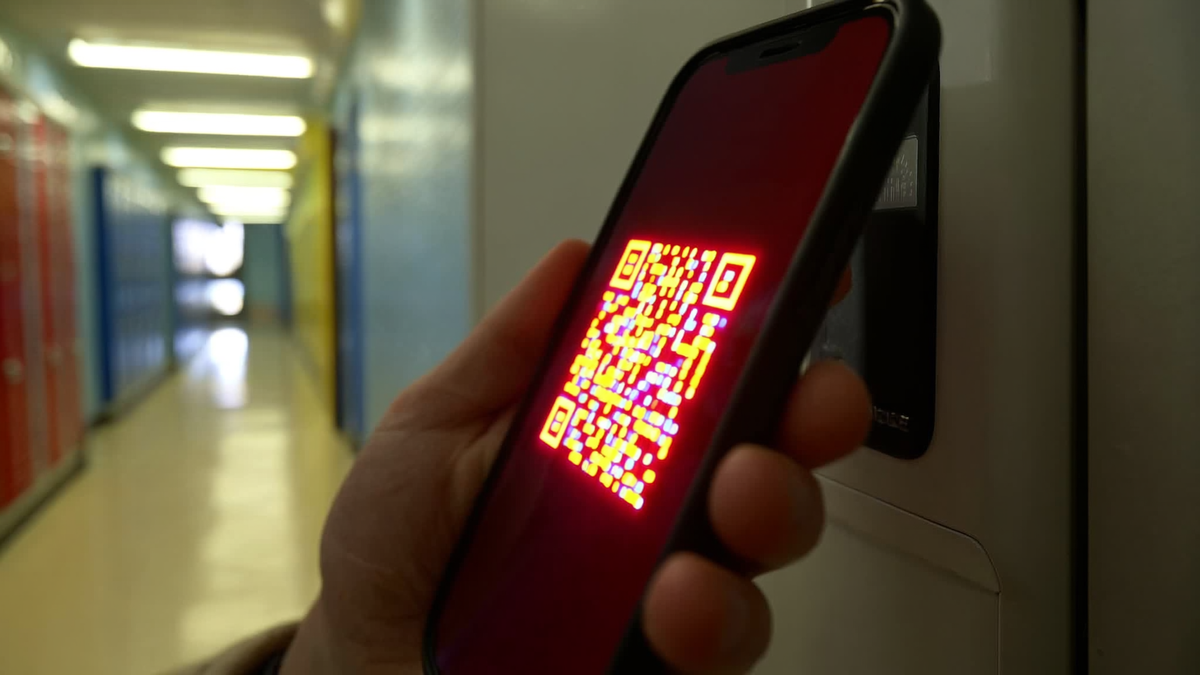
The School District of Philadelphia is rolling out a digital hall pass system to all schools for the 2026-27 academic year, giving administrators a new tool to monitor student movement and, the district hopes, prevent fights on campus.
The system is optional. Principals can decide whether to adopt it. But for the first time, every school in the 249-campus district will have access to the technology, which logs where students go when they leave the classroom and can block them from certain areas. The rollout comes alongside several other safety measures, including expanded violence-reduction mentoring and a requirement that all school safety officers wear ballistic vests.
How the digital hall pass works
The system runs through Infinite Campus, the platform schools already use for course materials, Chalkbeat Philadelphia reported. Students request permission to leave class through their Chromebooks. Once a teacher approves, the student’s trip is logged on a “hall monitor grid” visible to administrators and climate staff.
Staff can digitally deny a student access to parts of the building where there is a safety concern or a staffing gap. The system can also be automated so that certain students are not approved for hallway access at the same time, a feature designed to keep apart students who are in conflict.
Jade McCray, an assistant principal at Abraham Lincoln High School who was recently trained on the software, said the system tracks which students are out, where they should be, and what time they left and returned.
“If we know a situation is brewing … it’s probably not the best idea for them to be in the halls to possibly run into each other at the same time,” McCray said.
District officials said it will take time to get teachers and students trained on the new tool.
Climate staff raise surveillance concerns
Not everyone is sold. Nicole Hunt, president of Local 634, the union representing Philadelphia school climate staff, said the technology could actually hinder the workers whose job is to keep students safe.
“It takes a second to start a fight,” Hunt said. “How do we watch out for when a fight’s about to happen when we’re watching the tablet?”
In New York City, students and others have criticized a similar digital hall pass concept over concerns about over-surveillance. Some Philadelphia educators worry the technology will be more distracting than helpful.
The district is not requiring any school to use the system, leaving the decision to individual principals, the same approach it takes with cellphone policies. Across the district’s more than 116,000 students, what works at one campus does not always translate to another.
550 assaults a year drove the push
The digital hall pass is one piece of a larger safety strategy shaped by persistent violence in schools. Between 2021 and 2025, police responded to an average of about 550 assaults on public school campuses each year, according to city police data cited by Chalkbeat.
The district’s Youth Violence Reduction Initiative, which provides a calm space and consistent mentorship to students at highest risk of engaging in violence, is expanding to William L. Sayre High School this year. The program will now operate in three high schools. It launched at Olney High School last year.
At John Bartram High School, which piloted the initiative, student-on-student assaults are down 31 percent since the program started in 2023.
Ballistic vests, Safe Path and Handle With Care
The coming school year will also mark the first time all school safety officers wear ballistic vests.
The Safe Path program, which places trained adults on school perimeters to deescalate fights, will return to 25 campuses. And the Handle With Care program is expanding districtwide after a pilot in the 22nd Police District. Under that program, police officers alert school staff when a child has witnessed trauma in their neighborhood, allowing educators to respond with appropriate support.
Closures and cellphones add to a turbulent year
The safety measures arrive as the district navigates two other contentious issues heading into fall.
The district’s school closure plan is moving ahead as written. Officials announced Thursday they will open applications Aug. 31 for 20-person transition committees at each of the nine schools closing this academic year, schools receiving displaced students in 2027-28, and any school phasing out grade levels at the end of this year. Each committee will include teachers, staff, parents, caregivers, community partners and students. Applications close Sept. 18.
Superintendent Tony Watlington said the district needs to meaningfully partner with school communities for the transition to succeed.
“We really want this to be something that represents ‘nothing for us without us,’” Watlington said at Thursday’s school board meeting.
The closures are part of a 10-year, $3 billion facilities plan that promises to modernize 169 buildings, construct a new high school, renovate pools, update HVAC systems, improve bathrooms, refurbish athletic facilities, add kitchens and redesign classrooms. But elected officials led by City Councilmembers Nina Ahmad and Isaiah Thomas have pushed back hard, threatening lawsuits, calling for school board members’ resignations and shutting down board meetings. Community members have said repeatedly that their input has not been deeply considered.
On cellphones, the district continues to leave enforcement to individual principals. Some schools use Yondr pouches. Others use aluminum storage cabinets in each classroom. Gov. Josh Shapiro has publicly supported a statewide bell-to-bell cellphone ban, and a bill on the issue passed the state House in June and will be considered by the Senate.
Families who want to weigh in on the school transition process can apply for a committee seat through the district’s online portal or submit feedback through the district’s transition form. Applications close Sept. 18.