
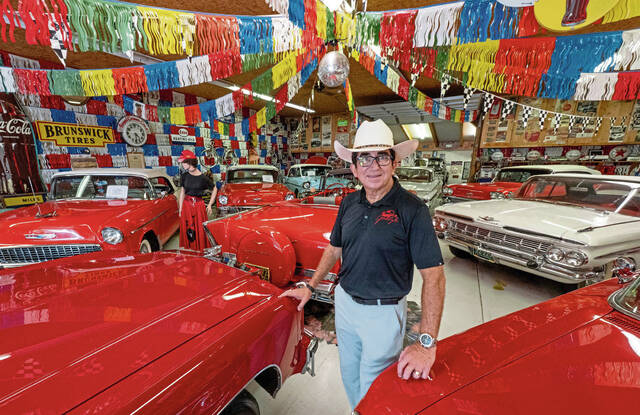
Joe R. Pyle may cheerfully say he’s never truly worked a day in his life. But the 92 vintage cars he’s collected at his childhood home in Greene County tell a different story — one that has required him to build several additions just to display them all.
The collection — headlined by a 1931 Buick Series 90 Roadster — is a trophy of Pyle’s eponymous, self-made auctioneering business, which stretches hundreds of miles in every direction and has grown in scope during his lengthy career specializing in everything from cars and antiques to real estate and airport equipment.
He’s now responsible for auctioning thousands of items annually from Pittsburgh International Airport’s lost and found.
This year’s airport auction is set to open Tuesday, and customers browsing the online-only listings can bid on lots of jewelry, technology and suitcases until Sept. 8.
The airport auction is just one piece of a career that has made Pyle as much a collector of relationships as he is of cars: He values the people he’s met through his craft more than any material goods he acquires.
And, at 64 years old, he still auctions in his signature cowboy hat and boots for the same reason he did as a kid: “It’s just fun to me.”
“I’m not saying I’m beyond needing to be profitable, but it’s more of a, ‘What can I do for this customer?’ ”
Opening bids
Pyle was born and raised in Mount Morris, a holler from the West Virginia border. He grew up in the fields beyond where his cars now sit, practicing his auctioneer’s voice atop the family tractor as he mowed the grass.
Pyle’s father, Don, owned a used auto dealership in town and began the car collection they now share with a 1930 Ford Model A Roadster. He took Joe to a family friend’s car auction when he was 10 years old, sparking his interest in the craft.
“He’s selling these cars — bang, sold — and so when I come home, I said, ‘That’s what I want to do when I grow up. I want to be an auctioneer,’” Joe Pyle said.
Back home, Don Pyle watched his son recreate the scene with Lincoln Logs and Matchbox cars. He resolved to cultivate his son’s interest.
“I can tell when somebody’s going to be something or not,” Don Pyle, who is now 95, said.
Don began taking time away from his business to crisscross the West Virginia back roads with Joe on the hunt for antiques to auction off, always filing away who owned what.
He also bought Joe his first auctioneering cassette tapes, where he learned how to fire off numbers in rapid succession.
“The old guy told me the more you practice, the better auctioneer you’ll be,” Joe Pyle said.
Practice soon turned into real-life results when another family friend, Clair Kearns, invited Joe to help him auction fencing and tools in Eighty-Four. That’s where he made his first sale: A garden hoe, for $2.25.
Pyle returned every week that summer, graduating to eggs, which Kearns had a massive surplus of. He taught his young understudy to give customers more eggs than they purchased to offload inventory.
If someone already bought 10 dozen eggs, would they refuse 20 dozen for the same total price?
“(Clair) used to tell me, ‘When you get on an auction block, you are in charge. You can’t let the crowd control you. You control the crowd,” Pyle said.
Pyle bought his first car, a 1972 Chevy Malibu SS, for $1,400 when he was 14. He promptly auctioned it off for $2,100 — a “windfall” profit of $600 for a teenager, after fees.
“I’d been going to the flea market making 30, 40, 50 bucks on the weekend. Then all of a sudden, one shot, $600,” he said, thumping his hand on a vintage ice cream parlor table in one of his sitting rooms.
Pyle’s next find was a Dodge Dart Swinger, on his way to building his very own business: Mountain State Auto Auction, which still operates to this day.
Lots of lots
Pyle’s decades as an auctioneer have supplied him with a seemingly endless supply of anecdotes.
He could talk about the time he wrangled 36 raccoons — one “as big as a Collie dog” — in a barn full of antique cars in New Castle, or the wealthy woman in Morgantown who was mortified that she had let a then-teenager oversee “a heck of an estate sale,” but still became a repeat customer.
He’s also developed an uncanny ability to provide a price range for an item he lays his eyes on, borne from sheer market memorization.
Pyle’s contacts from his early years auctioneering gave him a running start, and he grew quickly as old-timers retired from the business and passed their networks to him. At his peak, he could work at least eight auctions per week, often running well into the night.
His once-modest auto auction went through 14 renovations and now sells up to 42,000 cars per year, by his estimation. He operates more than a half-dozen satellite offices in West Virginia, southwestern Pennsylvania and Ohio.
Pyle’s individual auctions venture even further afield: as far north as Erie, as far east as Roanoke, Va., and as far west as Kentucky.
Pyle has to stay light on his feet when it comes to appraisals, since antique values can shift with customers’ tastes. Older generations placed more value on wooden furniture. For example, a bedroom set that may have sold for $10,000 earlier in Pyle’s career might bring in $1,500 today, he said.
“People that are inheriting that stuff now don’t get too excited about it,” he said.
Sellers used to pay a commission, while buyers today pay the premiums instead, Pyle said. That’s because overhead costs to run an auction have increased alongside more involved setups with video screens and required workers’ compensation, he said.
Pyle’s real estate wing — established after the 2008 financial crisis — has grown from 15 to 20 auctions in a typical month to 36 in a single week in July. He sold a building last year for $4.9 million in the largest single-session transaction of his career.
Many of Pyle’s auctions are now online or hybrid, since fully in-person events take “an army” of his employees to handle. His annual auction of Pittsburgh International Airport’s lost and found could draw up to 1,500 people and last for 10 hours. It’s now done online.
While online auctions take longer since bidding isn’t live, Pyle’s employees have an opportunity to catalog and identify the airport’s grab-bag of items, which could be hiding treasures like a 14-karat gold ring.
“We’re the seller’s agent, and so we’re trying our best to net them the most we can net them,” Pyle said.
Pyle’s brand has grown alongside his business. His calling-card cowboy hat features prominently in his logo and he dons it everywhere he goes, happy to be recognized at a restaurant or a West Virginia University football game.
He even ventured into TV commercials beginning a decade ago — some of which he films at home, using his cars as an eye-catching backdrop.
Auction school
Pyle said he was a diligent student, graduating near the top of his class of 239 at Waynesburg Central High School. He always planned to go to college.
But his father convinced him that continuing to build his auctioneering business would be a better investment, overcoming his skepticism that it would pay enough to support him full-time.
“He’s like, ‘I promise you, you will have so much business, you cannot keep up with it,’ ” Pyle said. “That was an inspirational, turning-point moment for me because all my buddies are going off to college … here I am, I’m going to be out here digging in an attic of a barn.”
Rather than continuing as a student, Pyle learned to enjoy teaching his craft to others. He has personally trained 49 businesspeople to swell the ranks of his company, including car dealers, real estate managers and 17 auctioneers.
Pyle has had the most luck teaching recruits when they are young, just like he was when he started.
“I found out if we get them when they’re in their teens, it’s a lot easier to get them trained than it is when we get them when they’re 30 or 40,” Pyle said.
Pyle’s wife, Charlotte, and his sons, Andrew and Aaron, also became auctioneers through his encouragement. Andrew and Aaron, as third-generation car enthusiasts, now handle that part of the company.
There are some Mondays when Pyle, his wife, and his sons are all working auction blocks simultaneously.
Charlotte said “couldn’t be prouder” to have raised Andrew, 35, and Aaron, 39, as auctioneers.
“I had to work at it — the boys have it in their blood,” she said. “Over the years it’s been a great family experience.”
As mesmerizing as an auctioneer’s rhythmic chants can be, Pyle is much more interested in his trainees’ relationship-building with bidders to keep them engaged.
“I’m not near as worried about how good you can count numbers as I am how connected you are to the customer,” he said.
Pyle’s pipeline of recruits has become self-sustaining after decades of developing his social network. He’s noticed that he tends to find people of high character in groups.
“If you get one that’s (of) excellent character, a good worker, business-minded, entrepreneur-minded, usually that’s who they run around with,” he said.
Garrett Wilkerson, 25, first connected with Pyle through a mutual friend while studying business at West Virginia University. Pyle asked him to manage a classic car auction in Pittsburgh, and he sold about $3 million worth of Corvettes that day.
After seeing what was possible as an auctioneer, Wilkerson passed up his dreams of Wall Street to work for Pyle.
“Joe’s blessed me beyond belief,” he said. “I learned more from four months of riding around in the car with Joe than I did in four years of sitting in the classroom.”
Pyle considers Wilkerson and the rest of his auctioneers his “adopted boys.” While Wilkerson’s parents are in his life, Pyle said employees don’t have present-day role models.
“We live in an unfathered nation,” he said. “It’s scary, but it’s true.”
Pyle and his auctioneers convene in Charleston on Thursdays for “Bro Night,” where they share dinner and talk about what they worked on during the week — or what unusual items they auctioned.
Pyle rattled off a sample list, from Al Capone’s poker table to a Mickey Mantle rookie card.
“We sold Marilyn Monroe’s pelvis X-ray last year,” Wilkerson offered.
Pyle stuck a hand up to stop him from elaborating, a cheeky grin breaking out. “People are going to think I’m some kind of smut guy.”
Wilkerson was hardly a social butterfly when he started. Now, he said, his family jokes that they can’t go anywhere without running into someone he knows.
“From my side, this isn’t a job; this is a lifestyle,” Wilkerson said. “You have to be fully committed to it, and it’ll treat you right in the long run.”
Pyle’s training has also paid practical dividends, since his understudies run most of his auctions now. But he still loves to get involved, whether he is providing input or working with a longtime bidder.
He doubts he’ll retire on his own accord.
“I always tell the boys: When it’s time to put the gavel and microphone down … you tell me.”