
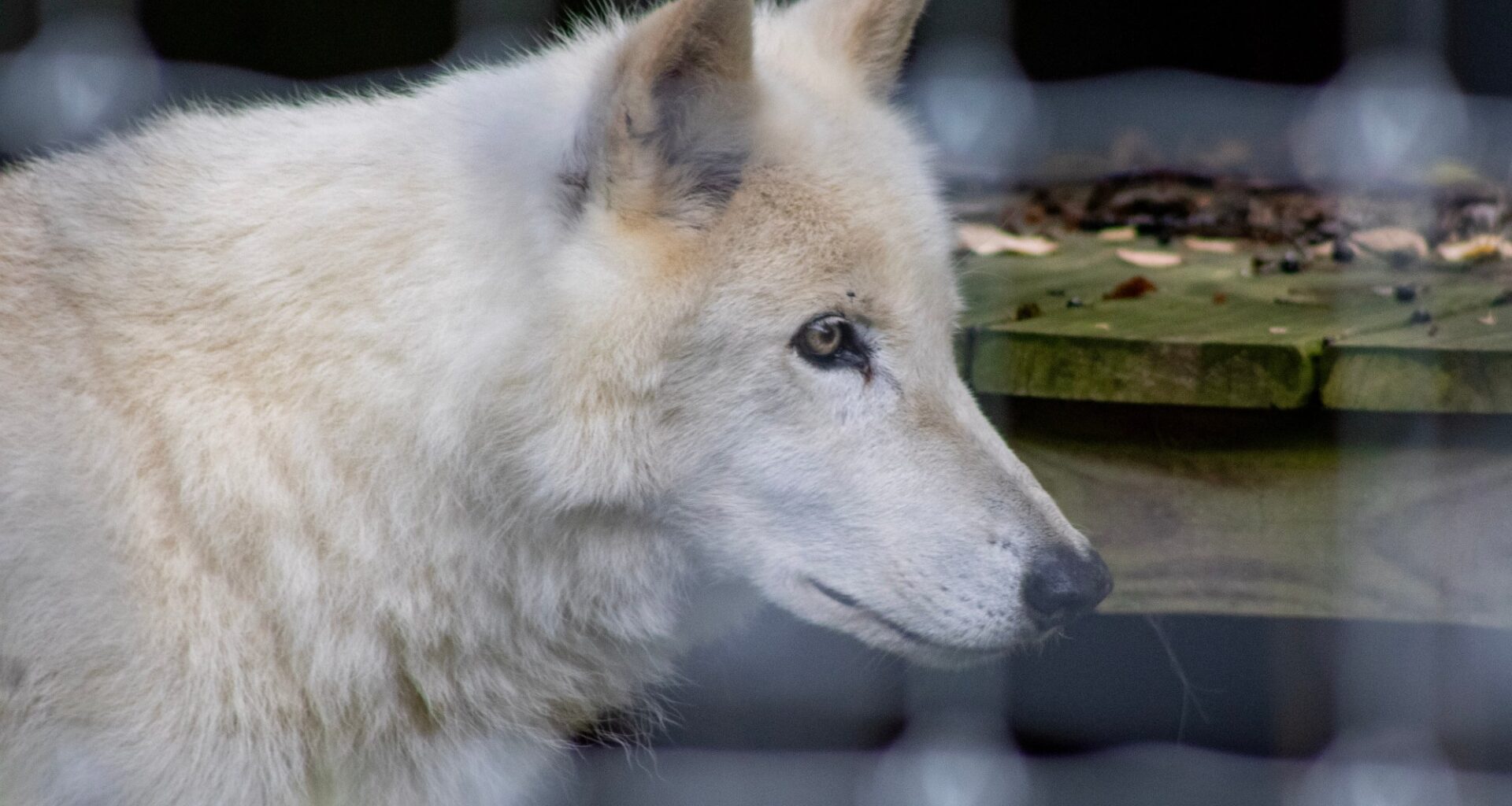
LITITZ — In the shaded expanse of Lititz’s thick summer greenery, a wolf watched from behind the fence, its bright eyes scanning the brush.
As I stepped closer, it watched me for a moment before slipping back into the shade.
The wolf was close enough to see clearly — thick fur framing its face, ears alert to every sound — but still just out of reach.
The retreat was a quiet signal. At the Wolf Sanctuary of PA, learning to recognize and respect those signals is part of caring for animals whose trust has to be earned.
The sanctuary is home to about 53 gray wolves and wolf-dogs, many rescued from homes and other human environments that could not meet their needs.
The wolves we keep
Wolves once roamed freely across Pennsylvania, but disappeared from the state more than a century ago. The wolves wandering Lititz today do not mark the return of Pennsylvania’s lost wild packs. Each animal arrived through human circumstances that left it unable to live independently in the wild.
Their stories offer a more nuanced way to understand the species: not as the wild predators that once roamed Pennsylvania’s forests, but as individual animals navigating a world humans have reshaped around them.
Caring for them extends far beyond food and fences. It means understanding how wolves communicate, form relationships and adapt when they can no longer live as their species evolved to live.

Isabelle cools off in her splash pond inside her enclosure at the Wolf Sanctuary of PA. (AISHWARYA BEHL/STAFF PHOTO)

Isabelle steps into her splash pond and takes a drink on a hot afternoon at the Wolf Sanctuary of PA. (AISHWARYA BEHL/STAFF PHOTO)
Show Caption
1 of 2
Isabelle cools off in her splash pond inside her enclosure at the Wolf Sanctuary of PA. (AISHWARYA BEHL/STAFF PHOTO)
Expand
Life before the sanctuary
For many of the wolves at the sanctuary, life in the human world began in places far removed from a wildlife refuge.
Blue came to the sanctuary from an animal facility in Montana, where he and his brother had been raised for use in movies and advertisements. The two were smaller than the other animals there, and the facility eventually sought a placement for them, said Michelle Vander Neut, the sanctuary’s education coordinator.
Spirit’s story began differently. She came from a family that loved her, but she developed separation anxiety and escaped from her home. In Maryland, where private ownership of wolves is illegal, she could have been euthanized if the sanctuary had not taken her in, Vander Neut said.
She was about a year and a half old when she arrived. Now 13, Spirit lives with Mika, her longtime companion.
Spirit endured neither abandonment nor abuse, yet she remained a wolf in a human world that left little room for her instincts.
Most of the sanctuary’s animals came from human homes or other captive settings. Others came from people who cared for them but ultimately could not meet the demands of living with a wolf.
Halona was found underweight and tethered to a chain in a dark barn. A family took her in before seeking a permanent home for her at the sanctuary.
Other animals have arrived malnourished, covered in parasites or confined to cages. Some have arrived with scars from muzzles that people had kept too tight around their noses, Vander Neut said.
The stories vary, but each reflects the tension between a wolf’s instincts and the constraints of human life.
“They don’t understand work schedules or anything like that,” Vander Neut said. “They want to be with their pack 24/7.”
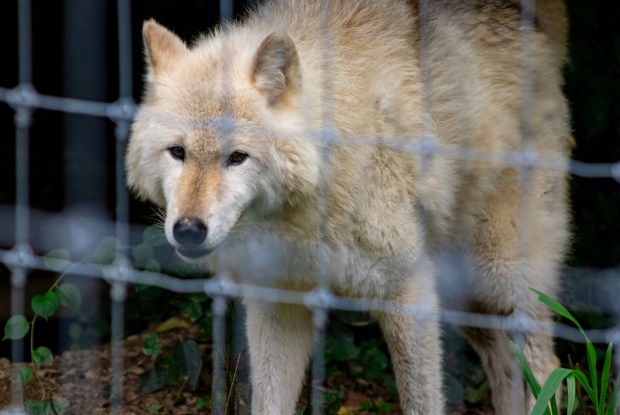 Max approaches the fence at the Wolf Sanctuary of PA on Aug. 5, 2026. (AISHWARYA BEHL/STAFF PHOTO)
Trust on wolf terms
After rescue, the work shifts to understanding each wolf’s needs.
For Vander Neut, who has worked at the sanctuary for 13 years, much of that work happens along the fences. She performs routine tasks near the animals, giving them time to become accustomed to her presence without requiring interaction.
“We never force a relationship here,” she said. “If they want to come to us, that’s great, but we’re not going to force them to.”
Some wolves prefer not to be touched. Others, Vander Neut said, want belly rubs. Both responses are respected.
For some wolves, trust takes years. Vander Neut said it took her about three years to build enough trust with Rumor for the wolf to allow her touch. Now, Rumor comes to the fence when Vander Neut approaches.
That individualized care extends to their physical health. Staff provide fresh water and medications, monitor their health and adjust diets as needed. Wolves receive about two to five pounds of meat per feeding, with portions varying seasonally, Vander Neut said.
The sanctuary recently renovated its Stallion Pen for on-site veterinary care, adding an operating table and equipment for procedures. Staff have already performed several spay and neuter procedures there, reducing the need to transport wolves long distances, a stressful process for the animals, Vander Neut said. Before the renovation, staff sometimes traveled as far as New Jersey or Malvern for veterinary care.
What the fence cannot hold
Outside the sanctuary, a wolf’s life is defined by movement, uncertainty and family.
That life is difficult to reproduce behind a fence.
L. David Mech, a senior research scientist with the U.S. Geological Survey who has studied wolves for decades, has observed them in the wild across some of the most remote landscapes in the Arctic.
A wolf pack is a family, Mech said, typically made up of a pair of parents and their offspring. In fall and winter, packs travel and hunt together; in spring and summer, they spend more time around a den, where new pups are raised.
To study wolves up close, Mech traveled to Ellesmere Island, 600 miles south of the North Pole, where he found wolves that were unafraid of people.
On a frozen Arctic plain, he once watched yearling wolves chase arctic hares across the snow, while their parents ambushed the fleeing hares and gave the prey back to the younger wolves.
It was a glimpse of something an enclosure cannot replicate: the uncertainty and coordination of a wild hunt.
“Captive wolves provide the public with the chance to see individuals interacting with each other mostly affectionately, but fail to demonstrate how they hunt and kill prey,” Mech said.
On Ellesmere Island, packs of 20 or more wolves can travel across territories as large as 2,555 square miles in search of prey, according to the U.S. Geological Survey.
For the wolves in Lititz, their food arrives rather than being hunted, their territories are enclosed, and people provide their veterinary care.
The sanctuary cannot recreate the wild. Its purpose is different: to give animals that cannot return to the wild a life in which their needs can be met without asking them to become something they are not.
Seeing wolves as they are
The sanctuary cannot recreate the experience of following a wolf pack across miles of wilderness. But its tours offer visitors a closer look at how wolves communicate, form relationships and respond to the world around them.
Vander Neut said tours also challenge assumptions carried over from domestic dogs. For wolves, a wagging tail can signal alarm, and barking may indicate distress. Those distinctions can shape how visitors interpret what they see.
Trinda Lim, a travel consultant with Discover Lancaster who lives in the Lititz area, has visited the sanctuary twice. She described the tours as “very enlightening” and said she hopes to return for a full-moon tour.
“The wolves look so happy,” Lim said.
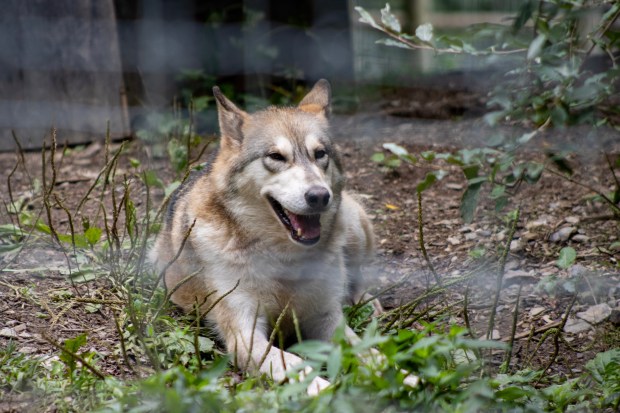 Isabelle lies in the shade of her enclosure at the Wolf Sanctuary of PA. (AISHWARYA BEHL/STAFF PHOTO)
Wildness that endures
The wolves at the sanctuary cannot return to the forests they evolved to inhabit. What the sanctuary can provide is something different: food, veterinary care and enough space to live as wolves, even when they cannot live in the wild.
Their lives remain shaped by humans. But much of the work is about preserving what remains distinctly wolf — their relationships, their independence and their ability to choose when to engage.
Sometimes, that means watching a wolf disappear into the trees.
How to visit and support
Visit: The sanctuary offers guided tours on Tuesdays, Thursdays, Saturdays and Sundays, as well as seasonal programs such as Twilight with the Wolves and Full Moon Fundraisers. Tours cover the wolves’ behavior, rescue histories, and the realities of caring for animals that cannot be returned to the wild.
Reservations: Reservations are available at WolfSanctuaryPA.org. Additional tour availability is posted at 10 a.m. on the first of each month as volunteer schedules are finalized.
Volunteer: Volunteers must be 18 or older and have visited the sanctuary on a tour before applying.
Support: About 10 paid staff members and 40 volunteers help care for the animals and operate the sanctuary, Vander Neut said. Donations help cover veterinary care, food and habitat maintenance. The sanctuary also accepts meat donations.