
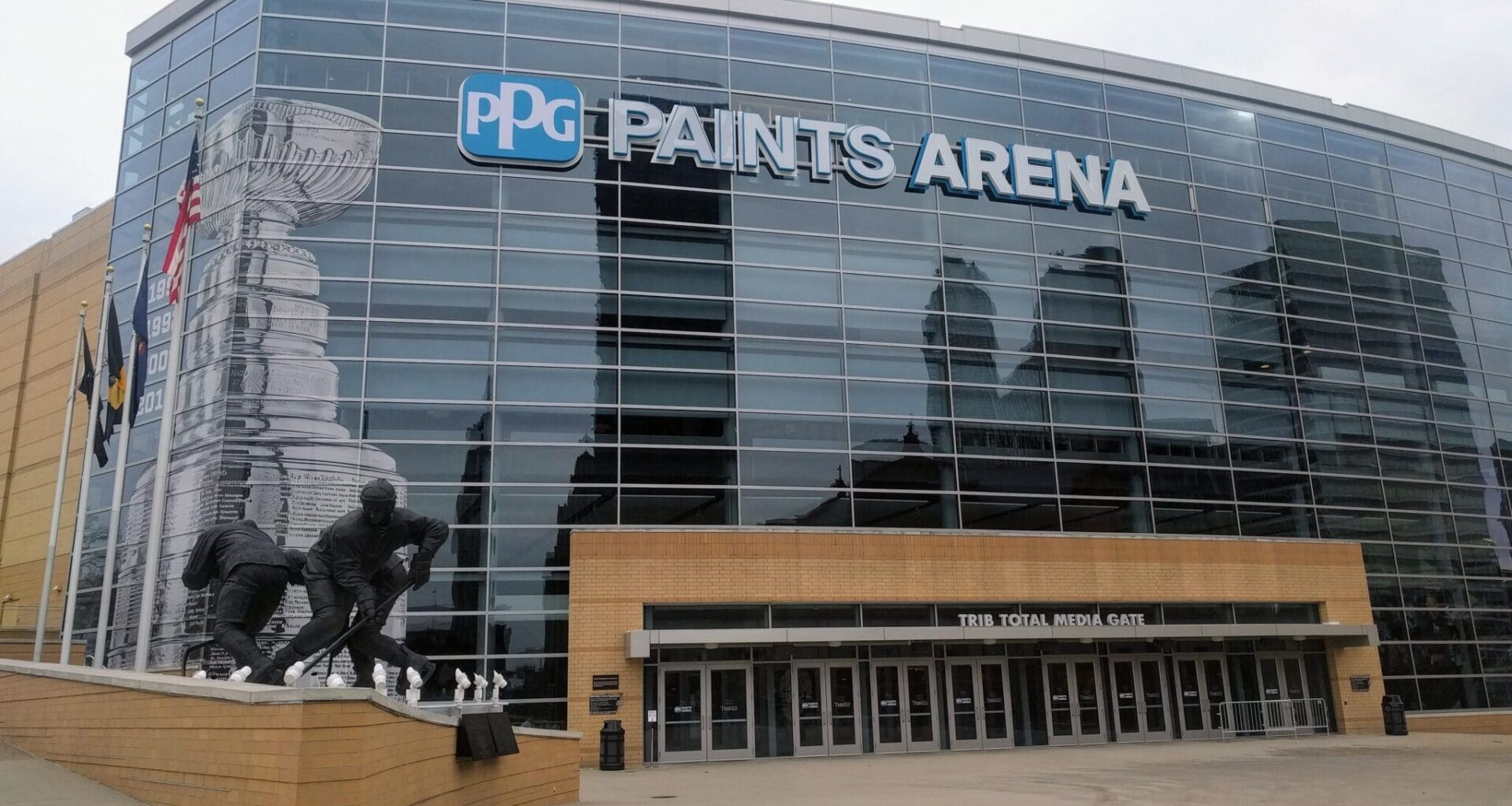
New arenas and stadiums come in groups, usually. But will the protracted timing of the Pittsburgh Penguins’ current home be a blessing or a curse in the future?
This week marks the 25th anniversary of the opening of what was then known as Heinz Field, now Acrisure Stadium. That came on the heels of the Pirates opening PNC Park just months earlier. Meanwhile, the Pittsburgh team, which lived in comparative squalor and most desperately needed a new venue, played on for eight more seasons in the Civic Arena, a barn which opened in 1961 and was not built with hockey in mind.
As many will remember, the Penguins’ arena negotiations were so difficult that the Pittsburgh Penguins nearly moved to Kansas City and into that city’s new arena.
Fast forward to 2026, and the new concert venue, Citizens Live at The Wylie, is scheduled to open Oct. 1 on the former site of the Civic Arena, and it is hard to believe that the Penguins are entering their 17th season at PPG Paints Arena. On the ice, the Penguins are building for the future, but looking much further down the line, could their actual building of the future be somewhere other than their current home?
After all of the hardship and red tape it took to get the arena built, will it stand the test of time the way venerable venues like Fenway Park have, or, however unlikely, will it go the route of McNichols Arena in Denver, which lasted just 24 years (1975–1999)?
There is no rumor or speculation that the Penguins are even thinking about a new building. This is simply an examination of how NHL arenas have evolved and what the landscape might look like down the road.
The current average age of all 32 NHL venues is 26 years, meaning it has been roughly a generation since the building boom of the 1990s. Arenas replaced in recent years lasted about 36 years on average as a team’s primary home, which would put PPG Paints Arena at roughly the midpoint of a modern arena’s typical run.
Arenas from before World War II were built to last. The Montreal Forum hosted 72 seasons, Maple Leaf Gardens 68, Boston Garden 67, and Chicago Stadium 65. What those buildings offered in longevity, though, they lacked in modern revenue streams like luxury boxes.
The Montreal Forum and Maple Leaf Gardens are actually still standing, though repurposed. The Forum is now a large entertainment complex that includes shops, restaurants, a movie theater, and a bowling alley, along with plenty of nods to the Canadiens’ history, with center ice memorialized in the middle of it.
Maple Leaf Gardens now houses a multi-purpose facility featuring a large Loblaws grocery store on the ground floor and the Mattamy Athletic Centre for Toronto Metropolitan University on the upper levels. One row of the original seats remains, as does the original arched roof, and center ice is simply marked with a replica faceoff dot painted in aisle 25 of the grocery store (supposedly near the tuna). There is still an ice rink upstairs, though not on the original’s footprint.
Lifespans began to shorten for the arenas that followed. The Civic Arena and Nassau Coliseum on Long Island had the longest runs of that era, each lasting 43 years as home to an NHL team. Other buildings of the period gave their clubs even less time before becoming a distant memory: Joe Louis Arena (Detroit) at 38 years, Northlands Coliseum (Edmonton) at 37, the Great Western Forum (Los Angeles) at 32, The Spectrum (Philadelphia) at 29, the Met Center (Minnesota) at 26, the Meadowlands (New Jersey) at 25, and the Capital Centre (Washington, D.C.) at 23. To put the difference in building philosophies in perspective, Maple Leaf Gardens (1931–1999) and the Montreal Forum (1924–1996) had more than double the lifespan of buildings like the Capital Centre (1973–1997) and Dallas’ Reunion Arena (1980–2001).
The arenas of the postwar era gave little thought to fans, appearance, character, or revenue. They were poorly lit, poorly designed, and hastily built. Just as with the baseball and football stadiums of the time, most arenas of the 1970s and ’80s were built in the most generic fashion possible.
Chicago Stadium was built in 1929 at a cost of $9.5 million. Shockingly, McNichols Arena in Denver was built in 1975 at a cost of just $10 million — 46 years later, for only $500,000 more. To put that into even further perspective, PPG Paints Arena was completed in 2010 at a cost of $321 million, 35 years after McNichols went up. In today’s dollars, McNichols would run approximately $61 million, while PPG Paints Arena would cost approximately $486 million.
Beginning with the new arenas in Boston, Montreal, and Chicago in the mid-to-late 1990s, the philosophy of the quick-fix, one-size-fits-all arena began to change. At PPG Paints Arena, for instance, the camera wells were among the first things installed. Before seats were even put in, the ideal spots for the best camera angles were identified, and the seating bowl was mapped out around them. Every new arena now features a bevy of revenue-generating luxury boxes, plenty of retail and restaurant space, and designs built to enhance the overall fan experience.
What does the future hold? This coming season will be Calgary’s last in the Saddledome, which will be 44 years old when its replacement, Scotia Place, opens in 2027. The arena itself is budgeted at approximately CA$926 million as part of a larger CA$1.23 billion district.
The Dallas Stars signed a nonbinding letter of intent in June 2026 for a new arena at The Shops at Willow Bend in Plano, as part of a proposed mixed-use sports and entertainment district. It would sit about 20 miles north of their current home, American Airlines Center. The project is still in the design selection phase, not an approved build. It would be the third home for the Stars since the franchise moved from Minnesota in 1993.
In Ottawa, the LeBreton Flats land deal still has not formally closed, though a design reveal is targeted for early 2027.
Across the Keystone State, Comcast Spectacor — which owns the Flyers — and the 76ers settled in April 2026 on a site for a new arena at Broad and Pattison, in the footprint of the old Spectrum. The roughly $1.5 billion building would be shared by the Flyers, the 76ers, and a new WNBA team, targeting a 2030 opening. Regulatory and legislative approvals are still outstanding, and construction is expected to take three years once it starts. The Flyers’ and 76ers’ current home, Xfinity Mobile Arena, would be demolished afterward.
The table below shows when each arena opened and what it cost to build.
All 32 NHL arenas, oldest to newest. Costs are as-built figures; Canadian venues in CAD. Present-day values adjusted to August 2026 using CPI.
Arena
Team
Opened
Age
Cost then
Cost now
Madison Square GardenRangers196858$123M$1.17B
Scotiabank SaddledomeFlames198343CA$97.7MCA$315M
Delta CenterMammoth199135$93M$225M
Honda CenterDucks199333$123M$281M
SAP CenterSharks199333$162.5M$371M
United CenterBlackhawks199432$175M$390M
Enterprise CenterBlues199432$170M$379M
TD GardenBruins199531$160M$346M
Rogers ArenaCanucks199531CA$160MCA$309M
Bell CentreCanadiens199630CA$270MCA$513M
KeyBank CenterSabres199630$127.5M$268M
Canadian Tire CentreSenators199630CA$188MCA$357M
Xfinity Mobile ArenaFlyers199630$210M$442M
Benchmark International ArenaLightning199630≈$139M≈$292M
Bridgestone ArenaPredators199630$144M$303M
Capital One ArenaCapitals199729$260M$535M
Amerant Bank ArenaPanthers199828$212M$429M
Ball ArenaAvalanche199927$164.5M$326M
Crypto.com ArenaKings199927$375M$743M
Lenovo CenterHurricanes199927$158M$313M
Scotiabank ArenaMaple Leafs199927CA$265MCA$482M
Nationwide ArenaBlue Jackets200026$150M$287M
Grand Casino ArenaWild200026≈$130M≈$249M
American Airlines CenterStars200125$420M$783M
Canada Life CentreJets200422CA$133.5MCA$215M
Prudential CenterDevils200719$375M$597M
PPG Paints ArenaPenguins201016$321M$486M
T-Mobile ArenaGolden Knights201610$375M$516M
Rogers PlaceOilers201610CA$483.5MCA$636M
Little Caesars ArenaRed Wings20179$862.9M$1.16B
Climate Pledge ArenaKraken20215≈$1.15B≈$1.40B
UBS ArenaIslanders20215≈$1.1B≈$1.34B
Notes: Madison Square Garden’s 1968 cost excludes the 2011–13 renovation, roughly $1B at the time and about $1.42B today. Climate Pledge Arena’s figure is for the 2018–21 rebuild inside the 1962 Seattle Center Coliseum roof. Delta Center’s figure predates the ~$525M renovation running through 2027. Canadian costs are adjusted with Canadian CPI and are not converted to U.S. dollars.
Only five new arenas have been built since PPG Paints Arena opened in 2010. Given the building’s relatively young age, the hoops the Penguins had to jump through to get it built, and all of the development happening around it, they will not be moving to a new home any time soon. Still, the trends around the league are worth watching. If Philadelphia’s plans come to fruition, the Flyers will walk away from a building only 34 years old — an age PPG Paints Arena will not reach until 2044.
The Penguins are building for the future on the ice. Do not expect them to do the same off it. While PPG Paints Arena may never see a hundred years the way Fenway Park has, it is in no danger of going the way of McNichols Arena either — and for the foreseeable future, it is literally the building where that future will be built.
Tags:nhl news Pittsburgh Penguins PPG Paints Arena Vince Comunale
Categorized:Pittsburgh Penguins