
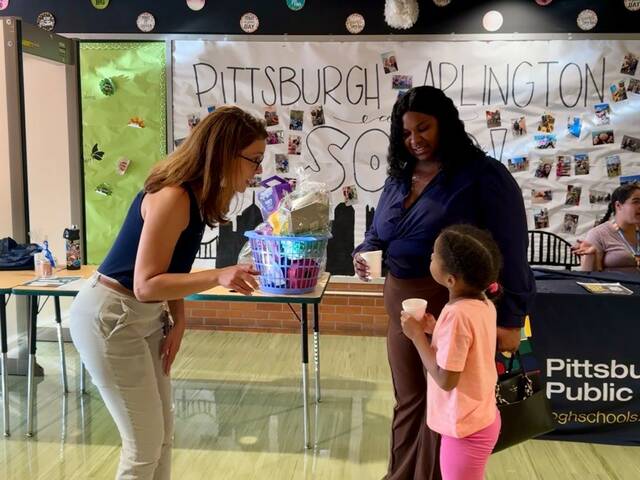
For years, learning and working at Pittsburgh Arlington PreK-8 school was overwhelming.
In the 2024-25 school year, said Principal Crystal Caldwell, more than 130 fights were recorded at the school, located in the city’s southern neighborhoods near Mt. Oliver. More than half of Arlington’s roughly 360 students were considered chronically absent. Caldwell was the building’s fourth principal in as many years.
“It was a lot — a lot of fights, a lot of angry parents,” said Imari Payne-Ford, a parent of two children at Arlington and who’s also worked to provide community services to families in need at the school for the past five years.
Long marred by instability and violence, Arlington’s leaders last school year decided to place an emphasis on instilling a positive school culture, focused on belonging.
With the help of staff, families and community resources, fighting incidents at Arlington were reduced to 10 last year. And morale and trust in the school has taken a 180-degree turn, Caldwell said.
“We have more active families now,” Payne-Ford said. “It was hard to get families to trust us. It’s impactful, the shift in culture at Arlington. It’s rewarding, seeing the bottom; and now seeing more smiles and families.”
Culture shift
Capitalizing on last year’s severe reduction in violence, and continuing the momentum for the school year that starts Monday, is a top priority for Caldwell.
“Arlington’s history has been a school of violence, and ‘Oh, don’t send your kid there.’ We’re trying to help people realize, ‘Oh, you should send your kid here,’ ” she said. “Being able to feel safe, heard and valued is the first step in strengthening education.
“You can’t learn if there’s chaos in your space, and having the culture be one of love and learning, instead of violence, has helped us so much.”
Last year Caldwell, assistant principal Michael Dreger and support staff members began walking the halls every morning to talk about safety and coordinate student support resources. Dubbing it the “safety huddle,” Caldwell believes the consistent communication has contributed to the reduction in school violence.
“We’ve been able to team up and talk about any conflicts in the school,” said Alexa Marotta, a restorative practice project assistant. “Communication blossomed from the safety huddles, and I love the different perspectives we all bring.”
The meetings give staff a consistent grasp on what’s going on in the school — and community. At Arlington, 84% of students are considered economically disadvantaged. Roughly 30% of students receive special education services and 11% are homeless.
“Sometimes, it’s big conversations like homelessness, a sudden death in the family, or a shooting in the community,” Caldwell said. “Sometimes it’s noticing a student who is irritable and in yesterday’s clothes, and taking them to the resource room to get new clothes.”
Staff also implemented a system last year that divides an entire school into smaller teams — called “houses” — to help build community among students and teachers, and rewards students for good behavior. The “house system” will be used across middle schools districtwide this year.
The goals, incentives and celebrations lead to positive behavior, said Dreger, the assistant principal. He meets with each grade level once a quarter to discuss school climate, safety and review data.
“There are positive things we do to build children up, but we also have consequences with actions,” Caldwell said. “Suspensions aren’t the end all, be all — sometimes they are warranted — but if a child makes a mistake, they need to be informed on what could have been done differently, and they need to feel they can give back to the community they harmed.”
Punishment can include “community service” opportunities before the student reintegrates into the classroom. If a child rips posters off the hallway walls, for example, their community service would be helping teachers repost the projects.
“We let the kids talk it out, and they come up with their own way to apologize and say how they will do better,” Caldwell said. “They need a moment of knowing it’s OK to make mistakes, but knowing they can learn from it.
“The key thing is, we still hold them accountable. We try to get to the root cause of what happened.”
What will this year hold?
Changes at the school last year were noticeable to Dontaya Fisher, mother of rising fifth grade student Omari Kemp and incoming pre-kindergarten student, Sir Yancey, 3.
“It seemed like they put an extra push last year, as far as attendance, violence and getting excited about coming to school,” Fisher said. “I see it getting better for the future, especially after last year.”
Omari, 10, had behavioral issues. He has been able to better regulate his emotions through lessons on mediation, social skills and deescalation, his mother said.
“The social class he’s in, as far as the resources they provide him with, has been very good to him,” Fisher said. “He’s much more calm now, and there’s no more tantrums.”
Marotta hopes to build on similar lessons this year. Teachers, also every morning, lead lessons focused on social-emotional skills. Her goal this year is to improve targeted support for students with extra needs.
“I see kids stepping into a leadership role at Arlington,” Marotta said. “Each year, I see more students wanting to be a part of the community and make a positive impact. When kids see teachers that are passionate, they want to be a part of it; and I think Arlington is going to thrive.”
Caldwell will continue to lean in on student leaders to be a positive influence among their peers. Poor behaviors, by nature, garner others’ attention. The student leaders have tried to encourage staff to spotlight attention for good behaviors, Caldwell said.
“They said, we as peers want to give attention to when they do something well,” Caldwell said. “It’s seeing it through the child’s lens, and having a say in how they lead.”
The school’s goal is now reducing the number of physical aggression incidents. Caldwell defined physical aggression as when a student has a hard time managing emotions but doesn’t touch others.
“Physical aggression is often, ‘I’m bringing trauma into school, and I’m frustrated,’ ” Caldwell said. “They enter the building that way, and we try to help them honor that their emotions are valid, and here’s how we can manage them.”
For the first time, the building is fully staffed, Caldwell said. Families appear to have more trust and interest in the school. Staff morale has improved.
While improvement in academics have yet to be seen — English and math proficiency rates on state assessments schoolwide were less than 11% in the 2024-25 school year — Caldwell believes the growth is coming.
“Even though we were focused on culture and violence, we saw an uptick on academics,” she said. “We saw growth on local assessments, because students felt safe and staff had more time to educate.”
Caldwell believes her ambitious plan to increase reading proficiency 30% schoolwide can be met through a strategy called “improvement science,” a data-driven model that helps teachers tailor instruction and focus on where students need remediation.
“It’s more rapidly looking at data and making skill-based decisions,” she said. “Our staff wanted to see students reading, but our systems weren’t doing it fast enough. This is helping them do that work in a more structured way, and at first, they’ll be working hard, but we’ll see growth.”
Payne-Ford, the community advocate and parent, is optimistic for the literacy emphasis for her son, Amari, 8, entering second grade.
Her older son, Mikey, 10, has autism. As he enters fifth grade, Payne-Ford anticipates Mikey continuing integration in the general education classrooms when appropriate.
“He is now in the ‘real world,’ regular education, and is still getting his needs met,” Payne-Ford said. “There is change. Our teachers are the reason my son’s in regular education now. We didn’t think that would happen.”
And the following year …
In the 2027-28 school year, Arlington will experience changes under Pittsburgh Public’s reconfiguration plan, called the Future-Ready Facilities Plan.
Arlington will be a dedicated middle school, serving students grades six through eight. It will receive South Brook students, a school that will close. Arlington elementary-aged students will attend Concord, Phillips or Roosevelt.
The district’s Parent Ambassadors program, which launched this summer, aims to help families navigate the transition. Arlington’s Parent Ambassador will encourage parents to access online school portals, Caldwell said. Only 9% of school families have logged onto those tools.
“There will be a lot of work to get ready for next year,” said school board member Eva Diodati, whose election district includes Arlington. “It will be a big change, and I know people are nervous, but I think the success Arlington has had means the place can handle change.”
Diodati believes the soft skills and relationship building students picked up at Arlington will translate over to other schools. Having the “house system” at all district middle schools is also a bright spot.
“I think we’ll see a lot more consistency from our middle schools. The consistent spirit of belonging, teamwork, conflict resolution and responding to problems, instead of reacting, gives me hope,” Diodati said.
“Schools in a similar position can take inspiration from Arlington. It’s hard, but it’s not impossible. I would love it if other schools look to Arlington as an opportunity to innovate and build themselves up.”