
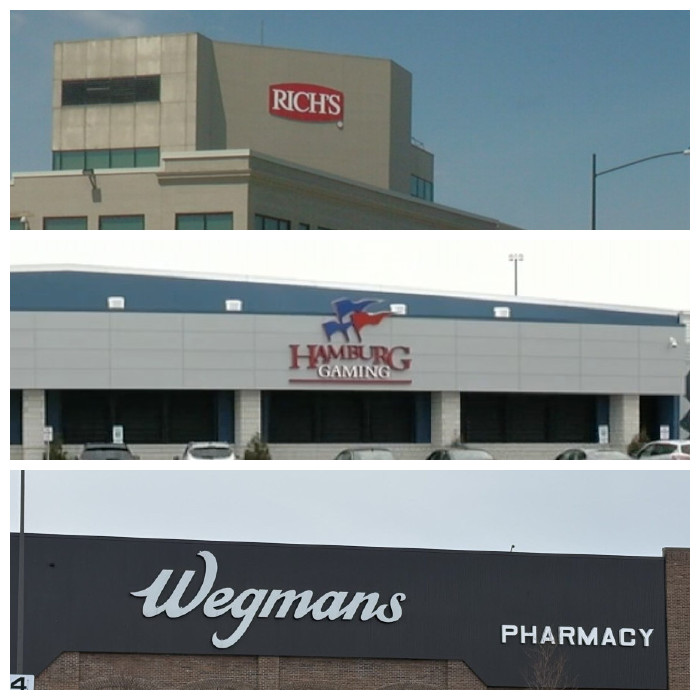
Erie County has banned the use of facial recognition technology and is requiring disclosure by companies who have used it to. A small number have, including Wegmans, Delaware North and Rich Products.
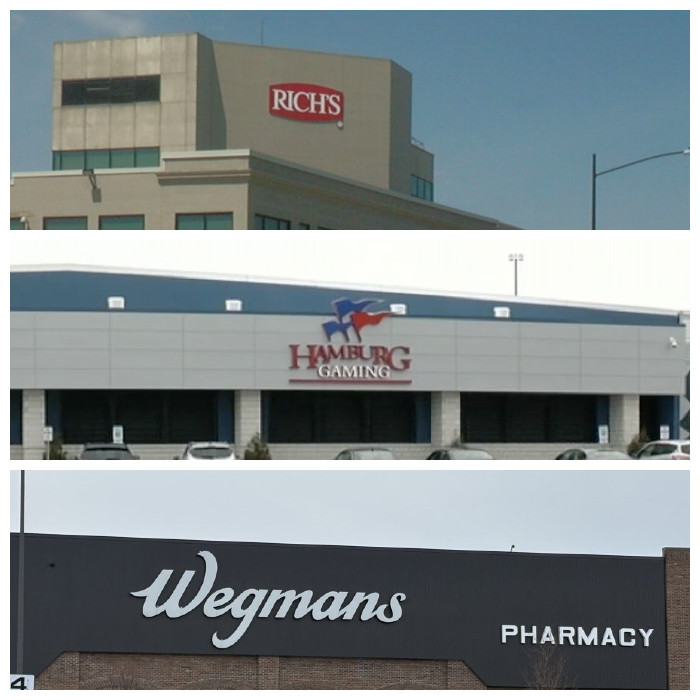
Rich Products, Hamburg Gaming and Wegmans have all disclosed use of facial recognition technology. Images via WKBW and J. Dale Shoemaker.
Some of the biggest companies operating in Erie County have admitted to using facial recognition technology in their businesses.
The list includes Delaware North, which scans the faces of each person who enters its Hamburg Gaming racetrack and casino.
Wegmans has used facial recognition technology at its store on Amherst Street.
And Rich Products said it captured 1.1 million “facial vectors” in May and June of this year, seemingly at its Niagara Street offices.
Wegmans and Rich Products say they’ve since destroyed the face scans and have pledged to not capture any more. Delaware North says it plans to continue scanning faces.
Those disclosures are thanks to a new Erie County law that requires companies to file notice if they have collected biometric data. If they have, the law mandates the companies destroy what they have and commit to not collecting more.
Investigative Post obtained the disclosure reports under the state Freedom of Information Law.

The law applies to all businesses and not-for-profits in the county, unless an exemption is carved out. Funeral homes, for example, can collect fingerprints of the deceased for “memorialization” purposes. Four funeral homes disclosed to the county that they’ve collected fingerprints for such purposes, but that they’ve since destroyed the records.
Businesses licensed by the state Gaming Commission — like Delaware North’s Hamburg Gaming — are also exempt.
The law has been in place since June 5. Businesses in Erie County had 30 days from that date to come into compliance. To date, just 30 companies have filed the necessary disclosures. The county has published a website explaining to companies how to comply but has yet to directly inform businesses of the new law.
Trek Fulater, an attorney and the county’s director of policy, said he expects the number to grow.
“I have a sneaking suspicion, as we move forward, we’re going to find more and more businesses that have this information,” he said.
The law applies to national and international brands, too. Major retailers that use facial recognition technology — Macy’s, for example — have not disclosed any use.
“I know some things take time to change, but I believe that we’ve given them enough notice, and I’m hoping that that number goes up,” Erie County Legislator Taisha St. Jean Tard said.
“I’m hoping that in the next couple weeks we could really make a big push.”
What’s being collected locally
Local concerns about facial recognition technology — resulting in the new Erie County law — began in January, when Wegmans made national headlines for its use of face scans in New York City. In January, a reporter from the news outlet Gothamist noticed a sign on one store disclosing that the company was collecting face scans. That prompted questions as to whether the Rochester-based grocer was using similar technology at its stores in Western New York.
The company, in January, refused to say. Spokesperson Michele Mehaffy said she would “not get into the specific measures used at each store.” Investigative Post at the time reported on all the other customer data Wegmans collects in addition to biometrics.
But once the new Erie County law took effect, the company admitted it had been using facial recognition technology at the Amherst Street store in Buffalo.
“This technology was only used in Erie County at the Amherst Street location and has already been disabled,” the company said in a May statement to WIVB.
David Spang, Wegmans’ vice president of asset protection, said in the company’s report to Erie County that the company is no longer “in possession of biometric information.”

Cameras at the Wegmans on Amherst Street. Photo: J. Dale Shoemaker.
Mehaffy, in an email, refused to say when Wegmans began scanning faces at the Amherst Street store or how many it captured. She would only say that the company no longer collects facial scans, deleted the data it had and removed the cameras.
“This technology was used solely as an added layer of security,” Mehaffy said. “Wegmans did not sell the data.”
Rich Products spokesperson Allie Friedman refused to tell Investigative Post where the company had deployed facial recognition cameras to collect the 1.1 million “facial vectors” it admitted to having — but implied the company was scanning the faces of its employees.
“The facial vectors related to associates and guests and were used in the limited context of facility safety and security measures at Rich’s,” she said in a statement.
Friedman said the technology was not used at the company’s entertainment venues like Sahlen Field, the Powerhouse or the Atrium. Friedman wouldn’t say how many people the system recorded, but noted the company deleted all the data it collected.
Delaware North, operator of Hamburg Gaming, wants to keep collecting face scans of visitors to the casino. It disclosed to Erie County that it collects copies of photo IDs and “facial captures” of all its patrons. Daniel Carpenter, associate general counsel, said in the company’s filing to Erie County that it plans to file for an exemption from the law to continue doing so.
The county’s rules include a carve-out for businesses licensed by the Gaming Commission. Delaware North spokesperson Glen White said the company deletes the face scans after 18 months.
Compliance a problem
So far, only seven businesses in Erie County have disclosed possessing biometric data — and only 30 have submitted disclosure forms at all.
Under the law, companies can be fined up to $6,000 daily for collecting biometric information and failing to disclose it. If a company is found to have violated the law, they have 30 days to disclose the data they have and destroy it before fines begin.

Erie County Legislator Taisha St. Jean Tard. Photo: WKBW 7 News.
St. Jean Tard said in an interview that she expects the county to begin sending letters to businesses, notifying them that they must disclose and destroy any biometric information they have in their possession.
With large retailers and other companies, Legislator Jeanne Vinal said the county’s new law may have “fallen on deaf ears” meaning it’s time for “a second outreach.”
“I do know that a lot of big guys need a lot of prodding,” she said. “For out-of-town businesses, they are going to need a notice sent to their corporate headquarters, I think so that they can understand how serious it is.”
Investigative Post reached out to Walmart, Target and Macy’s — three major retailers that have disclosed they collect biometric data and operate stores in Erie County. None responded to requests for comment.
St. Jean Tard said the possibility of a data breach was one motivation for enacting the law, which passed 7-3 in April.
“Imagine having all those faces in a cloud where anybody could hack and have that data,” she said. “That’s why this law is in place.”
A spreading technology
Use of facial recognition technology and other means of collecting biometric information has become widespread. In addition to private businesses, the U.S. government scans your face whenever you cross the Peace Bridge from Canada.
Companies using biometric data often say they use the technology to prevent theft, as Wegmans did. But others share or sell the data. Macy’s is explicit: “We may sell your biometric personal information,” the company’s website states.
WalMart, too, which has multiple locations in Erie County, discloses on its website that it collects some biometric data via its mobile app and may share that information with third parties. Neither company has submitted a disclosure statement to Erie County.
Mark Bartholomew, a University at Buffalo law professor who researches technology issues, said use of biometric data raises three main concerns:
Retailers will use the information to target advertisements to consumers to entice them to buy more products.
Companies will use the information to ban people they don’t want in their stores.
The data winds up in the hands of law enforcement.
For a retailer, Bartholomew said, biometric data may offer a “richer portrait of you,” allowing companies “to better pinpoint how to advertise to you. I think that’s one big concern.”
It may also be used to kick out certain people from a business, as New York Knicks owner James Dolan has done at Madison Square Garden.
The biometric data may also find its way into government hands, allowing law enforcement to track a person’s movements even more precisely than they can with license plate readers, which are deployed across the region.
Subscribe to our free weekly newsletters
“We should have some privacy, some shielding from some commercial entreaties,” Bartholomew said. “But even if you were of the [opinion that] ‘Ah, I don’t care how they sell to me,’ you might care a lot more that now the government has a facial identification for me.”
Bartholomew said the public and government is in a “race” with businesses utilizing biometric data. He said he likes Erie County’s law because it’s an example of government “taking a stand.”
“It’s a question of whether we get outraged enough,” he said, “or if we’re kind of like the frogs in the boiling water, and we’re just like, ‘Well, I’m so used to it, it’s the price of business.’”
posted 42 minutes ago – August 27, 2026