
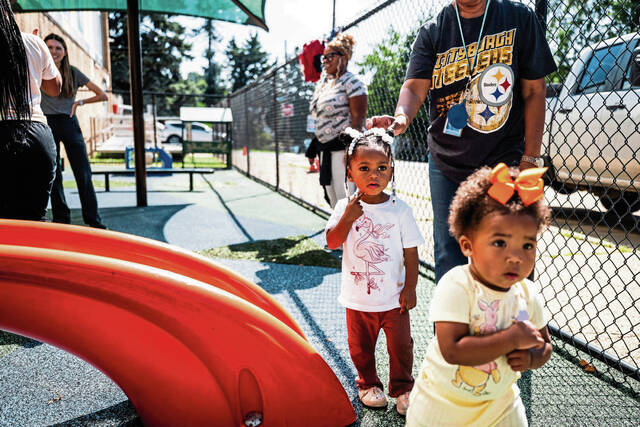
Pittsburgh parent Lauren Stuparitz credits the federal Head Start program with transforming her neurodivergent son’s life. Now, as the Trump administration proposes sweeping regulatory changes to the initiative, Stuparitz and other families worry about its future.
Now 6 years old, her son speaks in complete sentences, reads independently, communicates his needs and confidently raises his hand in class. He started first grade Monday at Pittsburgh Public Schools.
“The Head Start program in Pittsburgh was really a lifesaver for my family,” said Stuparitz of Westwood. “I probably sound very calm now because I have a little distance from the situation, but it’s very stressful worrying about your child’s health and future.”
As Stuparitz digests the proposed federal adjustments, she worries new guidelines will weaken the program’s ability to support families.
“I’ve had so many positive experiences with Head Start,” she said, “that I don’t understand why anybody would want to mess with something that’s working.”
History, proposed future
Established in the 1960s as a gold standard early learning initiative offered by roughly 1,600 agencies nationwide, Head Start serves children ages 3 to 5 from families at or below the poverty level. For a family of four in the contiguous United States, this means an income of $33,000 or less.
The Early Head Start branch supports infants, toddlers and pregnant women.
Overall, the federal enterprise benefits about 700,000 low-income children, including homeless, special education and foster care youth, according to the Associated Press.
Now, however, the Department of Health and Human Services has proposed a series of extensive changes to the 100-page regulations document governing these early education services.
Health Secretary Robert F. Kennedy Jr. described the proposal as “removing unnecessary bureaucracy, strengthening nutrition and physical health, trusting parents and local communities and opening Head Start to hundreds of thousands of more children.”
The measures, he said, would add 236,000 more children to the program and reduce federal spending by $2.2 billion.
But Head Start advocates are expressing concerns about the adjustments, saying they would “change things dramatically” for the programs, said Kara McFalls, executive director of the Pennsylvania Head Start Association.
”Head Start is a powerful program,” she said. “It changes lives, and we will support our programs and Head Start to continue to be recognized as a national program with quality standards that are replicable in every state and in every service community.
“We do not support changes to the standards in this way, and we stand by the rigorous quality that Head Start offers to families.”
The changes would eliminate about 1,400 Head Start regulations, leaving guidance of the program in those areas — including staff-to-student ratios, health and developmental screenings and parental input — up to state law.
That worries Susan Buffton, director of early childhood education programs for the Council of Three Rivers American Indian Center in Pittsburgh.
“Right now, Head Start programs should all look pretty much the same in terms of the services they provide and the quality of those services,” she said. “That wouldn’t necessarily be the case (under the proposed changes).
“You could have a program that’s operating at the bare minimum standards while another program is trying to maintain the highest standard, so you’re going to lose any sense of uniformity in the program as a whole.”
The proposal would limit the amount of federal funding Head Start providers can spend on administrative expenses — capping costs at 5% instead of the current 15%. Homeless families would be required to submit additional documentation to prove their housing status, and agencies would be allowed to expel or suspend children from the program.
It would eliminate teacher credential requirements and require Head Start providers to obtain a license with the state.
It also would bolster nutrition education and exercise requirements — 30 minutes of physical activity for every 3½ hours students are in a Head Start classroom.
The proposed adjustments are open for public comment until they take effect Oct. 6, but potential lawsuits could halt implementation, according to AP. Visit regulations.gov for guidelines on how to submit feedback.
State standards
Six agencies offer Head Start in Allegheny and Westmoreland counties, benefiting more than 30,000 pregnant women, infants, toddlers and preschoolers, McFalls said. The state Head Start association supports the 63 intermediate units, community action programs and agencies that operate Head Start and Early Head Start statewide.
Kim Russo Joseph, director of the Pittsburgh Public Schools Early Childhood Program, is confident the state’s Head Start classrooms would maintain a high-quality education even if the federal proposal goes into effect.
Pennsylvania’s early childhood education guidelines — set for programs such as Head Start Supplemental Assistance and Pre-K Counts — align with the current Head Start standards, she said.
“I feel that we are fortunate in the state of Pennsylvania that we have a supportive governor and we have an office of child development and early learning at the state level with folks that truly understand early childhood,” she said. “We do have really good state standards.”
For example, federal guidelines set staff-student ratios at one adult for every 10 children — between ages 3 and 5 — in a Head Start classroom, McFalls said. For classrooms with more than 17 children, two teachers are required.
Pennsylvania law also sets a one-adult-to-10-children ratio for classrooms of students ages 3 and 4, McFalls said.
But Russo Joseph suspects that other states are not as well-equipped.
“I’ve been on multiple phone calls and webinars since this was released,” she said. “There is a lot of panic (in) some places where they don’t have strong early childhood (regulations) across the state, where people really depend on that.
“And there are some states that don’t have other early childhood programs, that only have Head Start. This could be a really devastating blow for some states and some areas where families completely depend on this.”
Some states — including Alabama, Arkansas, Arizona, Florida, Georgia, Indiana, Mississippi, North Carolina, Nevada, Texas and Tennessee — allow for larger classroom sizes than the current Head Start regulations, according to national bipartisan advocacy nonprofit First Five Years Fund.
Florida, for example, sets staff-student ratios at one teacher for 15 students between ages 3 and 4 and one teacher for 20 students between ages 4 and 5.
Some Pennsylvania programs have three teachers to manage 15 students “because that is what that community needs,” McFalls said.
“While the administration says that of course programs can continue to do that, they have a goal to increase the number of children served in Head Start and cut money,” she said. “So while a program may prefer to keep their ratios as they are, I don’t see — nor do our programs see — how the funding will ensure the programs can do what they want to do.
“Deregulation does not come with more money or the same money, and that’s a real concern for us.”
Parental involvement
The Trump administration said the proposal will continue requiring programs to “engage parents and families in their children’s learning and development.”
But it would eliminate the requirement that programs have parent committees — groups made up entirely of parents and guardians with children enrolled in Head Start or Early Head Start.
Head Start providers would still be required to have a policy council, which serves a similar purpose. Only half of a policy council’s members must be parents or guardians of Head Start students.
Providers could choose to continue organizing parent committees. But Russo Joseph believes eliminating the requirement will make it difficult to find parents willing to give their time to a committee.
“Parents might not be as involved in having a say in the curriculum and materials and activities and things that are happening in the classrooms and how we’re using some of the grant funding,” she said.
Adam Hobaugh, policy council chair for the Council of Three Rivers American Indian Center, believes the removal of parent committees would hamper the council’s ability to “effectively govern from a parental point of view.”
Hobaugh is entering his fifth year serving on the policy council. His daughter, now in kindergarten, was enrolled in Head Start for about four years.
The American Indian center has three Head Start locations, in Pittsburgh’s Knoxville, Hazelwood and Dorseyville neighborhoods. Each location has its own parent committee, and representatives from each committee sit on the policy council, Hobaugh said.
“(The policy council) might not be aware of everything that’s going on, because we’re not active parents in that system,” Hobaugh said. “The parental involvement is crucial to knowing what’s going on and to being able to address the concerns.”
Screening requirements
Stuparitz, mother to a child who has experienced developmental delays, is concerned particularly about how the proposal would impact special education students — particularly by eliminating requirements for screenings that assess students’ academic, social, emotional and physical health.
“That is a huge safety net for kids and their families — to make sure that you can know the signs and act early … if the kids need extra support at that time in their development,” she said. “Helping the children with special needs when they’re 3 or 4 or 5 years old in a Head Start program sets them up for success in elementary school.”
She continued: “It becomes a snowball effect if it’s not addressed until later. The fact that they’re not going to do that kind of healthcare coordinating just does not sound like good practice.”
What the proposal means
The Head Start proposal would eliminate about 1,400 regulations, leaving guidance of the program in those areas up to state law. Some of the regulations slated for elimination include:
• A staff-to-student ratio of one adult for every 10 students in a classroom of students ages 3 to 5
• Required health and developmental screenings of students by providers
• Required parent committees, where parents and guardians of students give input on the program’s operation
• Standards that prevent explusion or suspension of children from programs
• Required credentials for teachers
• Required lead exposure prevention methods
The proposal also would:
• Set a 5% cap on providers’ administrative expenses — down from the current 15% limit
• Require 30 minutes of physical activity for every 3½ hours students are in a classroom
• Mandate providers to give more nutrition education to families
• Require that all instruction be delivered in English, except in tribal communities
• Mandate homeless families to submit additional documentation to prove their housing status