
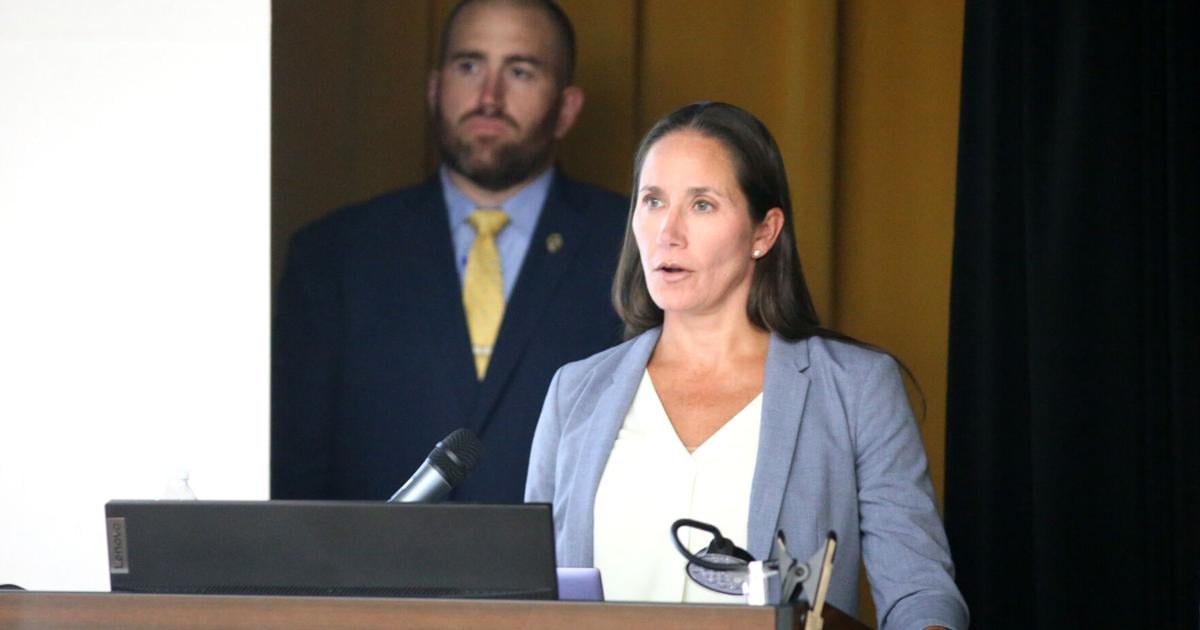
Social media, drug use and, increasingly, artificial intelligence are major factors contributing to the problem of human trafficking, according to two Pittsburgh representatives of the Pennsylvania Office of Attorney General.
About 50 people, including the Venango County district attorney and assistant district attorney and some local law enforcement officers, attended the presentation “Human Trafficking 101: Spotting the Signs,” held at the Oil Region Venango Campus and hosted by State Rep. R. Lee James. The AG representatives gave the presentation, discussing the signs and characteristics of human trafficking, myths about the crime and what can be done to stop it.
“There is no one picture of what a human trafficking victim looks like,” said Summer Carroll, assistant chief deputy attorney general in the Human Trafficking Section of the Pennsylvania Office of Attorney General. “What they have in common is vulnerabilities, and traffickers are very good at seeing what that vulnerability is and stepping in to fill that.”
That applies for both sex and labor trafficking, she added, noting that while sex trafficking tends to get the lion’s share of public attention, some statistics indicate that labor trafficking is even more common in the United States.
The most common vulnerability in 2023 was drug or substance abuse, said Jim Hindinger, supervisory special agent with the Pennsylvania attorney general’s office. Oftentimes, traffickers are also drug suppliers for their victims, forcing their compliance with the trafficker’s demands.
But there are many other vulnerabilities traffickers abuse, such as mental health concerns, unstable housing or recent relocation, poverty, history of sexual abuse or domestic violence, low self-esteem, or language or cultural barriers, Carroll said. For minors, additional vulnerabilities include being in the foster care system, being homeless or a runaway, or identifying as LGBTQ+.
Especially for sex trafficking, the crime is driven by demand. “When we reduce the demand for commercial sex, sex trafficking will go down,” Summer said.
A chart Summer shared showed Pennsylvania counties that had charged a defendant with a trafficking-related offense between 2014 and 2025. While no cases were shown in Venango, Clarion, Crawford or Forest counties, there were charges in Warren, Butler, Elk, Mercer and Jefferson in those years.
Social media and AI
The top three platforms in 2023 that were identified to recruit victims of sex trafficking were all popular social media sites: Snapchat, Facebook and Instagram, said Hindinger.
“Now we’re seeing TikTok direct messages and Discord trending up there,” he added. “But every social media site you can think of is used or has been used for trafficking.” Online video games are also a place where victims can be recruited, he said.
And artificial intelligence is adding wholly new dimensions to the dangers of the online world.
“AI can make a grown man look like a kid for a video chat, it’s gotten that good,” he said.
At the end of the presentation, Hindinger showed a video demonstrating how pictures of a child that are posted on social media could be used to create an AI-generated older “version” of them, and explained how they could be used to generate inappropriate pictures or videos, or for identity theft or other crimes. The video encouraged parents and guardians to be extremely careful of their child’s privacy when posting online.
“AI is so advanced now,” he said. “It’s a very powerful tool, and we do use it in law enforcement. As privacy laws change, we are required to disclose how we use it. Bad guys, they use it for everything.”
Hindinger also shared a short animated video demonstrating how a teen boy could be recruited to sex trafficking through online gaming. In the video, the boy’s family made sure to keep all of the chats for evidence against the trafficker — something Hindinger said is important.
”Sometimes parents delete all of the chats, or the kids delete everything because they are so scared, but then there is no evidence,” he said.
The psychological factor
In discussing a number of myths around human trafficking, Carroll said a common misconception is that most trafficked victims are physically held against their will, or that they are often kidnapped.
In reality, traffickers more often use psychological manipulation and grooming to make victims believe they want to be in that situation, as it is “much easier than holding them against their will,” she said.
That’s where the vulnerability of victims comes in, as traffickers step in to “fill the need” and often create a trauma-bonding situation, she continued. Meanwhile, federal data from 2019 to 2023 shows that kidnapping was involved in less than 1% of federal human trafficking prosecutions.
Trauma-bonding can be so effective that victims may not even want to testify against their traffickers, Carroll said, recounting the case of a 17-year-old girl who had been with her traffickers since she was 12, and who was so effectively manipulated that “she very much did not believe she was a victim.”
Sometimes, if victims refuse to testify or don’t wish to go through the justice system, law enforcement has to walk away from a case unless they can get a perpetrator on another charge, Hindinger said.
Traffickers can also manipulate victims by making them afraid for their safety or the safety of someone they love, like a child or younger sibling.
Who are traffickers?
While trafficking can occur with strangers, especially online, Carroll said that “very frequently” the trafficker is a person the victim knows and has a relationship with, such as family members, family friends and intimate partners, including spouses.
Like victims, Hindinger said traffickers also have no single face and can be any gender, age or race. They can reach victims at popular meeting places on campuses or at parties on or off campus, through deceptive offers of employment or romance, or by taking advantage of financial instability, among other things, he said.
A chart Hindinger shared showing the positions of trust held by traffickers in federal cases from 2019 to 2023 elicited some murmurs or surprise from the audience. According to the chart, by far the top two positions of trust held by traffickers were teachers or school staff and law enforcement.
Once victims have been trafficked long enough, they can also begin recruiting other victims, either because the trauma bond makes them loyal to their trafficker or because by recruiting someone else, they relieve the pressure on themselves, he said.
Fighting trafficking
Hindinger said that the human trafficking team with the PA Office of Attorney General in western PA consists of him and two other agents, who are responsible for 32 counties.
Because of their limited manpower, they rely on a response team that collaborates with other law enforcement agencies at the federal, state and local levels, as well as other groups.
“Any agency that wants to work with us, we work with,” Hindinger said, mentioning groups like the Salvation Army, Child Advocacy Centers, medical centers, first responders and local prosecution.
Hindinger and Carroll said anyone who suspects a person is a victim of human trafficking can call 911 in an emergency, or local authorities.
They also provided information about Safe2Say Something, which has a 24/7 anonymous tipline and an app, among other things.
Its website is safe2saypa.org, and the phone number is 1-844-SAF2SAY, or 1-844-723-2729.