
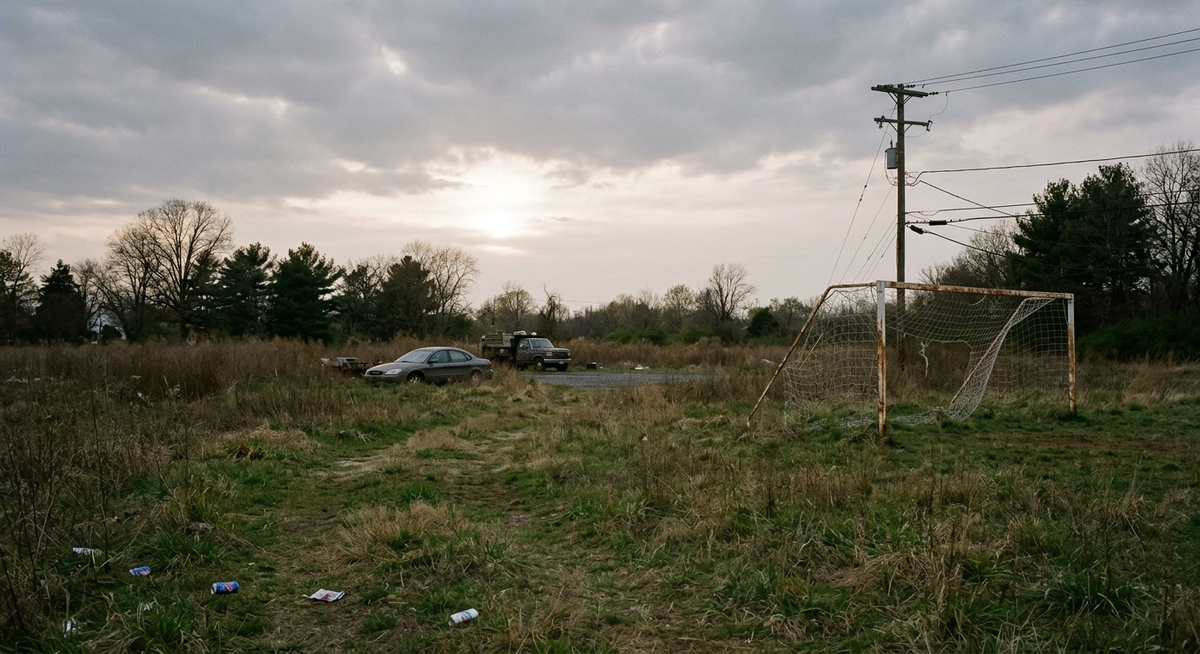
At the intersection of Dunks Ferry and Mechanicsville roads in the Far Northeast, just short of the Philadelphia County line, someone has spray-painted the word “POTTER’S” in big black letters on a weathered utility pole. It is the only obvious marker for what lies beyond a lonely soccer field with overgrown weeds and a single goal: Philadelphia’s last potter’s field, where hundreds of unclaimed people are buried.
Across the street, boys run baseball drills at Junod Playground. But on the cemetery side, past two concrete median barriers hidden behind a windbreak of trees, a mown field stretches 500 feet deep and 200 feet wide. A brass plaque reading “City Cemetery” once announced the site from Dunks Ferry Road. It was stolen long ago. Without it, and with the grave markers sunken into lumpy earth, the burial ground could be mistaken for just another field.
446 buried by 1975, then the space ran out
The city began using the Dunks Ferry Road site in 1956, after decades of burying unclaimed bodies at a cemetery on West Luzerne Street between North 2nd Street and Whitaker Avenue. Prior to the move, the coroner’s office buried an average of 100 unclaimed bodies every year, a figure that included victims of the 1918 influenza pandemic and a growing number of poor and unidentified people during the Depression.
In August 1957, just a year after the cemetery opened, investigators buried its most famous resident: a boy found in a cardboard box in Fox Chase who was never identified despite an investigation lasting decades. City detectives and other donors raised money for a headstone that read, “Heavenly Father, Bless This Unknown Boy, February 25, 1957.” In 1998, the boy’s body and headstone were moved to Ivy Hill Cemetery.
By 1975, the remains of 446 people had been interred at the site. Five of the bodies buried that year were children whose families could not afford the $1,500 to $1,800 undertaker’s fees. The medical examiner’s office doubled up 16 bodies in fiberboard coffins to conserve grave space.
One of those sharing a coffin with an infant was James Nolan, found starved to death in an abandoned house on the 2800 block of N. 12th Street. All he had for identification was a doctor’s prescription and a bus ticket from Baltimore.
“Lots of people don’t think it’s possible. But it’s very, very easy to die completely unknown in a big city,” said Jim McGovern, chief investigator for the medical examiner’s office.
Prisoners dug the graves for decades
Patty McCarthy, who first moved to the neighborhood near the potter’s field in 1965, told Hidden City Philadelphia that the cemetery was initially maintained by prisoners from Holmesburg who were trucked in to work on a prison farm established there in 1931. The city had originally planned to build a new prison on the farm, but those plans fell through. Food grown on the farm fed city prisoners, school children and patients in city hospitals.
Prisoners were still digging graves and helping transport bodies to the cemetery into the early 1980s.
When burials took place, McGovern said a Catholic prayer if he attended. When medical investigator Al Rosenblatt attended, he said a Jewish prayer. By mid-century, Catholic, Jewish and veterans’ organizations were paying for the burial of an increasing number of unclaimed people. A group of parishioners from nearby St. Anselm Roman Catholic Church, led by Gerald Whartenby, a city detective and church member, started attending burials in the mid-1970s.
A surge in unclaimed dead overwhelmed the site
Through the 1960s, the medical examiner’s office had remarkable success identifying the dead. In the first 16 years after the coroner’s office was rebranded as the medical examiner’s office in 1955, investigators identified all but 18 of the 75,000 bodies examined. In 1964, only one adult was buried in the potter’s field. By 1970, only two of 123 unidentified bodies brought to the office remained unidentified at burial.
But by the mid-1980s, the number of unclaimed bodies processed each year rose significantly. McCarthy traced the increase to a 1981 change in federal rules on death benefits. Before the change, friends and more distant relatives could claim Social Security benefits to pay for private burials. The new regulations restricted those benefits to children or spouses only.
In 1985, the city ran out of the small cement blocks, 5 by 5 inches, inscribed with grave numbers and placed above each burial. The city maintenance worker who had made the blocks for years quit, and budget constraints made it difficult to procure replacements. Starting the following year, unclaimed bodies were cremated unless they remained unidentified or impoverished relatives objected.
Increasing burial costs and a lack of funding led the city to stop burying the unclaimed at the Dunks Ferry Road cemetery altogether soon after.
Fiberboard coffins caving in beneath the grass
McCarthy, who moved back to the neighborhood as an adult in the late 1980s, said she believes the ground has subsided as the cheap fiberboard coffins deteriorated and collapsed underground. As early as 1968, a resident wrote to the Inquirer to complain about the cemetery’s condition: “This pauper’s burying ground used to be one of the best kept cemeteries in the city. Now the grass and weeds are high and some of the graves have sunk several inches.”
Today, crushed beer cans and bottles pile up near trailheads on the far side of the field that lead down to the Poquessing Creek. McCarthy said kids used to ride ATVs through the area, tearing up the land. The small cement markers have sunk into the earth over time, invisible unless you know where to look.
Many of McCarthy’s neighbors do not even know the cemetery exists. Nancy McClernan, who grew up in nearby Bensalem, remembers riding her bike down Century Lane toward the Parkwood playground as a child in the 1960s. Walking past the boy’s headstone, the only marker visible then, was the most unnerving part of the trip.
Now that headstone is gone, moved to Ivy Hill. In its place, a pair of groundhogs peek out of a hole in a mound of lumpy earth, right about where the stone once stood.
1,500 cremated remains finally laid to rest in 2010
For 25 years after burials stopped at the Dunks Ferry Road site, cremated remains of the unclaimed were kept in the medical examiner’s office in labeled bags and cardboard boxes. In 2010, 1,500 of those remains were buried at Laurel Hill Cemetery under a single headstone reading, “1500 Citizens, Consigned to Earth, City of Philadelphia, 2010.”
The medical examiner’s office still maintains a room with the remains of unclaimed people who died after 2010.
The potter’s field at Dunks Ferry and Mechanicsville roads, Philadelphia’s last, sits unmarked except for that spray-painted utility pole. No plaque, no fence, no formal acknowledgment from the city. Hundreds of people lie beneath a field that most passersby take for open parkland.