
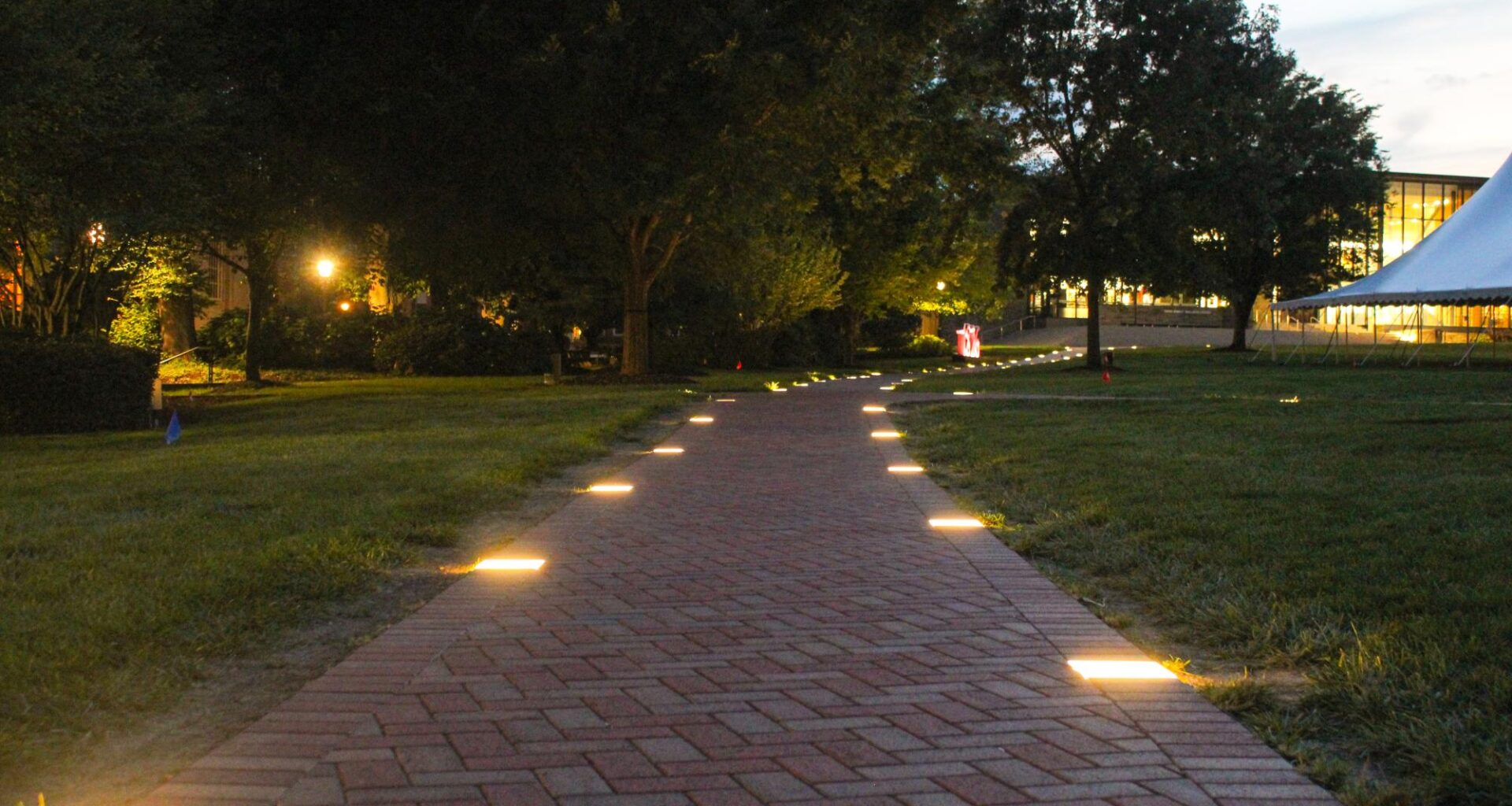
Permanent lighting was installed on Lafayette College’s Quad after a student and faculty-led movement raised concerns over on-campus safety. The project, which includes 148 lighted paving stones, was installed over the summer.
“I’m really pleased with the research that was done to try to install a type of lighting that would address the concern, but also leave the Quad in a way that could still be used by everybody who wants to use it,” said Dana Cuomo, an associate professor of Women’s, Gender & Sexuality Studies and the co-director of the college’s Gender-Based Violence Research Lab.
The installation follows a petition, launched in October by the research lab, calling on college President Nicole Hurd and facilities to develop a plan to improve campus lighting. The petition, which cited research findings that students — especially women and LGBTQ+ students — felt less safe in underlit areas of campus, received 305 signatures.
In an email written on behalf of Hurd, Chief of Staff Scott Morse deferred comments to Assistant Vice President of Operations Geoff Labe.
After the petition was created, student representatives from Pards Against Sexual Assault and Peer Anti-Violence Educators, both co-signers, met with members of facilities and Public Safety as part of a campus lighting committee to provide feedback on the lighting plan, according to Director of Student Advocacy & Prevention Karmen Brown.
“It’s so important because most of the administration isn’t here when it’s dark out or walking around during the hours that students are out and when safety might be a primary concern,” Madeline Loomis ‘28, a Peer Anti-Violence Educators coordinator on the committee, wrote in an email.
The Gender-Based Violence Research Lab was not involved in committee meetings, according to Cuomo.
Director of Public Safety John Troxell said that Public Safety officers actively patrol campus and will report dark spots or areas of concern to the committee when identified.
“I think there’s still a ton of work to do, but that’s why we’re continuing to have the meetings, and I think they’re very willing to hear our concerns and implement them,” said Emma Drewry ‘28, the co-president of Pards Against Sexual Assault. She also identified areas near New Oeschle Hall and the Watson Courts where she felt like lighting could be improved.
“Any work that’s being done on campus takes time, and it is a process because so many people are involved,” Drewry said. “I definitely think in the near future, we’ll reach a point where we’re feeling good about it.”
The Campus Lighting Committee will continue to meet and provide feedback to administration through this academic year, according to Brown.
“We anticipate continuing lighting enhancements across campus,” Labe, who did not provide specifics regarding future project locations, wrote in an email.
The college’s master plan, an outline for future campus construction, mentions “improved campus lighting” to Cattell Street, another area of concern noted in the Gender-Based Violence Lab’s Research, at an undetermined time.