
Hoops Rumors is checking in on the 2026 offseason for all 30 NBA teams, recapping the summer’s free agent signings, trades, draft picks, departures, and more. We’ll take a look at each team’s offseason moves and consider what might still be coming before the regular season begins. Today, we’re focusing on the Philadelphia 76ers.
Free agent signings
 Dean Wade: Four years, $38,700,000. Fourth year partially guaranteed ($1.65MM). Signed using non-taxpayer mid-level exception.
Anfernee Simons: Two years, $12,300,000. Second-year player option. Signed using non-taxpayer mid-level exception.
Ariel Hukporti: One year, $3,400,000. Fully guaranteed. Signed using bi-annual exception.
LeBron James: Two years, minimum salary. Second-year player option. Trade kicker (15%). Signed using minimum salary exception.
Kentavious Caldwell-Pope: One year, minimum salary. Fully guaranteed. Signed using minimum salary exception.
Duke Miles: One year, minimum salary. Non-guaranteed (Exhibit 9/10). Signed using minimum salary exception.
Trades
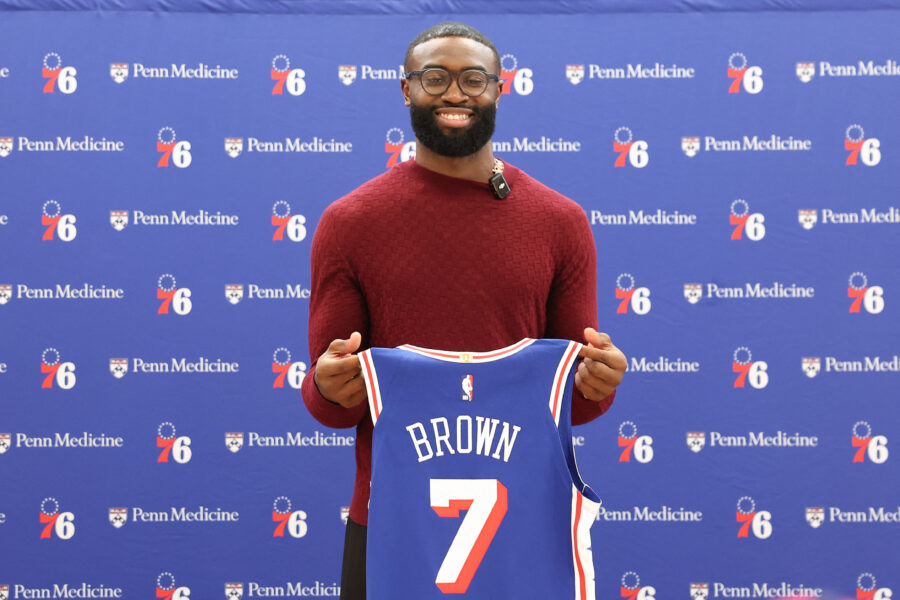
Acquired Jaylen Brown from the Celtics in exchange for Paul George, a 2028 first-round pick or swap, the Sixers’ 2031 first-round pick, either the Warriors’, Thunder’s, or Bucks’ 2028 second-round pick (whichever is most favorable), and either the Wizards’, Trail Blazers’, or Suns’ 2030 second-round pick (whichever is most favorable).
Acquired cash ($1MM) from the Clippers in exchange for Johni Broome and a 2027 second-round pick.
Draft picks
1-22: Labaron Philon Jr.
Signed to rookie scale contract (four years, $17,839,510). First two years guaranteed. Third- and fourth-year team options.
Two-way signings
One year, $91,000 partial guarantee (will increase to $339,441 at start of regular season).
One year, $91,000 partial guarantee (will increase to $339,441 at start of regular season).
Departed/unsigned free agents
Other roster moves
Salary cap situation
Note: Figures are rounded to one decimal place.
Operating over the cap ($165MM) and below the first tax apron ($209MM).
Hard-capped at first apron.
Team salary: $207.2MM (tax/apron).
Above luxury tax line by $6.8MM; below hard cap by $1.8MM.
Partial non-taxpayer mid-level exception ($44K) and partial bi-annual exception ($2.1MM) available.
Three traded player exceptions available (largest worth $4.2MM).
The offseason so far
It has been an offseason full of change in Philadelphia, starting with management’s decision to fire president of basketball operations Daryl Morey in May and replace him a few weeks later with former Cavaliers general manager Mike Gansey.
 Gansey was the most significant addition to the front office, but there were other changes as well. For instance, Jameer Nelson was promoted from assistant GM to executive vice president of basketball operations, while Elton Brand is no longer the GM; he was reportedly in discussions about staying with the Sixers’ parent company in a new role.
Nelson is now No. 2 in command under Gansey, with both behind Bob Myers on the organizational totem pole. Myers, the president of sports for Harris Blitzer Sports & Entertainment, said shortly after Morey was dismissed that the Sixers’ new head of basketball operations would have “a lot of authority” but that he expects to be involved in major personnel and roster decisions moving forward.
The hiring of Gansey and Myers’ increased influence in front office decision-making were critical components of a major roster makeover. After drafting Alabama guard Labaron Philon Jr. with the 22nd pick in June, the team went to work on the free agent market, signing Dean Wade (four years, $38.7MM), Anfernee Simons (two years, $12.3MM) and Ariel Hukporti (one year, $3.4MM) to standard deals and adding Caleb Love and Rayan Rupert on two-way contracts.
Word broke on July 1 that the Sixers had agreed to a stunning trade with the division rival Celtics, with Philadelphia sending Paul George, two first-round picks and two second-rounders to Boston in exchange for star wing Jaylen Brown.
George played reasonably well this past season when healthy, especially in the 2026 playoffs, but he’s six-plus years older than Brown and only appeared in 78 combined games in his two seasons as a Sixer. Brown, who turns 30 in October, is coming off a 2025/26 season in which he averaged career highs in points, rebounds and assists per game while making the All-NBA Second Team and finishing sixth in MVP voting.
The 76ers still weren’t satisfied with their series of transactions, however, as they immediately turned their attention to the most prominent free agent left on the market: LeBron James.
Gansey publicly said Brown’s acquisition played a key role in the team’s recruiting pitch to James, with Tyrese Maxey, Brown, Joel Embiid, head coach Nick Nurse and Myers all joining in on the effort to land the four-time MVP. And on July 24, James announced he would be signing a two-year, minimum-salary contract with Philadelphia, his fourth NBA team.
The Sixers waived Dalen Terry‘s non-guaranteed salary to create the roster and financial space to add James, but they still had to make another move to sign Kentavious Caldwell-Pope, who agreed to a buyout with Memphis in order to team up with James for a second time. Johni Broome turned out to be the final roster casualty, as the 2025 second-round pick was traded to the Clippers (along with a 2027 second-round pick) in exchange for $1MM in cash.
The good news for Philadelphia’s 2026 free agents is that nearly all of them caught on with new teams, both in the NBA and the EuroLeague. The lone exception was six-time All-Star Kyle Lowry, who retired after 20 years in the league.
Up next
The Sixers currently have 13 players on guaranteed standard contracts, with Jabari Walker on a non-guaranteed deal and Duke Miles on an Exhibit 10 agreement for training camp. As our tracker shows, the team also has an open two-way slot, with Miles among the camp invitees who could be competing for that spot.
The 76ers became hard-capped at the first tax apron ($209MM) when they signed Wade using more than the taxpayer portion of the mid-level exception. They’re currently $6.8MM above the luxury tax line and $1.8MM below that hard cap.
That $1.8MM figure is a critical one for the Sixers, because signing a player to a veteran’s minimum deal would carry a cap hit of $2.45MM. In other words, Philadelphia is likely to open the season 14 players on their standard roster, rather than the maximum of 15.
It wouldn’t be surprising if the team waits several months to fill that final roster spot. In fact, that’s probably the most likely outcome, since staying patient would enable the Sixers to evaluate any weaknesses they have during the season and use that slot to address said weaknesses.
While the 76ers technically have a very small portion ($44K) of their mid-level exception available, they seem unlikely to use it. The remaining portion ($2.1MM) of their bi-annual exception could be more useful, though it currently exceeds the space they have below the hard cap.
It’s worth noting that the Sixers could acquire a player (or players) using their three traded player exceptions, the largest of which is worth about $4.2MM. But again, they’re currently only $1.8MM beneath the first apron.
The Sixers enter the 2026/27 campaign with championship aspirations after reshaping their front office and overhauling their roster. How they fare could depend on Embiid’s health and how several high-usage players coexist, but they certainly appear much more dangerous on paper than they did just a few months ago.
Luke Adams contributed to this article.