
A PPL Corp. joint venture secured more than 11 square miles of northern Lackawanna County from Dunmore businessman Dominick DeNaples — including land bordering a vital source of public drinking water — to explore building at least two massive power plants for data centers.
A holding company tied to PPL Corp. and its venture with Blackstone Infrastructure signed agreements in April and June to purchase nearly 7,200 acres across Archbald, Carbondale, Carbondale Twp., Fell Twp. and Mayfield, while the joint venture also filed requests to add 2.25 gigawatts of natural gas power plants in Lackawanna County. The exact location of the two power plants is unclear, though the timing of the requests coincides with a memorandum to purchase land for a “west campus” that begins in Carbondale Twp. above Business Route 6, lines the city and extends north through Fell Twp. An east campus includes properties spanning from near Aylesworth Park in Archbald north to the Brownell Reservoir in Carbondale Twp., which provides 2 million gallons of drinking water daily to surrounding communities.
News of the memorandums drew immediate backlash from data center opponents.
“I see people’s homes. I see the mountains that belong to generations that haven’t even been born yet, and I am absolutely furious,” said Lackawanna County Commissioner Bill Gaughan, a staunch opponent of data centers. “Our county should not be offered up as the sacrificial lamb of the AI revolution that is occurring in this country, and it’s absolutely disgraceful what’s happening here.”
PPL Corp. spokesman Ryan Hill confirmed Friday the venture has secured the rights to purchase land in Lackawanna County to evaluate the suitability for power generation for data centers, though he emphasized that acquiring large swaths of land does not mean developing all of it.
“The benefit of having large sites is that they provide that flexibility for setbacks, buffers, open space, green space, other considerations for a project such as a generation project,” Hill said.
The purchase agreements represent massive portions of undeveloped land divided into two campuses.
Over the last year-and-a-half, Lackawanna County has emerged as a hot spot for largely speculative data center development encompassing thousands of acres and more than a dozen proposed projects. Though some developers have shifted plans to fewer buildings with bigger footprints, the county has around 90 proposed data centers, previously peaking at close to 100. Multiple proposals are tied up in litigation.
PPL Corp.’s venture with Blackstone now looks to fuel data centers with potential power plants in northern Lackawanna County.
The same venture purchased 500-plus acres in Luzerne County in April for $40.4 million while also filing for two natural gas power plants with identical outputs to the Lackawanna County projects at 1,500 and 750 megawatts, according to an interconnection request queue.
Gaughan contends the rush for data centers and power plants is “exploitation to a degree that we have never seen before in Lackawanna County.”
“There’s a line between economic development and exploitation,” the Democratic commissioner said. “They’re not even approaching that line anymore — they’re just stampeding right across it, and they’re stampeding right over the people of this county.”

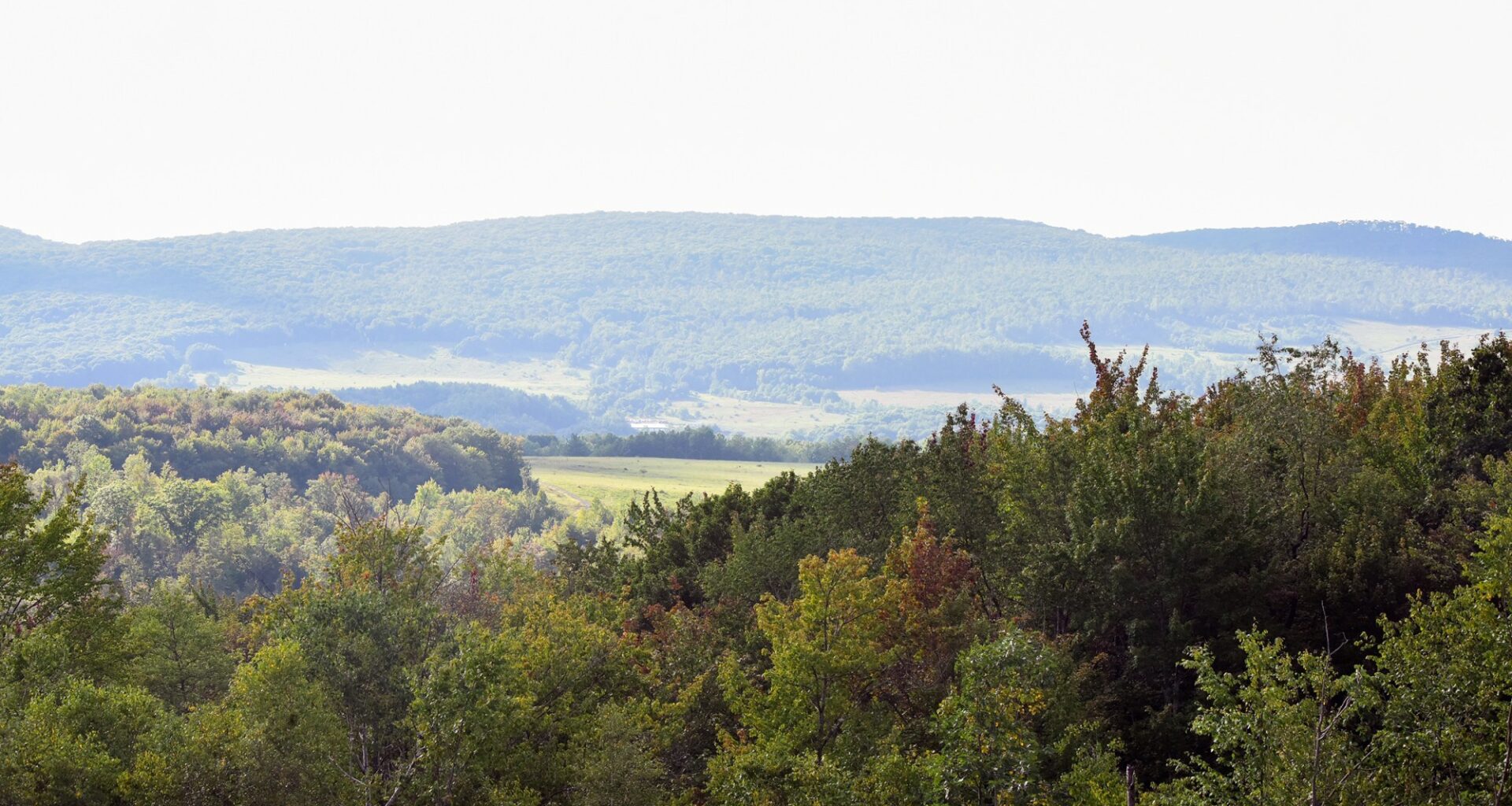
A view from the scenic overlook in Carbondale looking northwest Friday, August 28, 2026. (SEAN MCKEAG / STAFF PHOTOGRAPHER)
Show Caption
1 of 1
A view from the scenic overlook in Carbondale looking northwest Friday, August 28, 2026. (SEAN MCKEAG / STAFF PHOTOGRAPHER)
Expand
‘Engaging transparently’
The joint venture between PPL Corp. and Blackstone will not move forward with a power plant unless they have a signed agreement with a large customer, Hill said, explaining the first step is to sign a long-term agreement with a data center.
“If we decide to move forward with the project, we’re absolutely committed to engaging transparently with the local officials, stakeholders, the community,” he said. “Our focus is delivering reliability, affordability and local benefits.”
There have been no decisions about future projects or how the sites could be used, he said. Asked about the joint venture’s request in April to build two Lackawanna County natural gas power plants and the coinciding timing with the west campus memorandum, Hill said, “I wouldn’t draw any connection on timing there. … We’ve said publicly that we’ve secured spots in PJM’s Interconnection queue, but we’re not getting into talking about specific locations.”
Hill characterized the developments as very preliminary. He declined to comment on whether the 1,500-megawatt and 750-megawatt power plants are affiliated with the west or east campuses.
“We’re filing PJM Interconnection requests to be in a position to support these types of joint venture projects,” he said. “We’re laying the groundwork that will be required when those agreements would be signed at some point.”
The 1,500-megawatt plant has a requested in-service date of Jan. 1, 2033, and the 750-megawatt plant’s requested in-service date is Jan. 1, 2034, according to PJM data.
The power plants would contract with a large customer rather than sell to the grid to avoid market volatility, though the power plants will still be connected to the electric grid, rather than behind-the-meter generation, according to Hill.
PPL Corp. is distinct from PPL Electric Utilities, and utility ratepayers will not pay for the developments, he said.
There are no agreements in place with any data center developers, nor has the joint venture submitted any applications to local municipalities, Hill said.
Mayfield Mayor Al Chelik declined to comment due to ongoing litigation; Carbondale Mayor Michele Bannon declined to comment because she did not know enough about the developments. Andy Gorel, the chairman of Fell Twp.’s board of supervisors, said he can’t have an opinion until a project comes before supervisors.
‘Real reckoning’
Data center speculation fueling projected demand is a self-fulfilling prophecy, said Sierra Club Pennsylvania Chapter Director Tom Schuster, who is unrelated to the Scranton councilman with the same name. Demand goes up, driving up prices, and a joint venture forms to build new capacity to meet that projected demand, he said.
While there is demand for more electricity generation beyond data centers, clustering the power plants in one place is not optimal, neither from a grid perspective because it can create congestion, nor from an environmental perspective because it concentrates pollution and other community impacts, Schuster said. It also promotes more fracking for natural gas.
“It is another indicator of just how crazy this data center development has become,” Schuster said, addressing the possibility of power plants in east and west campuses. “You’re seeing proposals that just wouldn’t have made sense a couple years ago — like this — come to fruition because the data centers are hungry for all of the power they can get, no matter where they get it from, and the amount of gas generation they’re proposing for these two locations in close proximity is unprecedented.”
His major concern would be the close proximity of multiple parcels to the Brownell Reservoir in Carbondale Twp.
A coal power plant would be much more concerning, but even natural gas plants will change the contours of the soil and surface, which is “definitely going to have an impact,” Schuster said, calling for close scrutiny.
Pennsylvania American Water’s 2025 annual water quality report for its Brownell/Fallbrook systems cites a 2002 study from the Pennsylvania Department of Environmental Protection that characterized the Brownell system as “considered vulnerable to road deicing and spills along roads.”
PAW spokeswoman Alana Roberts said Friday the Brownell system produces an average of 2 million gallons per day but is rated for 4 million. The water utility is not aware of any discussions with PPL regarding land purchased near the Brownell Reservoir, she said.
The power plants take abstract discussions about the impacts of artificial intelligence and data centers and make them real, Schuster said.
“It starts to get visceral when you look up at the surrounding hillsides that you’re used to seeing forests on, and now you’re going to see cleared land with large power plants,” he said. “You’re going to be hearing them, smelling them. This is the type of thing that’s going to bring about a real reckoning on the future of this kind of development.”
At 1,500 megawatts, the larger power plant has essentially the same generating capacity as the Lackawanna Energy Center natural gas-fired power plant in Jessup. According to federal emissions data from 2023, the latest year available, the power plant emitted just over 3.7 million tons of greenhouse gases.
‘Living in a nightmare’
A mother of three from Archbald, Tamara Misewicz-Healey and her husband, Justin, formed the Stop Archbald Data Centers movement last year, spearheading local efforts to oppose data centers and associated power plants. After learning of the plans, Misewicz-Healey, an industrial hygienist, had two words: absolute insanity.
“When I learned about this, I honestly felt like I might be sick to my stomach because the scale of this is already of such concern, and it just keeps growing,” she said. “Honestly, it feels like I’m living in a nightmare, and I just am waiting to wake up from it — or waiting for somebody to come and stop this.”
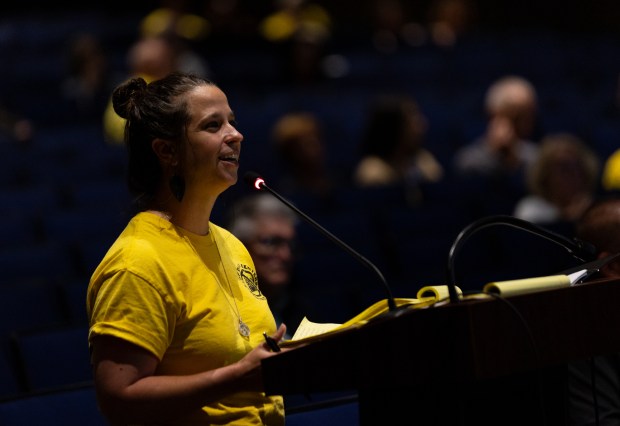 Stop Archbald Data Centers co-founder Tamara Misewicz-Healey cross-examines a data center representative during a conditional use hearing at the Valley View High School auditorium in Archbald on Thursday, June 18, 2026. (FRANK WILKES LESNEFSKY / STAFF PHOTO)
She compared the power plants to Lackawanna County’s historic energy sector — coal — and cited the potential for the local topography to trap pollution, allowing it to sit over the valley. When it does travel, it generally travels down the valley, she said.
“We learned from the past to build a brighter future that wasn’t monopolized, that was diversified, that held higher standards,” she said. “Yet, why does it feel like they are just repeating history and not at all learning the lessons that we, ourselves, were preaching? Here we are again — becoming the leaders once again in exploitative energy production.”
She advocated for residents to pressure county, state and federal elected officials to act.
“They need to do something, because there are so many projects at this point that us legally addressing every single one individually would just consume so much time and so much money,” she said. “The biggest thing we need to do is to speak out to ensure everyone is aware that this is not what we want. This is not the direction we want to go.”
‘Improperly attempt’
A Delaware limited liability company governed by PPL Corp. executives signed an April memorandum with DeNaples, who co-owns the Keystone Sanitary Landfill in Dunmore and Throop with his brother, Louis DeNaples, for the west campus encompassing nearly 4,860 billed acres beginning above Business Route 6 in Carbondale Twp. near Mayfield and extending north into Fell Twp. beyond the Owego Turnpike.
A day after filing the west campus memorandum April 24, the joint venture — using the name Invitium Energy LLC — applied with grid operator PJM to build 1,500-megawatt and 750-megawatt natural gas power plants in Lackawanna County. PPL Corp. owns 51% of Invitium, according to an Aug. 7 earnings report.
Two months later, the venture secured just over 2,200 more acres for an east campus, beginning less than 1,000 feet from Lackawanna County’s Aylesworth Park and extending north to the western border of the Brownell Reservoir.
The Sunday Times analyzed 36 parcels contained in the memorandums using Lackawanna County assessment data to determine the entire footprint represents about 7,177.2 billed acres spanning a mix of contiguous parcels and stand-alone pieces of land, representing 11.2 square miles, or about 2.4% of Lackawanna County’s entire 459-square-mile landmass. The acreage is equivalent to more than 5,400 football fields, or nearly double the combined footprints of the city of Carbondale and Mayfield.
The parcels are woven throughout the Upvalley communities from a real estate portfolio of former coal mining properties amassed over decades, including west of Business Route 6, east of the Casey Highway and between the two major arteries, lining large portions of Carbondale and dotting residential areas.
The east campus properties include hundreds of acres in Archbald and Mayfield slated for a nearly 1.4-million-square-foot warehousing project backed by nearly $21 million in grant funding for mine reclamation and site development. Gov. Josh Shapiro traveled to the property in October to announce new statewide grants.
But that development is now stalled in court after DeNaples initiated legal action against warehouse developer Mark Powell. Powell argues in court filings that DeNaples is trying to back out of the warehouse deal, alleging it is an effort to “improperly attempt to avoid the real estate transaction.”
‘Urgency’
State Rep. Kyle Mullins, D-112, Blakely, whose district includes the Upvalley and Archbald, said he will closely monitor the filings to demand transparency and ensure local residents receive clear answers about plans for the land.
“An acquisition of over 7,000 acres across five of our municipalities will undoubtedly raise significant questions, and the relentless saturation of speculative data center development in our region is entirely to blame for community concern,” Mullins said in an emailed statement.
Gaughan called on Shapiro, who recently strengthened his Governor’s Responsible Infrastructure Development, or GRID, standards for data centers via an executive order, to protect the region.
“Governor Shapiro said he wouldn’t let our communities be bulldozed, and I’m asking him to prove it here in Lackawanna County because I consider what has been uncovered here an emergency for the future of the county,” Gaughan said. “The urgency is very, very real.”
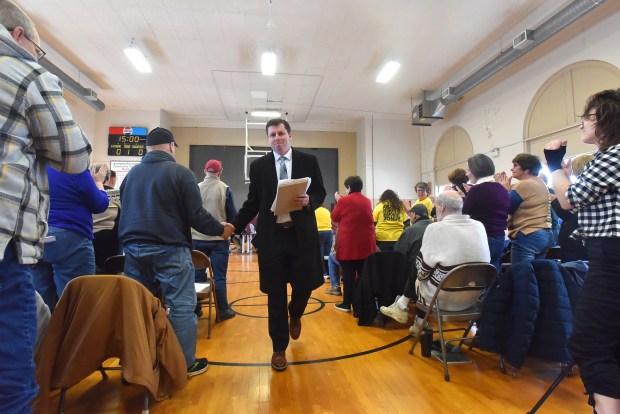 Lackawanna County Commissioner Bill Gaughan shakes the hand of a supporter after his remarks during the special meeting on data center applications at the Archbald Borough Building in Archbald Friday, March 27, 2026. (SEAN MCKEAG / STAFF PHOTOGRAPHER)
Shapiro’s office did not respond to an emailed list of questions by Friday night.
Lackawanna County is going to become a desert of data centers and power plants if something isn’t done, Gaughan said.
“I imagine future generations looking back at this time and saying, ‘Why didn’t anybody stop this?’” he said. “If they can come in and extract every last resource to make themselves richer, they will do it, and I just think that we have to draw a line in the sand and stop them at every turn.”