
Megan Wolfe enjoys seeing native plants, hearing the birds chirp in the morning and hiking on two nature preserves within walking distance of her Benton Twp. home.
“I like that it’s a rural area, and I’m particularly interested in the benefits for wildlife,” she said.
Wolfe worries any development will jeopardize the natural space she has called home for 20 years. While there have been no data center applications or permits issued, officials in the small Abingtons municipality want to protect the vast amounts of open space and hope to adopt an environmentally conscious ordinance regulating data center development as proposals proliferate across Northeast Pennsylvania.
Municipalities in Pennsylvania are required to allow for every type of lawful land use within their borders, or else they face legal challenges over exclusionary zoning.
Assessing environmental impact
The ordinance classifies data centers, their accessory uses and power substations as conditional uses, meaning they have to meet certain conditions and receive township approval, in the township’s industrial zone, a mile-long section between the Interstate 81 exits for Routes 107 and 438 in the southeast portion of the township.
Notably, it requires developers to use closed-loop cooling and submit studies showing the environmental impact of the data center. Under the ordinance:
• Buildings are required to be no higher than 35 feet, one of the shortest height restrictions outlined in a data center ordinance enacted by a Lackawanna County municipality, with the lot a minimum of 25 acres.
• Developers are required to provide a Data Center Acoustic and Ecological Impact Report, which must include measurements of existing environmental conditions for 14 days and capture data during the avian spring migration window from April 1 to June 1 and during the dawn chorus, which occurs daily one hour before sunrise to two hours after sunrise; measurement locations must include points along the perimeter of all critical habitats, wetlands and Pennsylvania Natural Diversity Inventory sites within a 2-mile radius of the property boundary.
• Requires a closed-loop cooling system that cycles water without evaporating it off for server racks and IT equipment. Use of open, evaporative cooling towers is prohibited unless the developer demonstrates by “clear and convincing evidence” that closed-loop technology is not feasible for the specific project, and gets a conditional exemption and all applicable state permits. Anti-freeze or heat transfer fluids used in closed loops must be nonhazardous.
• Conduct a balloon test, where tethered balloons are spaced to represent the outer corners and highest peaks of the proposed structure, for two days; the plans must be adjusted if the test finds any portion of the building or infrastructure visible from an area at high risk of environmental harm.
The ordinance includes requirements for water and electricity use, a geographic map of the site, wastewater disposal, thermal impact, use of backup generators, noise and vibration, buffering, screening, lighting and glare. Developers are additionally required to have an emergency management, parking, waste and decommissioning plans, and have public meetings and a website devoted to the plans.
Supervisor Chairwoman Bonnie Rosiak said officials began discussing updating the township’s zoning when data center development started making waves nationwide, but its development accelerated once developers began proposing them in Lackawanna County. Most of the development is concentrated in the Midvalley, with seven data center proposals in Archbald alone, and other projects proposed in Clifton Twp., Covington Twp., Dickson City, Jessup, Olyphant, and in the Abingtons townships of Newton and Ransom.
However, the ordinance has been revised to its current form after residents pushed for the changes.
She added it is a proactive measure to protect residents and the township’s rural character. The height restriction was enacted because the Fleetville Volunteer Fire Company, the only fire department in the township, doesn’t have a ladder truck.
“Hopefully it will control the spacing where data centers can be located,” she said. “We have a lot of large farmland we don’t want ruined.”
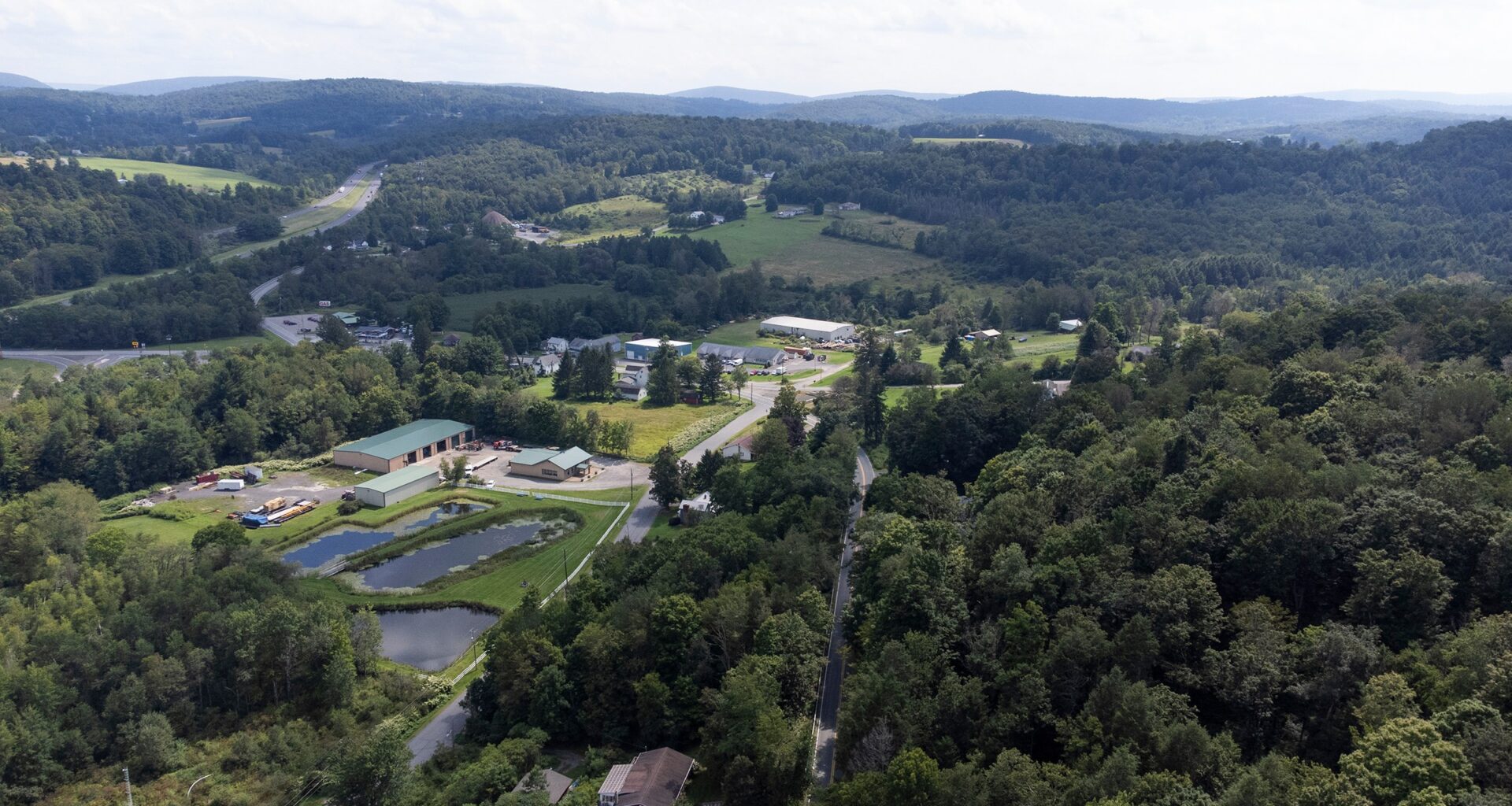
A parcel of land sits between Franklin Valley Road on the left and Jordan Hollow Road to the right in Benton Twp. Thursday, August 27, 2026. (SEAN MCKEAG / STAFF PHOTOGRAPHER)
Residents, conservancy voice thoughts
Living near Lackawanna State Park and two preserves owned by the nonprofit Countryside Conservancy — Ziegler and Gardner Spencer preserves, which she frequently hikes — Wolfe, a retired elementary school science teacher, enjoys the native plants in her backyard and listening to the birds in the morning.
She is concerned that any development will bring more air pollution and noise to the area, and affect the water quality, as the South Branch of the Tunkhannock Creek is across from her home. Wolfe particularly worries about the impact it will have on birds.
“I know there’ve been studies about birds having to call louder for their purposes of attracting mates and territory if they’re in a more urban situation, which of course takes more energy and puts more stress on the breeding population,” she said.
Noise from a potential data center, Wolfe said, would have a big impact on her quality of life.
“I like to go outside and sit in my yard, so going out and having a background hum from whatever kind of generator or machinery is there, that would be a big problem,” she said.
In addition to the 35-acre Ziegler and 82-acre Gardner-Spencer preserves that buffer Lackawanna State Park, which is partly in the township, the conservancy also has Fordham Preserve, which is 22 acres and not open to the public. Bill Kern, the conservancy’s executive director, said any development would be detrimental to the user experience and the conservation value of the properties.
“That has implications for wildlife and humans alike,” he said. “The whole point of us working to buffer Lackawanna State Park is to keep that development as far out and away from this preserved green space as possible.”
Being so massive, data center campuses, Kern said, have a far greater impact on the environment. He said companies spending so much money to develop land for data centers and warehouses makes conserving land more difficult.
“If we have to compete with the prices that they are commanding with their purchases, that’s really hard for us,” he said. “We’re always going to be here and keep plugging away and I feel like our work is more important now than ever before. It’s important that we work with expediency and urgency in mind because this development’s just going to keep coming.”
Kern thinks Benton Twp.’s data center ordinance will help their conservation work.
“Being proactive and controlling where and how development can happen on the front end is just light years better than being reactive,” he said. “We acknowledge that people need some development. We need places to live and places to work and all that, but we also believe that it needs to be concentrated and focused in certain areas, and other areas need to be held for green space and for outdoor recreation, and that’s just as vital as the other economic needs of a society.”
Wolfe is glad the ordinance asks for borders with native plantings, trees and shrubs, but is concerned that with the industrial zone bordering a wetland, a developer could eradicate it — which she said has happened elsewhere — in order to put in different kinds of buildings.
Renee Czubowscz, who owns property in the township, said maximum regulation of data centers will protect the community.
“It’s proactive on (the township’s) part to have regulations in place,” she said.
Representatives from Protect Rural Lackawanna, a grassroots organization developed to fight development, credit residents pushing officials for the ordinance being in its current form.
“The version on the table is stronger than what was first proposed, and that’s because people showed up and asked hard questions. The credit for the good parts belongs to the community,” the organization said.
While they praised the provisions on the height, closed-loop cooling system, balloon test and tying the monitoring to spring bird migration and the dawn chorus, they feel it needs improvement, such as longer setback requirements; protections for churches, schools, daycares, parks, medical facilities and other sensitive community places; smaller lot coverage; and stronger provisions on water, groundwater, noise limits, environmental monitoring and emergency response protections.
Rosiak acknowledged residents like the rural area and officials tried to address every aspect of data center development in the ordinance. Township officials are still waiting for the Lackawanna County Planning Commission to review the ordinance.
“A lot of people worked on it and we tried to be diligent to cover everything we can cover legally,” she said.
The township supervisors will vote on the ordinance at a special meeting Sept. 22 at 7 p.m. at the Benton Twp. Community Center, 16043 Route 407, Fleetville.