
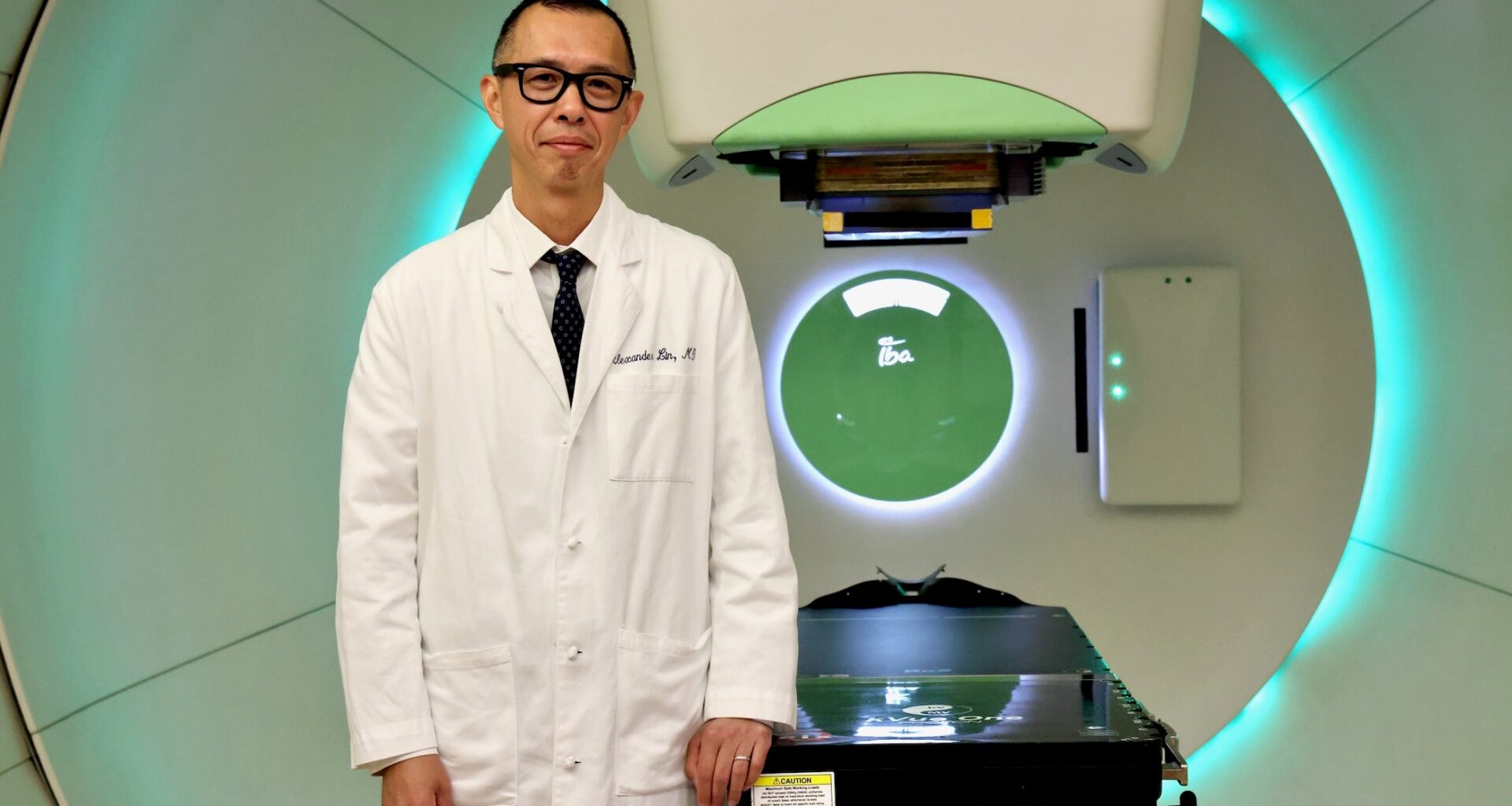
Inside a single treatment room at the center, several machines hum along in the background. In the middle of the room, a flat, hard table sits under a massive dome. The protons are fired from a nozzle-type device attached to the dome that is aimed directly at the table.
“This whole thing rotates,” Lin said as he gestured to the dome. “When a patient gets treatment on the table, let’s say you have to treat a specific location, this rotates around the patient to use beams of radiation customized to the anatomy of a patient.”
It’s an impressive setup. Proton radiation therapy was approved for cancer treatment in the late 1980s as an alternative option to traditional photon radiation, which is still widely used today.
But it took time for health systems and hospitals to adopt the technology due to costs and logistics. A cyclotron, or particle accelerator, is needed to generate the protons used in treatment, but the machine can weigh up to 200 tons.
“It literally had to be crane-lifted down into the ground when we built this center,” Lin said. “That’s what powers and produces all the protons we use for every patient who gets treatment. So, we have one cyclotron and there are these lines, called a beam line, that sends [protons] to each one of our rooms.”
Unlike photon radiation, which uses X-ray beams that enter the body to reach the tumor and then continue through the body to exit, proton radiation was designed to be more precise.
Charged protons hit the tumor site, but the particles stop there, meaning the radiation doesn’t continue through the body, sparing more healthy tissue from damage.
But the treatment still comes with consequences and lingering health issues, especially for patients with head and neck cancers, Lin said.
“They’re cured, but then they live with side effects such as dry mouth or changes in taste or the ability to enjoy food,” he said. “Sometimes difficulty swallowing or scar tissue in their neck that can make their neck feel pretty tight.”
Proton therapy is also still delivered in small doses over the course of many days and weeks. A person with a certain kind of head and neck cancer could need treatment five days a week for nearly two months, Lin said.
“And when they come in, we’re going to ask them to lie on this table, we’re going to put a mask on their face that’s tight that doesn’t allow them to move very much,” he said. “They’ll have to be on this table for 20 to 30 minutes to get one treatment.”
But researchers are hopeful that the high-dose, high-velocity FLASH proton therapy will change that.
“We can shorten that treatment to as short as maybe one to five treatments, and they can be done in one to two weeks,” Lin said.
There’s also evidence that this kind of approach may improve long-term health outcomes in cancer survivors. Pre-clinical animal trials in pet dogs with cancer showed that not only could FLASH deliver radiation faster, but the therapy seemed to spare more healthy tissue around tumor sites.