
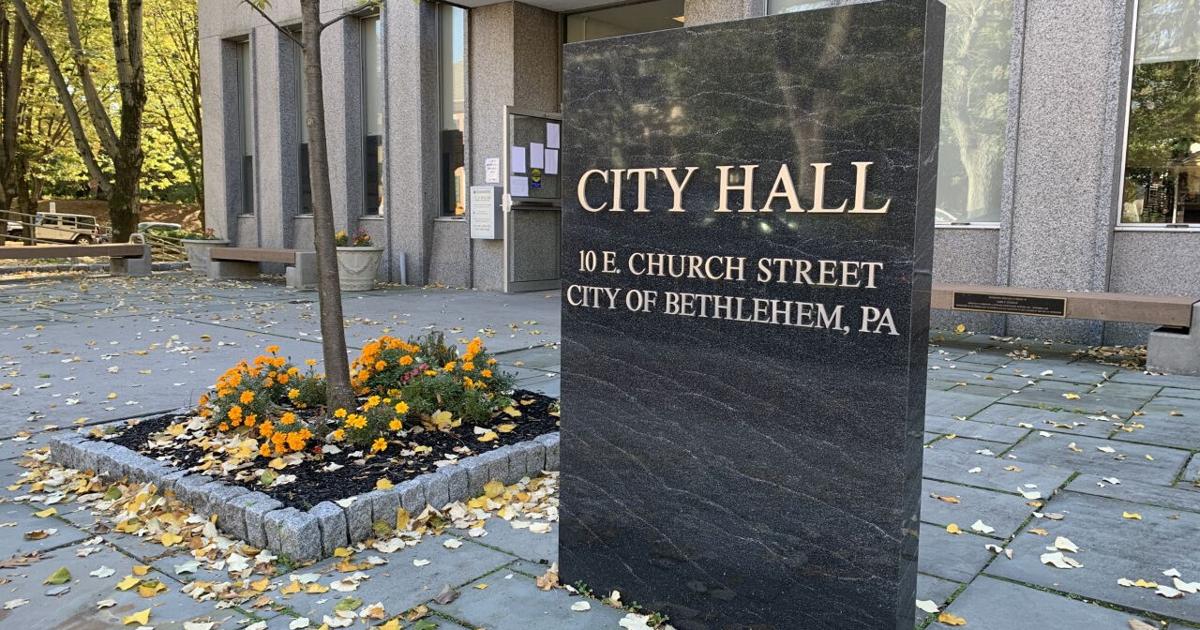
BETHLEHEM, Pa. – Bethlehem City Council on Tuesday passed a resolution that would require monthly reports on the city’s compliance with a proposed consent order and agreement with the Pennsylvania Department of Environmental Protection.
Under the resolution, the city’s director of water and sewer resources would submit a sworn monthly compliance report to City Council no later than 45 days from the end of the month being reported upon. Additionally, correspondence regarding the COA must be forwarded to council within five days of receipt.
“I think it’s really important to reinforce public trust in our municipal government,” said Councilmember Hilary Kwiatek, who introduced the measure.
The resolution says the reporting requirement is intended to provide transparency and allow City Council to oversee the city’s compliance.
“City Council finds that regular, transparent reporting concerning the city’s compliance with the COA, the NPDES permit, and any stipulated civil penalties is in the public interest and necessary for council’s oversight of city affairs,” the resolution’s language states.
The measure would not give council operational control over the wastewater treatment plant or replace the mayor’s authority over city departments.
The report would include discharge monitoring data, details of permit violations or other potential noncompliance, corrective actions, the status of required obligations and progress reports, and information about any civil penalties accrued or paid.
The resolution comes after a measure approved last month resolving discharge violations at the city’s wastewater treatment plant.
The COA, which followed two years of negotiations, outlined multiple recurring violations of The Clean Streams Law of Pennsylvania from the discharge permit at the city’s wastewater treatment plant located on Shimersville Road. In addition, the document provided for corrective actions to address the violations.
“I felt a little bit, and this could be on me as well, blindsighted in terms of not really knowing what the situation had been,” explained Kwiatek.
Edward Boscola, the city’s director of water and sewer resources, noted in a memo supporting the August resolution the department “has been working diligently over the past several years to improve operations and implement capital improvements” at the plant. He added that the department is working currently with an engineering consultant on a major plant treatment systems upgrade that will “preclude any future violations.”
According to the COA, the state DEP reissued a permit to Bethlehem in 2012. That permit authorized the discharge of treated sewage to Lehigh River and Saucon Creek, with certain restrictions and conditions by which the city’s wastewater treatment plant must abide.
However, the COA outlined a number of violations dating back to 2018, when levels of ammonia-nitrogen output exceeded the permit limit. Most recently, in June 2026, there was one violation of fecal coliform effluent that exceeded the permissible amount.
Other violations, the COA stated, included the failure to prevent cases of sanitary sewer overflow due to a range of suspected causes such as “blockage from grease and rags” and a “pump station inundated with fibrous material, and plastic straws/beads.”
The COA also outlines corrective measures the city must take, which include completing construction of the Broadway sewer line replacement, submitting written progress reports to the DEP on a semiannual basis, and upgrading its aeration systems.
To settle its civil penalties for certain violations to date, the city must pay nearly $27,000 to the Commonwealth of Pennsylvania-Clean Water Fund, the COA says. It also states that if the city does not comply with any term in the COA, Bethlehem will have to pay $500 a day or $1,000 per violation, depending on the nature of the transgression.
Fire, EMS study
During old business, Councilmember Jo Daniels asked for an update on an objective and comprehensive fire and EMS apparatus, protection and efficiency study authorized earlier this year with Center for Public Safety Management LLC.
The study is designed to analyze and evaluate apparatus, equipment, maintenance, station locations, response patterns, and staffing for both the fire and the EMS bureaus for a cost of no more than $82,740, according to city documents.
The comprehensive study will also analyze call volume, staffing and paramedic responses.
The report’s information will be presented at an upcoming Public Safety committee meeting, officials said.