
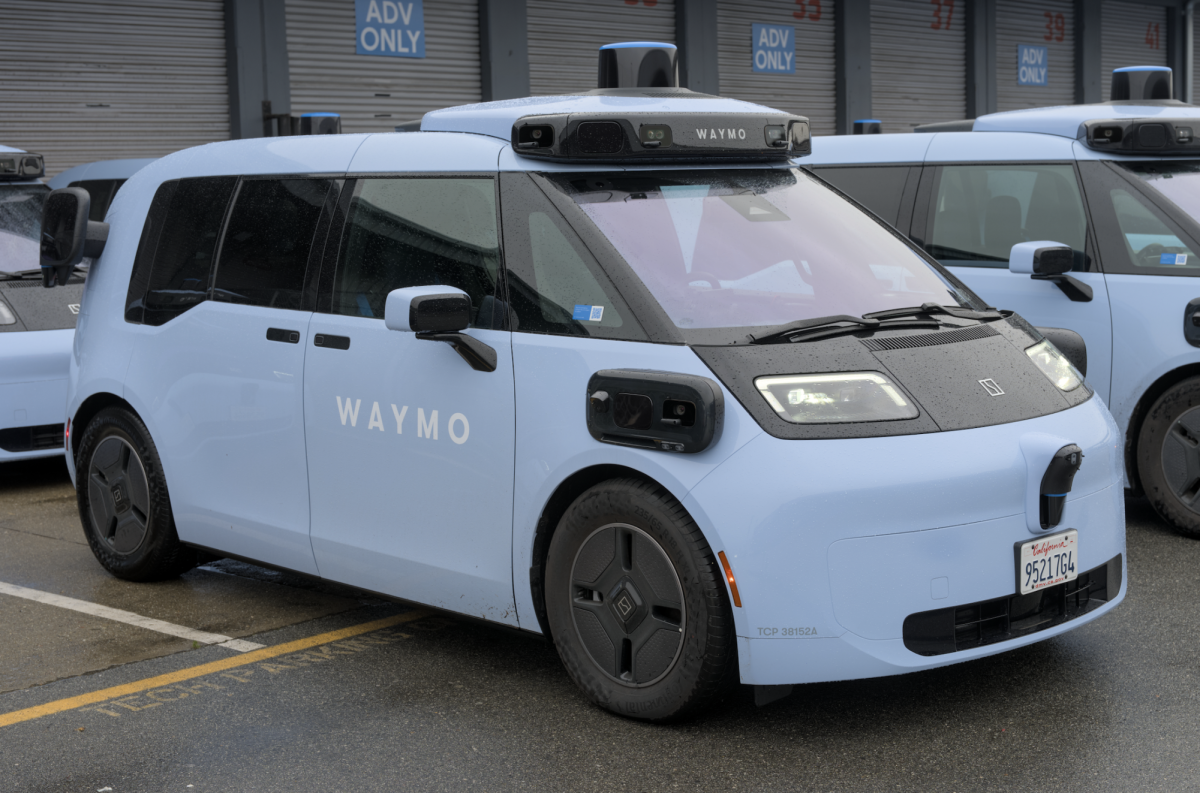
Oakland and Pittsburgh residents may have seen a set of high tech blue vans driving across the city’s streets.
After about a year of testing its regular vehicles in Pittsburgh, autonomous ride-hailing service Waymo began testing its new Ojai vans in Pittsburgh this past summer. The company has been testing its autonomous vehicles across the country, though some who study robotics and network systems at Pitt question their safety in Pittsburgh.
Waymo announced its expansion into Pittsburgh in December 2025 and received a permit in February 2026 that allowed the vehicles to operate without humans behind the wheel. However, the company told the Pittsburgh Post-Gazette it will continue to place a trained specialist in the driver’s seat.
Waymo did not respond to a request for comment by The Pitt News.
The Pitt News spotted one van on Fifth Avenue in Oakland in late August.
Jackie Krausche, a junior engineering science major and member of the Robotics and Automation Society at Pitt, said she is “all for” autonomous transportation for trains, having worked on upgrading fully autonomous trains in the New York City subway and Los Angeles metro system last summer.
However, Krausche isn’t convinced autonomous transportation for cars driving on any public roads is practical, safe, or a possible solution to traffic congestion, especially in the city of Pittsburgh.
“No algorithm, AI or software can account for Pittsburgh’s weird road design, bikes and scooters, pedestrians, animals, construction, et cetera,” Krausche said. “You’re adding more cars to the road, which take up a lot of space in lanes.”
Na Du, an assistant professor of informatics and network systems, said the biggest challenge with autonomous vehicles is that there are unlimited situations when driving a vehicle, whether it’s unusual road geometry, bad weather or pedestrians.
“The challenge is not to make the vehicle safe, but also to enable it to interact naturally, efficiently and predictably with human drivers, pedestrians and cyclists,” Du said.
Du said Waymo detects and predicts pedestrians using sensors like cameras and radar to interpret the environment. According to Du, the system not only has to identify a pedestrian but also track how that person is moving and predict future movement. Du believes these challenges make the university environment “interesting and difficult” for autonomous vehicles.
“A student may be walking along the sidewalk and suddenly cross the street to meet a friend or catch a bus or even in groups of pedestrians, bicycles, scooters, parked vehicles blocking visibility and people crossing outside a marked crosswalk,” Du said. “An autonomous vehicle has to reason about uncertainty if it cannot clearly determine what a pedestrian is going to do.”
Du said larger vehicles like the new Waymo vans also create additional engineering challenges, explaining that they have a larger physical footprint, different turning characteristics and greater difficulty maneuvering on narrow streets or finding safe pick-up and drop-off locations.
“These challenges are particularly relevant around Oakland, where there are frequent construction zones, congested street and heavy pedestrian traffic often entering and leaving unpredictably,” Du said.
University spokesperson Meredith Herndon said Pitt students should refer to Pitt’s campus safety tips for ride-sharing and research Waymo before using it in the future.
“Pitt students should review the ride information, share trip details with friends, and make sure that they understand the safety features of the app they are using,” Herndon said.
Krausche expressed worry that the rise of self-driving cars will lead to extensive lobbying in transportation planning, which she believes could cause city planners to cut pedestrian-friendly design and build Waymo parking lots so self-driving cars can move through cities without issues.
“This is similar to how car companies in the 1950s and 60s lobbied to build highways through downtowns of cities, bulldozing neighborhoods. Imagine the next generation of Waymo-only highways,” Krausche said.
Krausche argued that public transit is itself an autonomous alternative to driving, explaining that it “gives the burden of driving to the bus or train operator,” without the risks posed by self-driving cars.
“Transit is safe — very little risk of traffic collisions,” Krausche said.