
The Pittsburgh Public school district has long engaged in a process called “leveling.” It’s never been popular.
About a month into the school year, some classes are consolidated. Some teachers get moved to another class or even other schools. The process levels out schools across the district, reflecting actual enrollment figures.
District officials are aware that many students and parents don’t like the disruption, just as routines are getting established. But they say they it’s a practical necessity. In the summer, the district projects how many students will be in each school. But numbers aren’t real until school gets started.
This year, some parents are pushing back.
As the district prepares for an almost complete rearrangement next school year — the Future-Ready Facilities Plan — these parents are saying this is no time for more disruption.
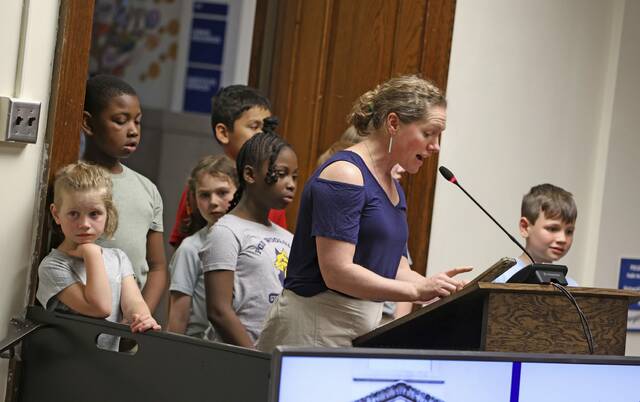
Sarah Zangle, a parent at Woolslair PreK-5, started a petition requesting a two-year moratorium on leveling.
Zangle and other contend that moving teachers in October may cause even more uncertainty and upheaval to students at buildings closing at the end of this academic year.
“We anticipate learning loss, social-emotional stunting,” she said. ”Students are moving neighborhoods, classrooms and teachers.”
Zangle, of Lawrenceville, believes buildings that will close over the next two years — Woolslair, Manchester, Schiller, Montessori, Fulton, Miller, the Student Achievement Center, Spring Hill and Morrow Primary — may be disproportionately impacted by leveling. The closures are part of the Future-Ready Facilities Plan, approved by the school board in May.
“Leveling” works like this: Once the school year begins, a school with fewer students than originally projected might lose teachers to another school with a larger-than-expected enrollment. Students in schools that lost teachers would have their classes merged to form bigger classrooms. Schools with newly added teachers would divide larger classes into smaller ones.
The result is that students start again with a new teacher.
Zangle believes the practice will further disrupt student learning and negatively impact their children’s social and emotional well-being, especially as the district prepares a reconfiguration of its buildings next year.
For example, last year, two fifth grade classes at Woolslair combined into one class of 34 students as a result of leveling, she said. At the same time, a Woolslair fifth grade teacher was placed in the second grade at Woolslair, and the second grade teacher moved to Manchester to take a position of a teacher moving to an East End school that is not closing.
Ebony Pugh, district spokeswoman, said Pittsburgh Public recognizes the changes can be disruptive to routines and relationships. But at the same time, the process is necessary. The district has to work with actual student enrollment rather than projections.
School budgets and staffing allocations must be developed months before the first day of school, Pugh said. But over that time, families move, addresses change and students enroll or withdraw. The number of students who arrive in a school, grade or classroom can differ from projections.
Pittsburgh Public conducts the leveling process at the beginning of October so that the district “has a more reliable picture of actual enrollment and can make more informed staffing decisions while still addressing class-size needs relatively early in the school year,” Pugh said.
“Once actual enrollment becomes clearer, PPS must reconcile those projections with where students are actually attending school,” Pugh said. “That is the purpose of leveling.”
Vanessa Dagavarian, another Woolslair parent, believes leveling adds another layer of anxiety to students and staff at buildings closing.
“It’s disruptive to academic success, but it’s also emotionally distressing, especially when kids know the school is closing,” said Dagavarian, of Brookline. “We need to be able to reduce harm as much as possible.”
But pausing leveling would create another set of challenges for students and schools, Pugh said.
“The district must continue operating responsibly during this transition and appropriately staff schools for the students they are serving now,” she said. “Planning for future changes cannot prevent us from meeting our instructional, contractual and fiscal responsibilities during the current school year.”
Class size requirements are established through the district’s contract with its teacher’s union, which make certain staffing adjustments necessary when actual enrollment differs from projections, Pugh said. District and school leaders also review class size, student needs, teacher certification, contractual requirements and other factors before recommendations are finalized.
“Our responsibility is to balance the very real impact that these changes can have on individual students and families with our responsibility to serve students across the district,” Pugh said. “Leveling helps ensure that our teaching resources follow our students and that schools are appropriately staffed based on actual enrollment and instructional need.”
Some other urban school districts level, although it appears increasingly controversial. The School District of Philadelphia in 2024 announced that it would reallocate $8.8 million in district money to end leveling, the Philadelphia Inquirer reported.
“Keeping things consistent this year feels like a no-brainer,” said Emily Sawyer, a Manchester parent. “The idea would be we have enough money and teachers that schools don’t have to do this.”
Seeking clarity on Pittsburgh Public’s leveling practice, Zangle met on Wednesday with Deputy Superintendent Theodore Thompson.
“He was receptive and understood our concerns, but he didn’t make any promises,” she said. “I felt like our conversation was meaningful, and it felt like I was heard.”