

The casual reader of Time magazine’s issue for September 19, 1955, had much to ponder. A cover picture of African American attorney and future Supreme Court Justice Thurgood Marshall and several articles on the movement to integrate the south’s public schools reflected the difficulty of the struggle with many southern state legislatures stating that any attempt at school integration would lead to a cut in state funds.
Other articles focused on a troublesome Communist Russian named Nikita Khruschev and a raft of public opinion polls that showed Americans overwhelmingly liked having Ike in the White House.
But those looking for something lighter could have turned to the Music section. Under the title of an article “Love that Moo” was the latest musical sensation, a trombone playing 22-year-old blonde from Allentown, Pennsylvania named Lillian Briggs.

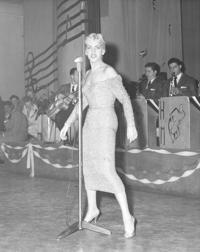
Lilian Briggs performing at the Sands Hotel and Casino in Las Vegas in January 1956
“Boy, it really can moo,” Briggs is quoted as saying about the sound of her trombone.
And that trombone, according to Time, “was mooing last week at Brooklyn’s Paramount Theater before several thousand frenzied teenagers who had already fallen for Lillian after hearing her fast-rising record of ‘I Want You To Be My Baby.’”
Attempting to describe the performance, Time had this to say:
“On stage, her blonde head tossed back, her neat muscularly curvaceous body sheathed in sequins, Lillian spread her feet, arms and fingers and began to sing, with a curious mixture of breezy bounce and bare innuendo, ‘I want, I want you to, I want you to be, I want you to be my baby.’
“Then, grinning at the shrieks and whistles from the audience, Lillian strode to another microphone, picked up her trombone, and proceeded to blow monotone sounds through the brass tubing. The kids up front made such a hullabaloo, squealing, whistling, and clapping in tempo, that they could not possibly hear anything more than the socking rhythm—but that was enough.”
Somehow sandwiched between Frank Sinatra and the “bobbysoxers” and Elvis fans waiting in the wings, this young woman from Allentown, owing a lot to jazz, blazed out a sound that attracted her to at least a portion of her contemporaries.
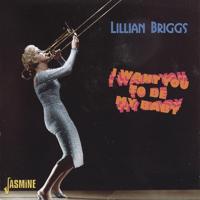
Time’s interviewer attempted to discover where Briggs’ sound came from. He traced it to the popular Gerry Mulligan Quartet and its trumpeter Chet Baker.
Lillian herself, actual name Lillian Biggs Winograd, born June 3, 1933, began her interest in the trombone while a student at Allentown Central Catholic High School. She did it she recalled because she wanted to join the band and get to see school football games for free. She told Time that her original goal was to be a psychiatrist, after having seen the movie Spellbound, in which Ingrid Bergman played psychiatrist to Gregory Peck’s paranoid guilt complex. But after hearing Chet Baker she began to take the trombone more seriously. Later in her career she would cite Louis Armstrong as a major influence.
After graduation she began to look for a job. For 14 months she drove a 2 ½ ton truck for Hudsco Cleaners in Catasauqua. But she found the work exhausting and quit.
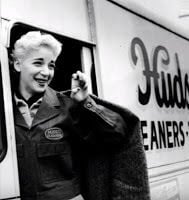
Briggs during her truck driving days
From the website From the Vaults
Over time she formed an all-girl orchestra, playing in clubs in Pennsylvania and New Jersey. “Occasionally,” wrote Time, “she would put on a ‘bop hat’ and long plaid jacket with a huge key chain and hoarsely sing her own lyrics to a song.” Briggs admitted at that point she was not much as a singer, an agent suggested there was a way she could “style” a song.
Yet Briggs had a style of her own, one that the public, particularly her own generation, seemed to take to.
“Lillian’s zoom to success is not surprising,” concluded Time. “She has looks, a brassy voice that —when anybody cares to listen—is both true and spirited, and she can play a trombone. The rock ‘n’ roll fad probably whirled her up faster than otherwise would have happened, but her sudden good fortune has not made her cocky. “If anything goes off in this business,” she says, “I’ll go back to driving a truck.”
Fortunately for Lillian Briggs, truck driving was in her past. The year she appeared in Time she also joined Joy Cayler’s All-Girl Orchestra. The following year she appeared with them in New York’s Arcadia Ball Room. Her performance of “Shake Rattle and Roll” there brought her to the attention of agent Jack Petrill, who signed her to a contract that had her solo act appearing all over the country driving in her white Cadillac convertible. In 1955 she released her first single “I Want You to Be My Baby.” It sold over a million copies and reached No. 18 on the Billboard’s Hot 100.
In January of 1956 Lillian appeared at the Sands Hotel and Casino in Las Vegas. The years of 1956 to 1964 was to be the high point of Lillian Briggs’ career, which saw her appearing on Jack Parr’s Tonight Show, Mike Douglas, American Bandstand and The Steve Allen Show.
As the Women in Rock project puts it, “she billed herself as the ‘Queen of Rock and Roll’ but her records drew more on her background as a big band performer than on contemporary rock and rollers; They are pervaded by swinging rhythms, brassy lead vocals, scat singing, call and response and response with backing vocalists, blistering tempos and jazzy instrumental interludes prominently featuring horns.”
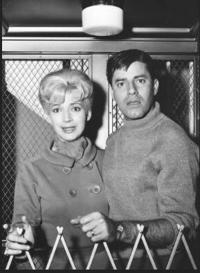
Lillian Briggs and Jerry Lewis
Briggs ventured into movies, playing a jazz trombonist in the Jerry Lewis 1961 film “The Ladies Man” and recorded several soundtracks for three Hollywood films, “The Fugitive Kind,” “Mr. Wonderful” and “My Sister Eileen.” In 1965 she appeared as a contestant on the quiz show “What’s My Line?” where she talked about giving trombone lessons to panelist Arlene Francis.
In the 1970s Briggs was ready to retire from show business. She relocated to Miami Beach where she became a co-partner in Turnberry Isle, a luxury condominium. Among her many friends in retirement was Lucille Ball.
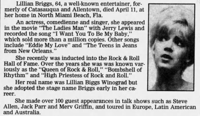
Excerpt from Lillian Briggs’ obituary, 1998
Her name appeared briefly in 1988 when she loaned her yacht Monkey Business to presidential aspirant Gary Hart, who was caught having an extramarital affair with Donna Rice, which ended his planned run for president. Lillian Briggs died of lung cancer in her North Miami home on April 11, 1998. She was 64.