

By SHANNON O. WELLS
For those with disabilities and mobility challenges, some basic morning tasks that many take for granted can be time-consuming and tedious.
“Think about this morning. Many of you probably opened up your refrigerator to get … some milk or something. … That is right now possible, but (for others) that may take 45 minutes to an hour,” said Rory Cooper, director of Pitt’s Human Engineering Research Laboratories (HERL). “Most of you would probably find an alternative way to get the refrigerator open, if that was the case.
“What happens for most people is they ask somebody else to do that, while they would rather do it themselves.”
How about starting the day with a cup of coffee or glass of orange juice?
“That is a task that most people would like to be able to perform efficiently, rapidly, on their own,” Cooper added. “That takes — even now with the best current technology — 10 to 15 minutes, for one sip.”
An award of up to $41.5 million from the Advanced Research Projects Agency for Health (ARPA-H) to develop the Robotic Assisted Mobility and Manipulation Platform (RAMMP) system seeks to make such frustrating, time-consuming ordeals a thing of the past.
With the award, researchers at HERL, an institute within Pitt’s schools of health sciences and part of the U.S. Department of Veterans Affairs, will lead a team using next-generation robotics and new assistive technology to reimagine a wheelchair and assistive robotic arm intended to improve the independence, safety and quality of life for people with disabilities, including veterans.
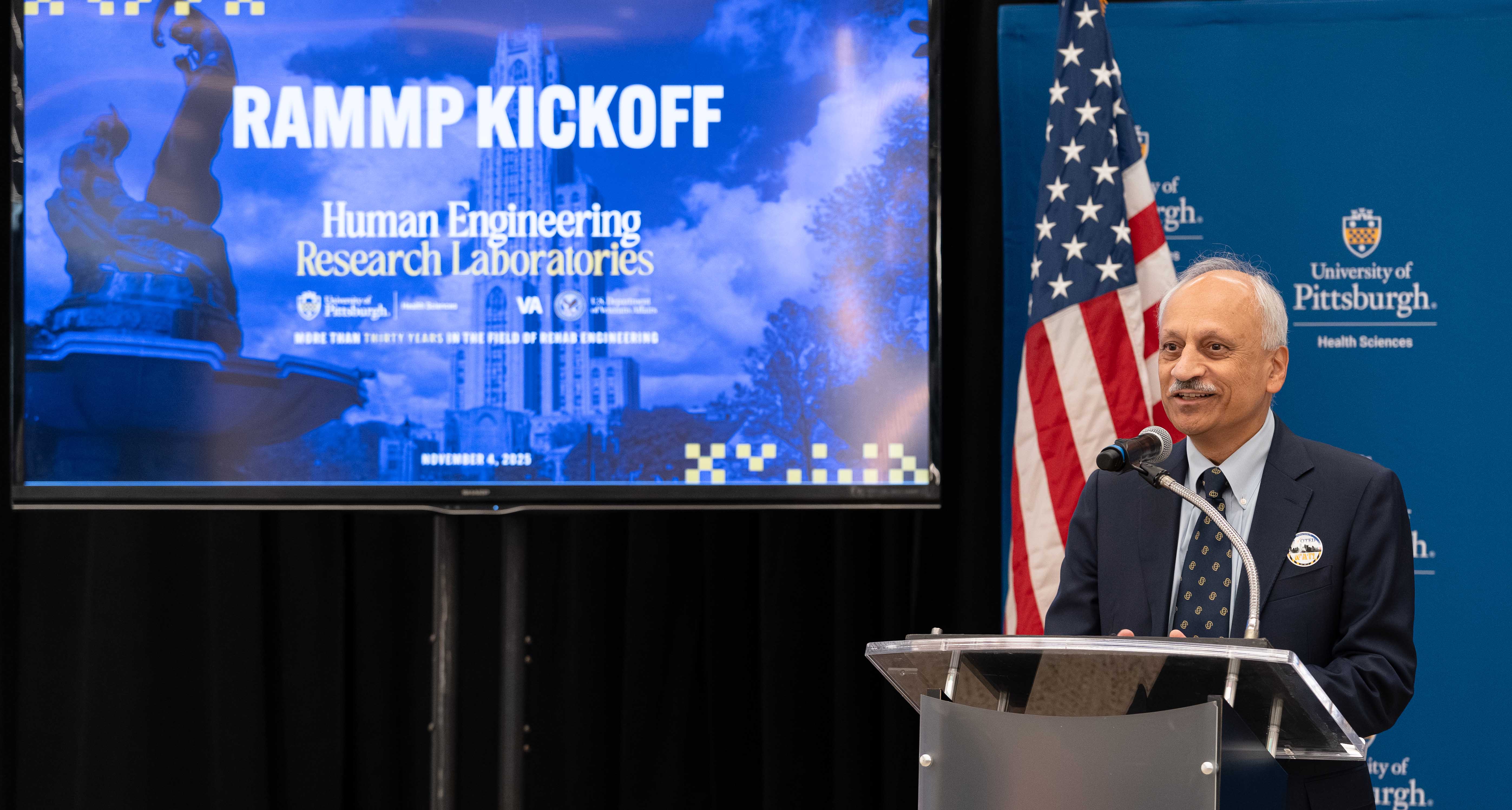
Cooper, a Pitt distinguished professor of rehabilitation engineering, shared the encouraging news of the award during Nov. 4 event at HERL’s Experience Center in the Portal at Bakery Square on Penn Avenue. Cooper was joined by Chancellor Joan Gabel; Anantha Shekhar, senior vice chancellor for health sciences; and Rob Rutenbar, senior vice chancellor of research.
RAMMP will integrate advanced robotics, artificial intelligence, a novel operating system, and digital twin technology through the Robotic Assistive Mobility Manipulation Simulation (RAMMS) environment — a virtual platform that “enables precise, safe and scalable testing and development within realistic simulated settings,” a statement about the award explained. The system also seeks to create new workforce and manufacturing opportunities in Pittsburgh and across Pennsylvania, with the goal of “producing advanced mobility systems domestically.”
Joining Pitt in the national research consortium are Kinova Robotics, LUCI Mobility, ATDev, Carnegie Mellon University, Cornell University, Northeastern University and Purdue University.
In addition to Cooper, the project’s principal investigators include Jorge Candiotti, associate professor of physical medicine and rehabilitation, and research biomedical engineer within HERL and the U.S. Department of Veterans Affairs.
“Most powered wheelchairs aren’t designed to overcome many of the common challenges in the real world — and changing the environment to accommodate them is nearly impossible,” Cooper said before the announcement event. “We need smarter technology that prevents tipping and falling, improves mobility and adds more function such as coordinated mobility and robotic arm manipulation of objects so people with disabilities can fully participate in everyday life.”
Using robotic arms for more effective object interaction, the RAMMP system is intended to advance the design of powered mobility and manipulation devices by improving their function, obstacle detection and negotiation and seamless integration. RAMMP’s real-time “360-degree environmental awareness” nature and adaptive control features allow users to navigate “complex environments with enhanced capabilities, confidence and safety.”
“We are redesigning everything from the ground up,” Cooper said. “In terms of the seating system, the base, its robotic arm, the control system, the mechanical design, the operating system — everything will be new.”
Congratulating Cooper on winning “this remarkable grant,” Rutenbar said his research team has talked about the award — and Cooper’s vision for it — “for a really long time. So we are delighted to see this one finally, finally get over the line, get announced today, be shared with the public and be celebrated today.”
Rutenbar also mentioned Cooper’s engineering degrees and professor appointments in the schools of Medicine and Health and Rehabilitation Sciences, noting that he represents the “perfect embodiment of somebody who is collaborating across the full spectrum … looking at how to connect STEM research and STEM problem solving with health science technologies and pressing health problems.”
Noting the relationship of ARPA-H to the Defense Advanced Research Project Agency (DARPA), whose “secret sauce,” Rutenbar said, is an ability to identify missing technological capabilities “that can provide advantage to the working war fighter, and then build and demonstrate working versions of those technologies — often in the battlefield, under harsh, real-world conditions.
“ARPA-H is taking the DARPA model and aiming to build high-impact solutions to society’s most challenging health problems, enhancing the quality of life.
“We look forward to seeing what Rory and his team are going to be creating and demo-ing and delivering, so Rory, please invite us back when your robots start rolling and grabbing and manipulating and sensing and doing whatever else they’re doing to improve the lives of their users.”
Calling Cooper a “force of nature,” Shekhar emphasized how much the HERL mission and goals have grown since Cooper “walked into this building,” where 15 years ago, “not much was happening other than maybe a few storage things. Rory looked at this building and said, ‘We’re going to build HERL.’
“Since then, this building has not only taken on HERL … but more importantly, it has saved and changed the lives of so many thousands of disabled people thanks to Rory’s leadership,” Shekhar said, adding that Cooper’s past efforts and current ambitions symbolize Pitt’s role as a “transformative agent.”
“It’s no surprise that Rory has been able to bring together some of the best in the country and in the world, and robotics engineers from CMU and Northeastern and Purdue and other powerhouses that are really capable of bringing together both healthcare and engineering transformations,” he said. “… I’m sure over the next five years, and with this generous grant support from ARPA-H, we will create amazing robots that are going to change lives.”
Chancellor Gabel noted how Cooper launched HERL with two graduate students in 1994, the same year Pitt’s graduation speaker David McCullough delivered “what’s become sort of a pin-in-the-map commencement speech, and noted how this great city and its great university were not only — and this is a quote — ‘each enlarged, each inspired by the other,’ but also, and I quote, ‘joined in a vital past as well as the future.’
“Today, I think we see that sentiment and the progress that Dr. Cooper and his team have made come to life, and how when Pittsburgh has needed something, this university and its faculty and its staff and its students have risen up to provide it,” she said, “whether it be a polio vaccine in the 1950s or the type of incredible innovation found here at HERL that is transforming assistive technologies to enable human achievement.
“We could not be prouder of this award through (ARPA-H) and how the work done here will improve accessibility that will benefit wheelchair users who may be veterans, part of the aging population across Pittsburgh and beyond,” Gabel said.
Shannon O. Wells is a writer for the University Times. Reach him at shannonw@pitt.edu.
Have a story idea or news to share? Share it with the University Times.
Follow the University Times on Twitter and Facebook.